
The Reason Tulsi is Forbidden in Ganesha Puja: The Legend of the Mutual Curse
Learn the fascinating mythological story from the Brahmavaivarta Purana explaining why offering the holy Tulsi (Basil) leaves to Lord Ganesha is strictly forbidden.
Vedic Wisdom
Writer & Research Team
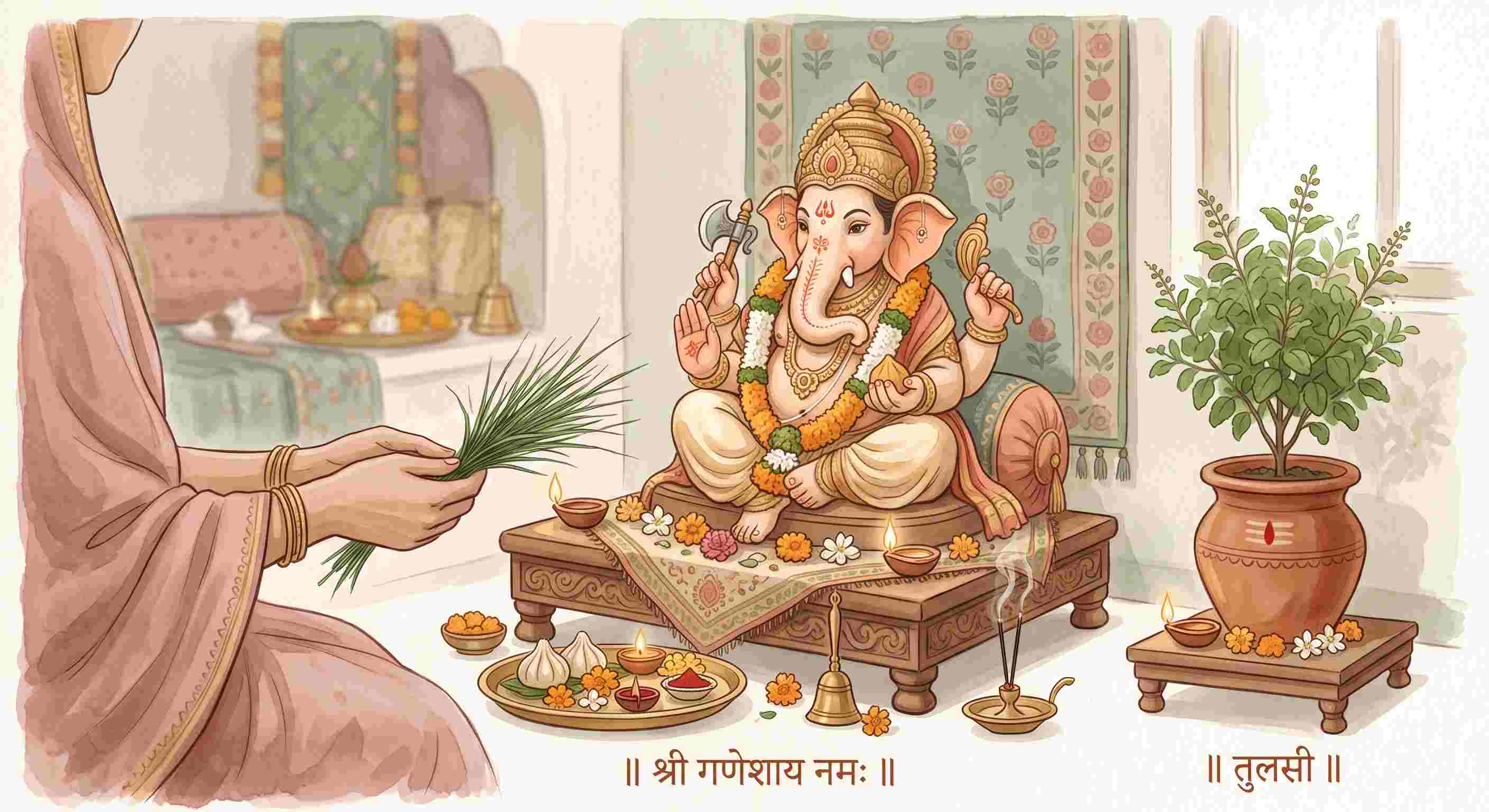
In Hinduism, Tulsi (Holy Basil) is considered exceptionally pure, sacred, and dear to Lord Vishnu. Offering Tulsi leaves is practically mandatory in the daily worship of Narayan, Krishna, and Rama. However, when it comes to the worship of Lord Ganesha—the remover of obstacles (Vighnaharta) and the lord of auspicious beginnings—offering a Tulsi leaf is considered a major ritualistic flaw. Despite its immense spiritual purity, why is Tulsi kept strictly away from Ganapati? The answer lies in an intriguing tale of romantic infatuation and mutual curses recorded in the ancient scriptures.
Sacred Heritage
Timeless Temple Tradition
Architectural Wonder
Ancient Vedic Mastery
Scriptural Origin
Puranic & Epic History
Spiritual Sadhana
Living Faith & Wisdom
The Untold Mystery: Why Tulsi is Not Offered to Lord Ganesha?
If you have ever participated in a traditional Hindu prayer, you already know that the Tulsi plant (Holy Basil) holds the highest, most sacred position in Vedic rituals. It is considered the earthly manifestation of a goddess, the absolute favorite of Lord Vishnu, and a mandatory element in almost every major Hindu festival. Without a few leaves of Tulsi, no offering to Lord Krishna or Narayana is ever considered complete.
Yet, in the vast and fascinating world of Hindu mythology, there is one glaring, strict exception that often confuses both young devotees and curious researchers alike. When it comes to worshipping the beloved elephant-headed deity, Ganpati Bappa, the holy basil is strictly prohibited. This brings us to one of the most frequently asked questions in Indian spirituality: why tulsi is not offered to lord ganesha?
To find the answer, we must take a deep dive into the pages of the ancient Brahmavaivarta Purana. The story of Tulsi and Ganesha is not just a tale of anger and curses; it is a profound philosophical lesson about ego, boundaries, devotion, and cosmic destiny. In this comprehensive guide, we will explore the epic encounter that led to this eternal ban, the exchange of divine curses, and the deep spiritual science behind Ganesh pooja rules.
The Setting: Lord Ganesha's Deep Samadhi on the Banks of Ganga
Our story begins thousands of years ago on the serene, purifying banks of the sacred river Ganga. Long before he was known as the remover of obstacles or the lord of auspicious beginnings, Lord Ganesha was a fierce ascetic. He was the ultimate embodiment of cosmic intellect, divine wisdom, and unwavering focus.
According to the Brahmavaivarta Purana, on one particular day, Lord Ganesha was deeply engrossed in a state of Samadhi (unbroken, profound meditation). Dressed in the simple attire of a sage, his body smeared with sacred ash, and his eyes firmly closed to the material world, he was channeling the highest spiritual energies of the universe. The atmosphere around him was incredibly calm, vibrating with the power of his intense Tapasya (penance).
Enter Princess Tulsi: The Wandering Maiden
At that exact moment in the timeline of the universe, Princess Tulsi was wandering along the same riverbanks. She was the exceptionally beautiful and graceful daughter of the celestial King Dharmadhwaja. Blessed with unparalleled charm and a divine aura, Tulsi was on a journey of her own, wandering the earthly realm in search of a suitable, divine life partner.
As she walked through the lush green forests bordering the Ganga, her eyes fell upon the meditating form of Lord Ganesha. Despite his ascetic appearance, Ganesha radiated a magnetic, divine glow. His serene face, his majestic aura, and his quiet strength instantly captivated the young princess. Overwhelmed by a sudden, intense wave of romantic infatuation, Tulsi made a decision that would forever alter the course of Hindu rituals.
The Interruption: A Proposal of Marriage
Driven by her worldly desires and blinded by her attraction, Princess Tulsi decided to break the sacred silence. She approached the meditating deity and intentionally interrupted his deep trance.
As Lord Ganesha slowly opened his eyes, pulled back from the depths of the cosmos to the earthly plane, he saw the beautiful maiden standing before him. With folded hands but a heart full of desire, Tulsi expressed her deep admiration for him. Without hesitation, she formally proposed marriage to the elephant-headed god, asking him to abandon his meditation and accept her as his divine consort.
The Clash of Vows: Ganesha's Polite Rejection
Lord Ganesha, who is worshipped as the symbol of supreme spiritual composure and emotional intelligence, did not immediately lose his temper. Instead, he politely but firmly declined her romantic proposal.
He gently explained to Princess Tulsi that he was a strict Brahmachari (a lifelong celibate). His entire existence was dedicated to universal wisdom, removing the obstacles of his devotees, and serving the higher spiritual truths of the cosmos. He explained that marriage and worldly attachments were completely out of the question for him. Like a wise teacher, he advised the young princess to let go of her sudden infatuation, control her desires, and focus her energy on higher spiritual pursuits rather than mortal attachments.
The Fury of Ego: Tulsi's Harsh Curse on Ganesha
In the realm of gods and humans alike, a rejected ego often transforms into blinding anger. Stung by the rejection—especially after humbling herself to propose—Tulsi's infatuation instantly turned into burning humiliation and fury.
She could not fathom how anyone, even a god, could reject her unparalleled beauty and royal lineage. Blinded by her wounded pride, Tulsi lashed out at the calm deity. Standing on the banks of the Ganga, she raised her hand and pronounced a harsh, inescapable curse upon Lord Ganesha.
"You take so much pride in your vow of celibacy," she declared fiercely. "I curse you that this vow will inevitably be broken! You shall not remain a Brahmachari. You will be forced to marry, and not just once, but twice!"
(Note: In Hindu mythology, this divine curse eventually manifested in earthly reality. According to the cosmic arrangement, Lord Ganesha later married Riddhi (Prosperity) and Siddhi (Spiritual Power), the two daughters of Prajapati Vishwaroopa.)
The Retaliation: Ganesha's Devastating Counter-Curse
Hearing such an unjustified, ego-driven curse leveled against him simply for upholding his sacred vows, Lord Ganesha’s legendary composure finally broke. The injustice of her anger ignited his divine fury.
Lord Ganesha, wielding the power of a supreme deity, retaliated by pronouncing a devastating counter-curse upon the arrogant princess.
"Because you allowed your worldly desires and arrogance to blind your judgment," Ganesha roared, "I curse you to lose your heavenly status! You shall be born in the mortal realm as a mere plant. And since you were so desperate for a husband, your husband will not be a god, but a ferocious, cruel Asura (demon)!"
The Realization and Repentance of Tulsi
The moment the words left Ganesha's mouth, the heavy weight of cosmic reality crashed down upon Tulsi. The blinding fog of her ego and anger instantly evaporated, replaced by sheer terror. The thought of being married to a demon and living life as a stationary plant in the mortal world horrified her.
Realizing the massive blunder she had committed by cursing a supreme deity, Tulsi broke down in bitter tears. She fell to her knees, folded her trembling hands, and begged Lord Ganesha for mercy and forgiveness. She repented for her arrogance, acknowledging that she had let temporary infatuation destroy her divine grace.
The Supreme Blessing: A Curse Transformed
Lord Ganesha is universally known as Vighnaharta (the remover of sorrows) and Dayanidhi (the ocean of compassion). Seeing her genuine remorse, her tearful repentance, and her shattered ego, Ganesha’s heart softened.
However, in Vedic cosmic law, a curse pronounced by a deity cannot be entirely taken back or erased; it must play out its destiny. But a merciful god can modify the curse, transforming the ultimate outcome into a blessing. And that is exactly what Lord Ganesha did.
He gently told Tulsi, "You must undergo the effects of this curse. You will endure a mortal life, and you will be married to the demon Shankhchuda. However, after you complete your destined karmic cycle and the demon is defeated, your physical form will transform into the most sacred plant on Earth—the Holy Basil (Tulsi)."
Ganesha continued his divine blessing: "In your plant form, you will become exceptionally pure. You will be crowned the absolute favorite of Lord Vishnu (Narayana). You will be considered the supreme purifier of the world, and your leaves will become absolutely mandatory in the worship of all major gods. No offering to Lord Krishna will be accepted without you."
But then, Ganesha added one final, unchangeable decree: "However, as a lasting cosmic reminder of this encounter, your initial arrogance, and the clash of our vows, you shall forever remain strictly forbidden in my worship. A tulsi leaf in ganesh pooja will never be accepted."
And thus, the eternal rule was written into the fabric of Hindu traditions.
If Not Tulsi, Then What? The Importance of Durva Grass
Now that we have answered the question of can we offer tulsi to ganesha (with a resounding NO), it brings up another crucial question for devotees: What is the most beloved offering to Lord Ganesha?
The answer is Durva Grass (Bermuda grass). Just as Tulsi is beloved to Vishnu, and Belpatra is beloved to Shiva, Durva grass is the absolute favorite of Ganpati Bappa.
The Legend of Analasura and Durva Grass
According to the Puranas, there was once a terrifying demon named Analasura who could emit deadly fire from his eyes, burning everything in his path. To save the sages and the heavens, Lord Ganesha swallowed the demon whole. However, the immense heat and fire of the demon's body caused unbearable burning inside Ganesha’s stomach.
The gods tried everything to cool him down, but nothing worked. Finally, a group of ancient sages brought 21 blades of fresh, green Durva grass and placed them on Lord Ganesha’s head. Miraculously, the cooling properties of the Durva grass instantly extinguished the fiery heat inside his body.
Deeply relieved, Lord Ganesha declared that whoever offers him Durva grass with pure devotion will receive his absolute blessings, and all their obstacles will be removed. Therefore, offering a bundle of 21 Durva grass shoots is considered highly auspicious during Ganesh Chaturthi and daily prayers.
A Quick Guide to Deity Offerings in Hinduism
To help you navigate the complex but beautiful rules of Vedic rituals, here is a quick reference table detailing which sacred leaves are offered to which deities:
| Deity | Primary Sacred Offering | Strictly Forbidden Offering |
|---|---|---|
| Lord Ganesha | Durva Grass (21 blades) & Red Hibiscus flowers | Tulsi leaves (Due to the mythological curse) |
| Lord Vishnu / Krishna | Tulsi leaves (Holy Basil) | Akshat (Unbroken rice) without turmeric |
| Lord Shiva | Belpatra (Bilva leaves), Bhasma, Dhatura | Tulsi leaves, Kumkum, Ketaki flower |
| Goddess Durga / Kali | Red Hibiscus, Neem leaves, Lemon | Durva Grass |
The Philosophical Meaning Behind the Myth
Beyond the fascinating storyline, the myth of Ganesha and Tulsi holds deep psychological and philosophical significance for human beings.
- The Danger of Unchecked Ego: Tulsi’s tragedy was not her attraction, but her ego. When things didn't go her way, her immediate reaction was to curse and destroy. It teaches us that ego and arrogance can strip away our grace and lead to downfall.
- The Sanctity of Boundaries: Lord Ganesha represents focus and discipline. His rejection of Tulsi is a metaphor for setting strict boundaries to protect one's life purpose (Dharma) from worldly distractions.
- Forgiveness and Transformation: Ganesha’s final blessing shows that the divine is ultimately compassionate. Even when we make monumental mistakes, true repentance can transform our lowest points into periods of supreme spiritual growth.
Frequently Asked Questions (FAQs)
1. Can I accidentally offer Tulsi to Ganesha? Will I incur bad karma?
In Hinduism, intention (Bhav) matters more than the physical ritual. If you accidentally place a tulsi leaf in ganesh pooja out of ignorance, without malicious intent, it is not considered a sin. You can simply ask for forgiveness mentally (Kshama Prarthana) and remove the leaf.
2. Is Tulsi allowed during Ganesh Chaturthi if offered to other deities on the same altar?
Yes, if you have a joint altar where Lord Krishna or Vishnu is placed next to Lord Ganesha, you can offer Tulsi to Vishnu. You just must ensure that the Tulsi leaves are not directly placed on the idol or image of Lord Ganesha.
3. What flowers should I offer to Lord Ganesha?
Lord Ganesha absolutely loves red-colored flowers. The Red Hibiscus (Jaswand) is considered his most favorite flower. You can also offer Marigolds (Genda) and red roses.
Conclusion
The ancient scriptures of India are not just rulebooks; they are highly detailed, deeply emotional narratives designed to teach us how to navigate life. The story explaining why tulsi is not offered to lord ganesha is a brilliant example of this. It bridges the gap between divine folklore and everyday household rituals. The next time you sit down to pray and carefully separate the Tulsi leaves from the Durva grass, you will carry with you the profound cosmic history of the Great Ascetic and the Wandering Princess.
Why this matters today
Learn the fascinating mythological story from the Brahmavaivarta Purana explaining why offering the holy Tulsi (Basil) leaves to Lord Ganesha is strictly forbidden.
Related Topics
Frequently asked questions
What is offered to Lord Ganesha instead of Tulsi?
Lord Ganesha is extremely fond of Durva grass (Bermuda grass). Offering a bundle of 21 blades of fresh Durva grass is considered the absolute best way to please him and seek his blessings.
Which Purana contains the story of Tulsi and Ganesha's curse?
The detailed mythological account of why Tulsi is not offered to Lord Ganesha is recorded in the Brahmavaivarta Purana.
Are there any other Hindu deities who should not be offered Tulsi?
Yes, apart from Lord Ganesha, Tulsi is traditionally not offered to Lord Shiva, Goddess Durga, and Lord Bhairava during their primary worship rituals.
Can we use Tulsi leaves in Modak or Prasad for Ganesha?
No. Since Tulsi is completely forbidden in Ganesha worship, it should not be included in any Prasad or offerings dedicated directly to Lord Ganesha.