
Hindu Mythology
भगवान गणेश का एक दांत कैसे टूटा? जानिए इसके पीछे के 3 बड़े रहस्य
Bhakti Voice Editorial Team · 8 min · Updated 2026-08-21
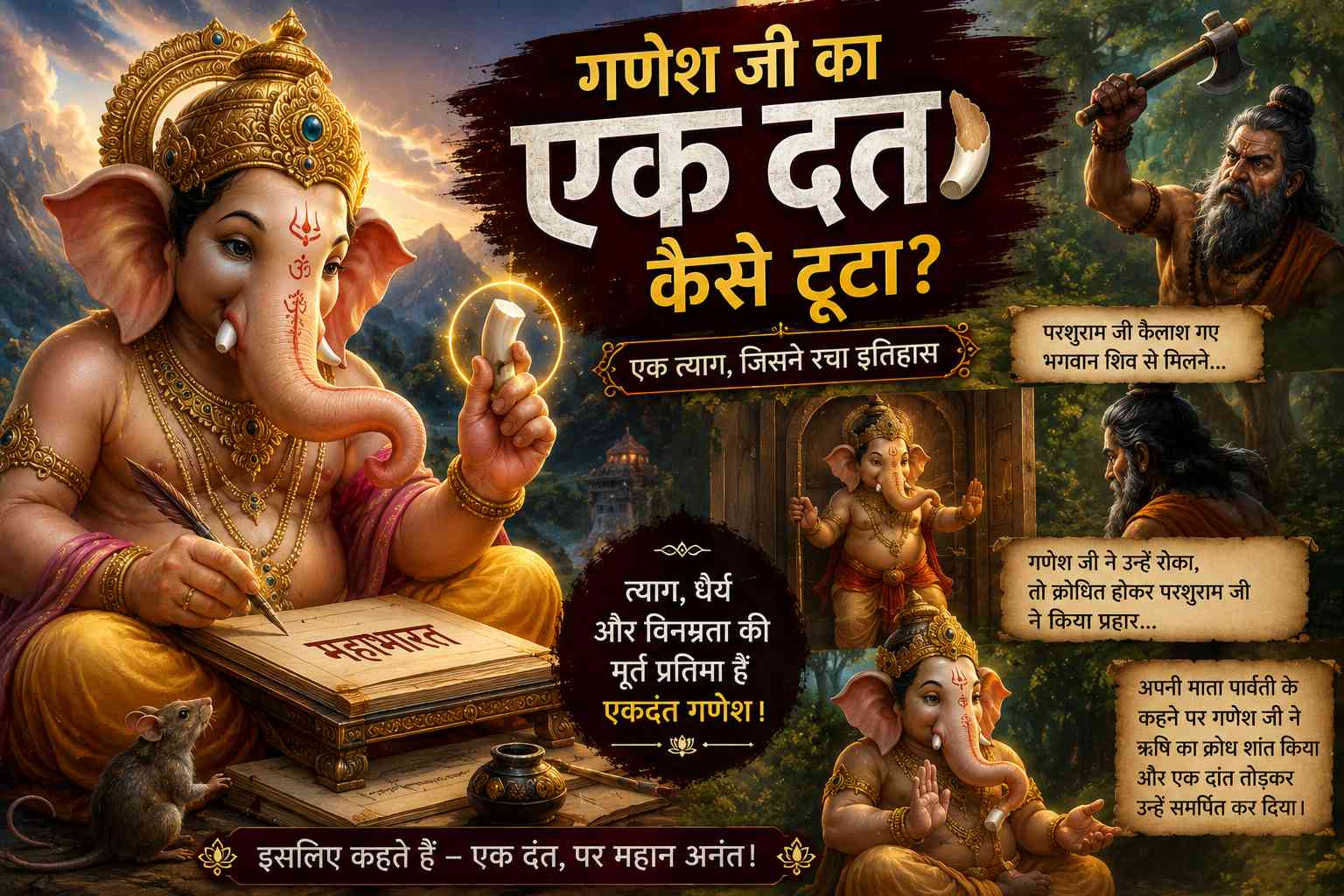
प्रथम पूज्य, विघ्नहर्ता और बुद्धि के देवता भगवान गणेश को हिंदू धर्म में सर्वोच्च स्थान प्राप्त है। उनकी हर एक विशेषता, रूप और स्वरूप के पीछे कोई न कोई गहरा आध्यात्मिक रहस्य छुपा हुआ है। गणपति के स्वरूप में सबसे विशिष्ट बात यह है कि उनका एक दांत पूर्ण है और दूसरा खंडित (टूटा हुआ) है। इसी वजह से उन्हें 'एकदंत' भी कहा जाता है। लेकिन क्या आपने कभी सोचा है कि भगवान गणेश का यह दांत कैसे टूटा था? क्या यह किसी भयानक युद्ध का परिणाम था, या फिर किसी महान उद्देश्य के लिए किया गया त्याग? आइए इस लेख में विस्तार से जानते हैं गणेश जी के एकदंत होने की सभी पौराणिक कथाओं के पीछे छिपे रहस्यों को।
Introduction to Lord Ganesha's Unique Form
Lord Ganesha, the elephant-headed deity, holds a prominent place in Hindu culture. From the curving trunk to the large ears and the single broken tusk, every aspect of His appearance carries a profound lesson. Among these physical traits, the broken tusk is the most striking feature that gave Him the name 'Ekdanta' (The One-Tusked Lord).
There are multiple ancient legends and Puranic references that explain how Ganesha lost his tusk. Far from being a flaw, this broken tusk represents supreme sacrifice, unwavering devotion, and the victory of wisdom over ignorance.
Story 1: The Epic Writing of Mahabharata
One of the most famous and inspiring legends associated with Ganesha's broken tusk involves the composition of the great epic, the Mahabharata. Sage Vyasa wanted to document the epic poetry of Mahabharata and approached Lord Ganesha to act as the scribe.
Ganesha agreed under one strict condition: Sage Vyasa must recite the verses continuously without a moment's pause. In return, Vyasa put a counter-condition that Ganesha must fully comprehend every verse before writing it down.
As they progressed at a breathtaking speed, Ganesha's pen suddenly snapped due to the intense pace of writing. Realizing that stopping to look for a new pen would break the continuous flow of the dictation, Ganesha did not hesitate for a second. He broke off one of his own tusks and used it as a stylus to continue writing the Mahabharata without interruption. This extraordinary sacrifice highlights that no price is too high in the pursuit of knowledge and truth.
Story 2: The Battle with Lord Parashurama
Another prominent account found in the Padma Purana and other texts details a fierce confrontation between Lord Ganesha and Lord Parashurama, an ardent devotee of Lord Shiva.
Once, when Parashurama visited Mount Kailash to pay his respects to Lord Shiva, he found that Shiva was meditating inside. Lord Ganesha, acting as the dutiful guardian of the inner chambers, respectfully barred Parashurama from entering at that exact moment.
Known for his fierce temper, Parashurama felt insulted and engaged in a fierce battle with the young Ganesha. Initially, Ganesha overpowered him using his trunk. To honor the divine axe (Parashu) that Lord Shiva had gifted to Parashurama, Ganesha deliberately allowed the weapon to strike him. To preserve the honor of his father's weapon, Ganesha took the blow on his tusk, causing it to snap. Thus, he earned the title Ekdant while demonstrating utmost respect for parental and divine authority.
Story 3: Defeating Mooshikasura or Gajamukhasura
In several regional variants and ancient texts, another tale attributes the loss of the tusk to a battle with powerful demons like Gajamukhasura or Mooshikasura.
During a fierce combat with a demon who was causing havoc among sages and gods, Ganesha launched His tusk as a missile weapon against the demon when standard weapons failed to subdue him. The demon, realizing his folly, surrendered and was transformed into Ganesha's vehicle, the mouse (Mooshika). However, because the divine tusk was hurled as a weapon, it remained broken, permanently sealing His identity as Ekdant.
Spiritual Significance of the Broken Tusk
Beyond mythological narratives, the broken tusk carries deep philosophical meaning in Hindu spirituality. It symbolizes the duality of existence—retaining the good and discarding the bad, just as an elephant uses its tusks for both eating and defense.
Furthermore, it teaches detachment from physical perfection. True power lies in wisdom, sacrifice, and character rather than outward symmetry. Whenever we look at the smiling face of Ekdant holding His broken tusk, we are reminded that true greatness comes from selfless actions and dedication to righteousness (dharma).
Frequently asked questions
Why is Lord Ganesha called Ekdant?
Lord Ganesha is called Ekdant because he has only one full tusk while the other tusk is broken or fractured, symbolizing various legendary events like writing the Mahabharata or his encounter with Parashurama.
Did Ganesha break his own tusk to write the Mahabharata?
Yes, according to popular Hindu legend, when Sage Vyasa was dictating the Mahabharata, Ganesha's pen broke. To ensure the continuous flow of the epic without breaking his vow, Ganesha snapped off his own tusk and used it as a pen.