
Das Lakshan Parv: The Eternal Festival of Self-Purification and 10 Supreme Virtues
A comprehensive guide to Jain Das Lakshan Parv (Paryushan). Explore the profound spiritual meaning of the 10 supreme virtues (Dharmas), daily rituals, fasting, and Kshamavani.
Jain Philosophy Research Desk
Writer & Research Team
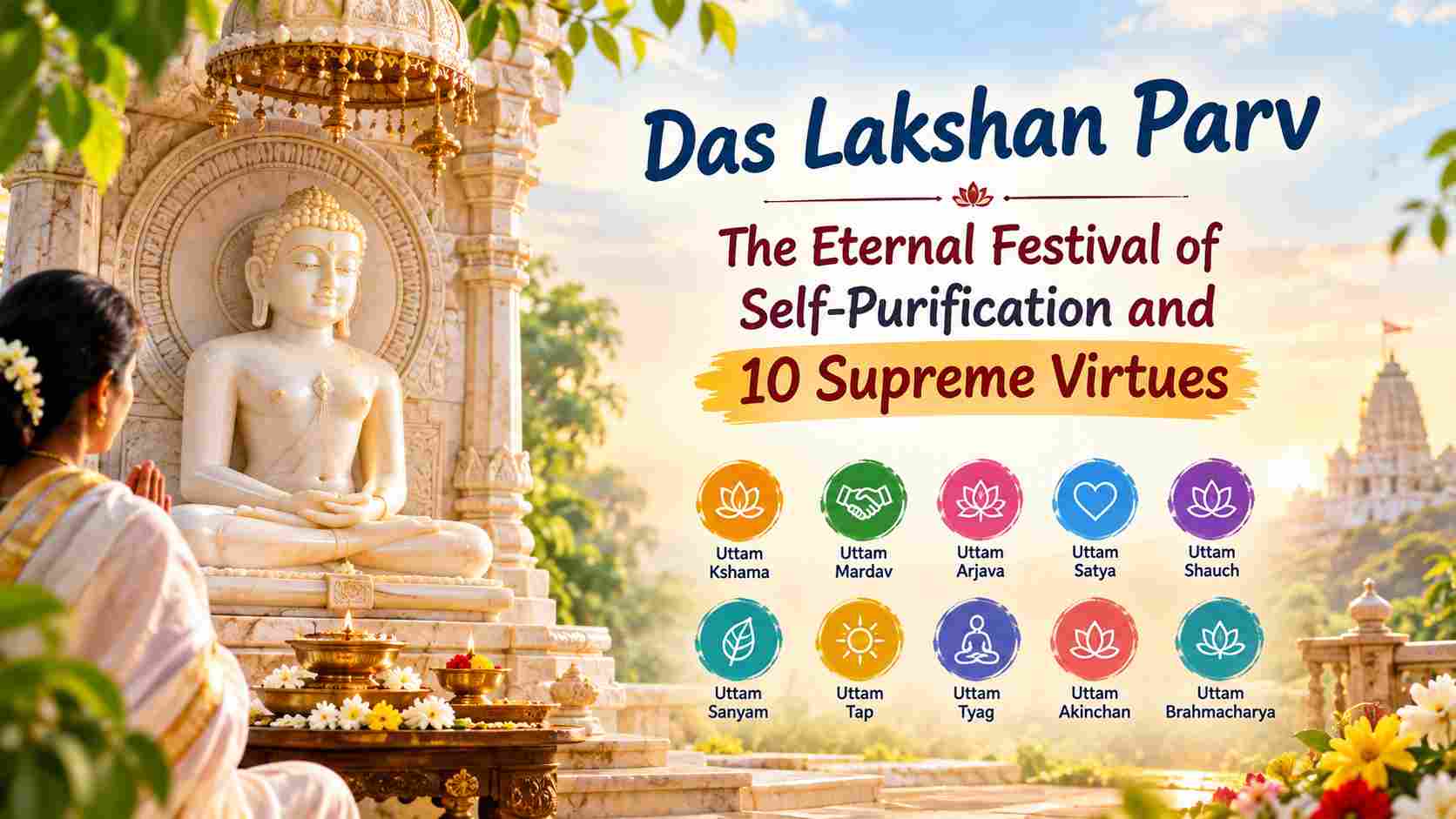
Das Lakshan Parv (the Festival of Ten Virtues), observed predominantly by the Digambara Jain community during the sacred Bhadrapada month, is not a celebration of historical occurrences, victories, or mythological milestones. Instead, it is a ten-day spiritual pilgrimage within—a systematic framework for self-introspection, shedding karmic impurities, and realigning with the innate attributes of the soul. Grounded in Acharya Umasvati’s Tattvartha Sutra ('Uttama-kshamā-mārdavārjava-śauca-satya-saṁyama-tapas-tyāgākiñcanya-brahmacaryāṇi dharmaḥ'), each of the ten days invites seekers to transcend worldly conditioning and cultivate supreme spiritual excellence.
Sacred Heritage
Timeless Temple Tradition
Architectural Wonder
Ancient Vedic Mastery
Scriptural Origin
Puranic & Epic History
Spiritual Sadhana
Living Faith & Wisdom
Understanding Das Lakshan Parv: The Metaphysics of Dharma and the 10 Supreme Virtues of Jainism
In conventional religious frameworks across the globe, festivals frequently commemorate heroic battles, agricultural harvests, celestial planetary positions, or the earthly incarnations of divine avatars. Jainism, however, adopts an intrinsically distinct and profoundly internal perspective. During the sacred festival of Das Lakshan Parv (observed in the Digambar Jain tradition and closely aligned with the Shwetambar Paryushan Parv), the focus shifts entirely from the external world to the internal landscape of the soul.
In the canonical Jain text, the Tattvartha Sutra (Chapter 9, Sutra 6), Acharya Umasvati declares that Dharma is neither an external creed nor a divine decree. Rather, it is the inherent, pristine nature of the soul. The ancient Prakrit phrase 'Vatthu Sahavo Dhammo' translates to "the inherent nature of a substance is its true dharma." When a soul sheds the dense obscurations of karmic matter (pudgala), its innate radiance emerges in ten cardinal manifestations known as the 10 Supreme Virtues of Jainism.
What is Das Lakshan Parv?
Das Lakshan Parv is observed annually during the bright half (Shukla Paksha) of the lunar month of Bhadrapada, specifically from Panchami (the fifth day) to Anant Chaturdashi (the fourteenth day). This ten-day period marks the prime window for rigorous self-investigation, spiritual fasting, and meditation.
During this sacred time, monks, nuns, householders (shravakas), and novices step back from commercial, domestic, and recreational pursuits to focus exclusively on internal purification. This ten-day spiritual retreat operates as an inner laboratory where worldly attachment (raga) and aversion (dvesha) are systematically diagnosed, diminished, and eradicated.
The Ten Supreme Virtues (Uttama Dharmas): A Sequential Evolution
The prefix 'Uttama' (Supreme) is critical in Jain metaphysics. It denotes that these ten virtues are not mere social etiquette, tactical stoicism, or moral compromises. 'Uttama' implies that the virtue is practiced with Samyak Darshana (Right Faith), Samyak Jnana (Right Knowledge), and Samyak Charitra (Right Conduct), completely free from desires for worldly praise, celestial rewards, or karmic reciprocation.
The sequence in which these ten virtues are ordered reflects an intentional psychological progression: a practitioner must first neutralize emotional volatility through forgiveness before dismantling deep-seated ego. Only then can transparency arise, leading directly to the purity of desirelessness and the ultimate realization of absolute truth.
Summary Table: The 10 Days of Das Lakshan Parv
| Day | Supreme Virtue (Dharma) | English Translation | Psychological Antidote To | Core Spiritual Focus |
|---|---|---|---|---|
| Day 1 | Uttam Kshama | Supreme Forgiveness | Krodha (Anger) | Realizing the soul's independence; releasing grudges. |
| Day 2 | Uttam Mardava | Supreme Humility | Mana (Pride/Ego) | Recognizing the equality of all souls; shedding arrogance. |
| Day 3 | Uttam Aarjava | Supreme Straightforwardness | Maya (Deceit) | Aligning thoughts, words, and actions in total honesty. |
| Day 4 | Uttam Saucha | Supreme Purity | Lobha (Greed) | Cultivating inner contentment; eliminating covetousness. |
| Day 5 | Uttam Satya | Supreme Truth | Asatya (Falsehood) | Speaking what is factual, beneficial, measured, and non-violent. |
| Day 6 | Uttam Sanyam | Supreme Self-Restraint | Indulgence / Harm | Mastering the five senses and protecting all living beings. |
| Day 7 | Uttam Tap | Supreme Penance | Karmic Bondage | Practicing austerities for the shedding of karmic matter (Nirjara). |
| Day 8 | Uttam Tyag | Supreme Renunciation | Attachment | Surrendering possessions and relinquishing the illusion of ownership. |
| Day 9 | Uttam Akinchanya | Supreme Non-Attachment | Possessiveness | Realizing that nothing material belongs to the true self. |
| Day 10 | Uttam Brahmacharya | Supreme Celibacy / Soul-Dwelling | Sensory Attachment | Abiding entirely within one's own divine, pristine nature. |
Deep Dive into the 10 Days of Das Lakshan Parv
Day 1: Uttam Kshama (Supreme Forgiveness)
Uttam Kshama is the direct antidote to Krodha (anger). In Jain psychology, anger is regarded as an internal fire that incinerates accumulated spiritual merit in a single instant. True Kshama is not the passive endurance of a person lacking the power to retaliate. It is the conscious decision of one who possesses the capacity to strike back, yet realizes that the offender is merely an instrumental agent (nimitta) of one's own past karmas.
To cultivate Uttam Kshama, the aspirant meditates on the soul's independence. An external insult or physical assault can only affect the material body or societal reputation—neither of which constitutes the immortal self. Recognizing that anger harms the person harboring it far more than the intended target transforms retribution into universal compassion (karuna).
Day 2: Uttam Mardava (Supreme Humility)
Uttam Mardava represents the dissolution of Mana (pride, arrogance, and vanity). Jain scriptures identify eight primary sources of pride (ashta-mada): pride of caste or lineage (kula), family standing (jati), physical appearance (rupa), wealth (dhana), intellect (jnana), physical strength (bala), austerity (tapa), and spiritual influence (prabhutva).
Mardava emphasizes that all living beings are equal in their intrinsic potential for omniscience (Kevala Jnana). Material wealth, status, and intellectual achievements are transient karmic configurations. Cultivating supreme tenderness and humility softens consciousness, making it receptive to higher spiritual insights.
Day 3: Uttam Aarjava (Supreme Straightforwardness)
Uttam Aarjava counteracts Maya (deceit, cunning, and manipulation). Deceit fractures internal harmony by creating contradictions between thoughts (mana), speech (vachana), and actions (kaya). This misalignment consumes substantial mental energy and binds heavy karmas to the soul (maya karma bandha).
Aarjava requires complete transparency and candor. It is the restoration of uncorrupted clarity where inner intentions mirror outer expressions. Living without deception provides mental peace and eliminates the chronic anxiety associated with sustaining falsehoods.
Day 4: Uttam Saucha (Supreme Purity and Contentment)
Uttam Saucha overcomes Lobha (greed), often described as the root of ethical transgressions (sarva dosha nam janani). Greed extends beyond the hoarding of material wealth; it represents an insatiable psychological desire to possess external objects under the false assumption that possession produces enduring happiness.
Saucha denotes internal cleanliness realized through contentment (santosha). True bliss is recognized as an inherent property of the soul rather than an imported material experience. When cravings subside, authentic serenity arises.
Day 5: Uttam Satya (Supreme Truth)
Uttam Satya transcends the mere factual accuracy of spoken words. In Jain ethics, speech must pass through multiple criteria: it must be factually correct (satya), beneficial (hita), measured (mita), and non-injurious (priya). Even a factual statement that intentionally causes harm or distress violates true Dharma.
At the ultimate philosophical level (Nishchaya Naya), Satya is the recognition of self-truth—acknowledging that the pure, conscious soul is the sole enduring reality, while the physical world consists of constantly changing attributes (paryayas).
Day 6: Uttam Sanyam (Supreme Self-Restraint)
Uttam Sanyam rests on two core pillars: Indriya Nirodha (control of the five senses: sight, sound, smell, taste, and touch) and Prani Raksha (protection of all living beings, from microscopic single-sensed organisms to complex life forms).
Unchecked senses foster attachment and perpetual desire. Sanyam is not self-mortification, but the intentional mastery of consciousness, channeling mental energy toward spiritual liberation rather than sensory indulgence.
Day 7: Uttam Tap (Supreme Penance and Austerity)
In Jainism, Tap (austerity) serves the specific scientific purpose of Karma Nirjara—the burning away and dissociation of accumulated karmic particles from the soul.
Treatises divide Tap into six external and six internal practices. The six external penances (Bahyabhyantara Tapa)—including fasting (anashana) and dietary restraint—discipline the physical body. The six internal penances (Abhyantara Tapa)—including repentance (prayaschitta), humility (vinaya), service (vaiyavritya), scriptural study (swadhyaya), renunciation of possessiveness (vyutsarga), and meditation (dhyana)—purify the inner self.
Day 8: Uttam Tyag (Supreme Renunciation)
Uttam Tyag involves the deliberate surrender of material belongings, wealth, and inner attachments to dissolve the illusion of ownership. Externally, it is realized through fourfold charity (Chaturvidha Dana):
- Ahara Dana: Distributing wholesome food to ascetics and the hungry.
- Aushadha Dana: Providing medicines and healthcare to the sick.
- Jnana Dana: Sharing knowledge, scriptural wisdom, and educational support.
- Abhaya Dana: Offering protection, shelter, and fearlessness to all living entities.
Internally, true Tyag is relinquishing the egoistic conviction of 'mine' (mamata). Giving becomes an act of liberation from the burdens of accumulation.
Day 9: Uttam Akinchanya (Supreme Non-Attachment)
Akinchanya translates to the realization of 'nothingness'—the inner awareness that 'nothing in this material universe belongs to me, nor do I belong to anything material.' It marks the transcendence of Parigraha (possessiveness).
Possessiveness lies not simply in the presence of physical objects, but in the internal craving and attachment toward them. Monks practice Akinchanya by possessing no property, while householders practice it by setting voluntary limits on assets, land, and consumables to restrain consumerist impulses.
Day 10: Uttam Brahmacharya (Supreme Self-Absorption and Celibacy)
Beyond physical celibacy or sensual restraint, the etymology of Brahmacharya signifies 'Brahma' (the pure soul) + 'Charya' (to dwell or immerse in). Thus, Uttam Brahmacharya fundamentally means 'abiding entirely within one's own divine nature.'
Recognizing that sensory pleasures are fleeting experiences that reinforce worldly cycles (samsara), consciousness turns inward. Finding complete satisfaction within the true self dissolves the impulse to seek external sensory fulfillment.
Anant Chaturdashi and the Culmination: Kshamavani Parv
The tenth day culminates with Anant Chaturdashi, observed through day-long fasting, prayer, and deep contemplation on the infinite nature of the soul.
Following Das Lakshan, the community observes Kshamavani Parv (The Day of Universal Forgiveness). On this occasion, individuals set aside ego, requesting and extending unconditional forgiveness across all relationships using the traditional verse:
"Khamemi Savva Jive, Savve Jiva Khamantu Me;
Metti Me Savva Bhuesu, Veram Majjham Na Kenai"
Translation: "I grant forgiveness to all living beings; may all living beings forgive me. I share friendship with all entities; I harbor animosity toward none."
This practice clears accumulated interpersonal resentments, ensuring that spiritual discipline translates into daily emotional and moral conduct.
Daily Practices for the Modern Householder
Practicing the ten virtues during Das Lakshan provides a structured approach to ethical reflection and mental clarity. Essential disciplines include:
- Temple Darshan & Abhishek: Engaging in morning meditation and worship to establish calm focus.
- Swadhyaya: Spending dedicated time daily studying classical philosophical texts like the Samayasara or Tattvartha Sutra.
- Ahar Sanyam (Dietary Restraint): Practicing non-violence through diet, avoiding late-evening meals (Chauvihar), and consuming simple, freshly prepared vegetarian food.
- Mauna Vrata (Intentional Silence): Observing designated periods of silence and reducing digital distractions.
- Pratikramana (Introspection): Reviewing daily actions, acknowledging errors, and resolving to avoid harmful behaviors.
Through this conscious framework, Das Lakshan Parv serves as an accessible pathway for dismantling mental agitation and rediscovering the inherent peace of the soul.
Why this matters today
A comprehensive guide to Jain Das Lakshan Parv (Paryushan). Explore the profound spiritual meaning of the 10 supreme virtues (Dharmas), daily rituals, fasting, and Kshamavani.
Related Topics
Frequently asked questions
What is the core spiritual purpose of Das Lakshan Parv?
The fundamental goal of Das Lakshan Parv is 'Atma-Vishuddhi' (self-purification). Rather than seeking external boons, the practitioner systematically weakens the four passions (kashayas)—anger, pride, deceit, and greed—by actively meditating on the natural qualities of the pure self across ten progressive stages.
How does Das Lakshan differ from Paryushan Parv?
While both share identical spiritual objectives, Shvetambara Jains observe an 8-day Paryushan culminating in Samvatsari, whereas Digambara Jains observe Das Lakshan for 10 continuous days (from Bhadrapada Shukla Panchami to Chaturdashi), focusing each day on one of the ten supreme virtues outlined in Tattvartha Sutra.
What are the 10 Supreme Virtues (Uttama Dharmas)?
The ten virtues are: 1. Uttam Kshama (Supreme Forgiveness), 2. Uttam Mardava (Supreme Humility), 3. Uttam Aarjava (Supreme Straightforwardness), 4. Uttam Saucha (Supreme Contentment/Purity), 5. Uttam Satya (Supreme Truth), 6. Uttam Sanyam (Supreme Self-Restraint), 7. Uttam Tap (Supreme Penance), 8. Uttam Tyag (Supreme Renunciation), 9. Uttam Akinchanya (Supreme Non-Attachment), and 10. Uttam Brahmacharya (Supreme Chastity/Self-Absorption).
What is Kshamavani Parv and when is it observed?
Kshamavani Parv (Forgiveness Day) is observed on Ashvin Krishna Pratipada, immediately after Anant Chaturdashi. On this day, individuals seek mutual forgiveness across all beings, uttering 'Micchami Dukkadam' or 'Khamemi Savva Jive', acknowledging universal interconnectedness and dissolving lingering grudges.
What dietary disciplines are observed during these ten days?
Devotees observe varying degrees of restraint, including boiling drinking water, refraining from eating after sunset (Ratri Bhojan Tyag), avoiding green vegetables (sachitta tyag), observing single meals (Ekashana), consuming only once with boiled water (Biyashana), or fasting without water/food (Upvas).