
Jain Philosophy
Jai Jinendra: Unlocking the Profound Spiritual Meaning Behind the Jain Greeting
Bhakti Guide Editorial · 6 min · Updated 2026-08-25
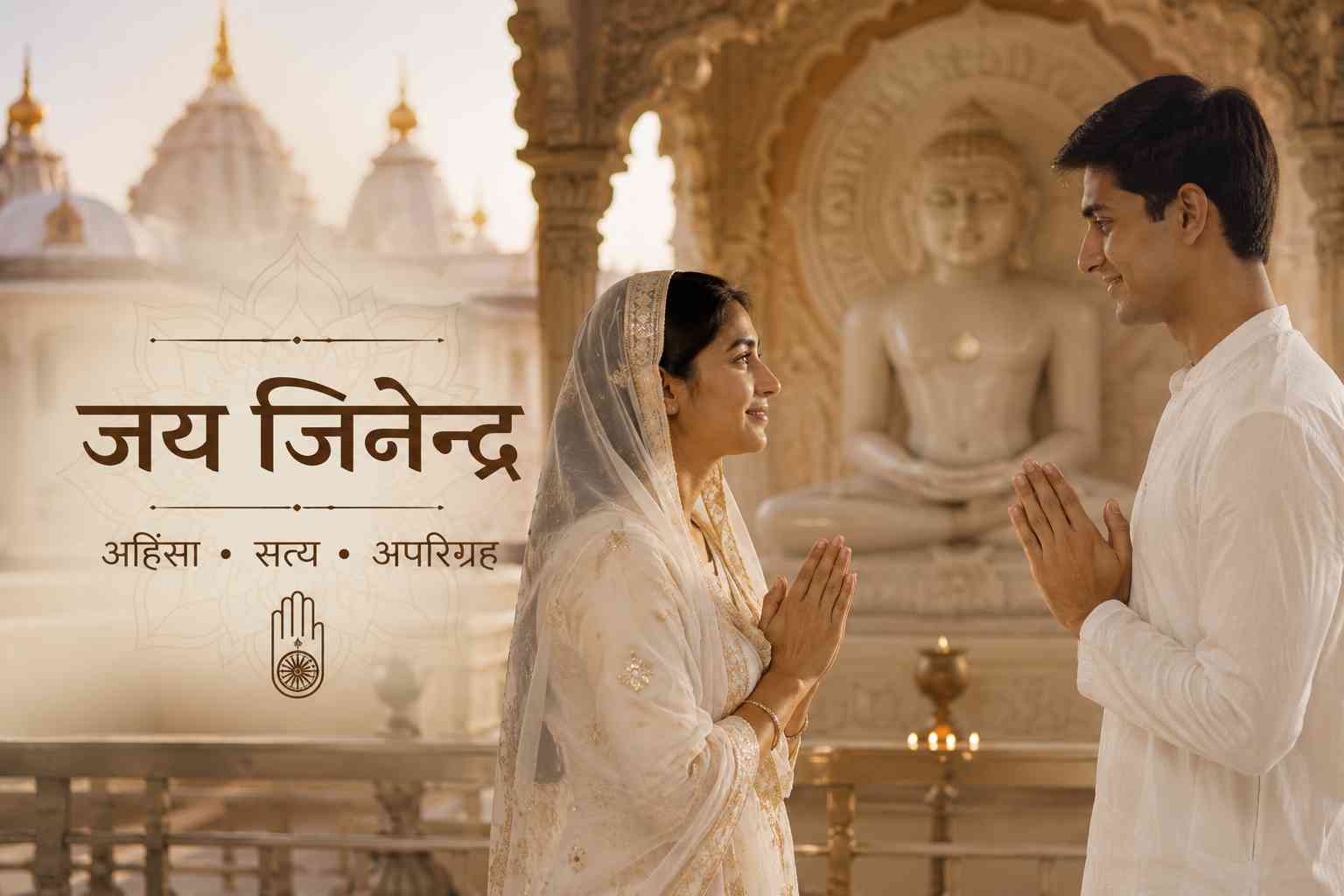
When two Jains meet or part ways, regardless of where they are in the world, they greet each other with two simple, yet profoundly powerful words: "Jai Jinendra." To a casual observer, it might just seem like a cultural equivalent of saying "Hello" or "Namaste." But if you dig a little deeper into Jain philosophy, you'll discover that "Jai Jinendra" is so much more than a routine salutation. It is a sacred mini-mantra, a gentle reminder of the ultimate goal of human life, and a beautiful way of acknowledging the divine, pure potential that resides within every living being. Let's explore the etymology, the historical context, and the deep spiritual significance of this universal Jain greeting, and see how it can bring everyday mindfulness into our lives.
1. Breaking Down the Words: The True Meaning of Jai Jinendra
To truly grasp the magic of this greeting, let's break it down linguistically. The phrase has deep roots in ancient Prakrit and Sanskrit languages. The word 'Jai' simply translates to 'Victory', 'Hail', or 'Glory to'. The second word, 'Jinendra', is a beautiful compound (Sandhi) of two terms: 'Jina' and 'Indra'.
The word 'Jina' comes from the Sanskrit root 'Ji', which means to conquer or to win. But here's the beautiful part: in the Jain context, this victory has absolutely nothing to do with fighting external wars, conquering kingdoms, or dominating other people. It is entirely about the inner conquest. An 'Indra', on the other hand, translates to a Lord, a Chief, or the most supreme being amongst a group.
When you put it all together, 'Jinendra' means the 'Lord of the Jinas' or the 'Supreme Conqueror'. It primarily refers to the Arihantas and the Tirthankaras (like Lord Mahavira and Lord Parshvanatha), who achieved absolute omniscience (Kevala Jnana) by conquering their inner impurities. So, when you fold your hands and say 'Jai Jinendra', you are essentially saying: 'Glory to the Supreme Conqueror of Inner Passions'.
2. Who is a 'Jina'? The Battle Within
Jainism teaches a very empowering concept: the greatest war you will ever fight is the one happening inside your own mind. As Lord Mahavira profoundly stated in the Uttaradhyayana Sutra: 'Conquer yourself, for it is better to conquer oneself than to conquer a million enemies in battle.'
A 'Jina' is someone who has successfully defeated their fundamental inner enemies, which are known in Jain philosophy as the 'Kashayas' (passions or toxic emotions). The four main Kashayas are Krodha (Anger), Mana (Ego or Pride), Maya (Deceit or Illusion), and Lobha (Greed). Alongside these, a true Jina also completely overcomes attachment (Raga) and aversion (Dvesha).
By saying 'Jai Jinendra', we pay our highest respects to those enlightened souls who have walked this incredibly difficult path, burned away all their karmas, and attained eternal liberation (Moksha). We are honoring a victory that was completely non-violent (Ahimsak).
3. The Psychological Magic: Why We Say It Every Day
You might wonder, why did ancient Jain scholars make this specific phrase the standard greeting instead of a simple 'Good morning' or 'Have a nice day'? The answer lies in mindfulness and psychological conditioning.
Every single time you say 'Jai Jinendra', you are consciously reminding yourself of your ultimate life goal—to become a Jina yourself. Think about it as an instant grounding mechanism. Imagine you are frustrated or angry with someone, and right in that moment, you greet them with 'Jai Jinendra'. Instantly, your brain is reminded that harboring anger (Krodha) is the exact opposite of what a Jina does. It naturally softens the ego and creates space for forgiveness (Kshama).
Furthermore, Jain metaphysics teaches that every living being—whether human, animal, or even a tiny insect—houses a pure soul that is fully capable of becoming a liberated Siddha. When you say 'Jai Jinendra' to someone, you are looking past their physical body, their wealth, or their social status. You are directly acknowledging the pure, divine, Jina-like potential hidden within them.
4. The Three Pillars of Jainism in One Greeting
It's fascinating how a two-word greeting can beautifully encapsulate the foundational pillars of an entire philosophy.
First, it reinforces Ahimsa (Non-violence). To become a Jina, one must practice supreme non-violence in thought, word, and action. By glorifying the Jina, we are renewing our own commitment to a non-violent lifestyle.
Second, it subtly promotes Anekantavada (Respecting multiple viewpoints). When we truly recognize the divine soul in the person standing in front of us, we become much more open-minded and willing to accept their perspectives, which strips away our intellectual arrogance.
Finally, a Jina embodies Aparigraha (Non-possessiveness). 'Jai Jinendra' serves as a daily reminder that our material wealth, gadgets, and bank balances are temporary. The only true, lasting wealth is the purity and peace of the soul.
5. Bringing the Meaning to Life
In today's fast-paced world, it's very easy for a greeting to become a hollow, mechanical reflex. We often mumble it without a second thought. But spirituality is all about living with intention.
When we deeply understand the profound meaning of 'Jai Jinendra', every single interaction becomes a mini-meditation. It transforms a simple 'hello' into a powerful affirmation of peace, respect, and spiritual growth.
The next time you meet someone, pause for a brief second. Fold your hands, smile, and say 'Jai Jinendra' with the full, mindful awareness that you are saluting the supreme state of detachment and inner peace—both in the person you are greeting, and in yourself.
Frequently asked questions
What is the exact translation of 'Jai Jinendra'?
'Jai' means 'Victory' or 'Hail'. 'Jinendra' is a combination of two words: 'Jina' (one who has conquered their inner passions) and 'Indra' (Lord or Chief). Literally translated, it means 'Hail to the Supreme Conqueror' or 'Victory to the Lord of Jinas'.
Who is considered a 'Jina' in Jainism?
A 'Jina' is an enlightened soul who has completely conquered their inner spiritual enemies—namely anger, ego, deceit, and greed. The 24 Tirthankaras, from Lord Rishabhanatha to Lord Mahavira, are the supreme Jinas who guide the path to liberation.