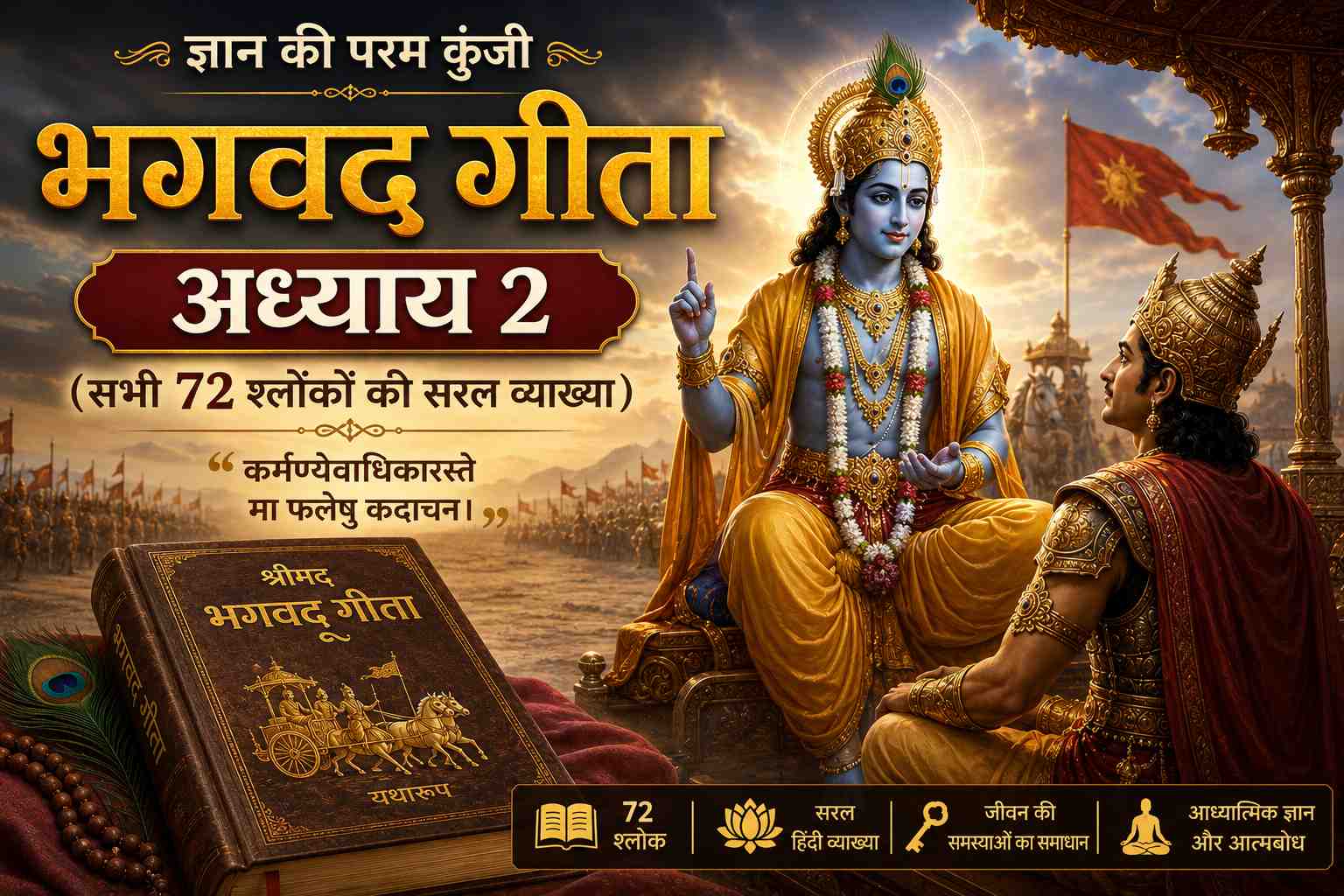
Chapter 2 of the Bhagavad Gita, titled 'Sankhya Yoga' (The Yoga of Analytical Knowledge), is universally revered as the condensed essence of the entire 700-verse scripture. Spanning 72 verses, this masterwork transitions humanity from the crippling despair of Chapter 1 into transcendental liberation. Lord Krishna begins with an unsparing awakening call to dispel Arjuna's weakness of heart, reveals the eternal, indestructible nature of the soul (Atman), establishes the royal science of selfless action without attachment to fruits (Nishkama Karma Yoga), and concludes with a definitive description of the enlightened, steady-minded sage (Sthitaprajna) who attains supreme peace (Brahmi Sthiti).
Verse 2.1: Krishna Looks Upon the Weeping Warrior
Sanskrit:
सञ्जय उवाच |
तं तथा कृपयाविष्टमश्रुपूर्णाकुलेक्षणम् |
विषीदन्तमिदं वाक्यमुवाच मधुसूदनः || १ ||
Transliteration:
sañjaya uvāca
taṁ tathā kṛpayāviṣṭam aśru-pūrṇākulekṣaṇam
viṣīdantam idaṁ vākyam uvāca madhusūdanaḥ (2.1)
English Meaning:
Sanjaya said: Seeing Arjuna overwhelmed with pity, his eyes filled with tears and distress, and grieving deeply, Madhusudana (Lord Krishna) spoke these words.
Commentary:
Sanjaya describes Arjuna's state to Dhritarashtra. Arjuna is submerged in emotional grief, his eyes blinded by tears. Lord Krishna (Madhusudana, slayer of the demon Madhu) prepares to destroy the inner demon of ignorance that holds Arjuna captive.
Verse 2.2: Krishna's Rebuke: Whence Comes This Filth of Delusion?
Sanskrit:
श्रीभगवानुवाच |
कुतस्त्वा कश्मलमिदं विषमे समुपस्थितम् |
अनार्यजुष्टमस्वर्ग्यमकीर्तिकरमर्जुन || २ ||
Transliteration:
śrī-bhagavān uvāca
kutas tvā kaśmalam idaṁ viṣame samupasthitam
anārya-juṣṭam asvargyam akīrti-karam arjuna (2.2)
English Meaning:
The Supreme Lord said: O Arjuna, from where has this impurity (Kashmalam) come upon you at this critical, perilous moment? It is unbefitting a noble person (Anarya), it does not lead to higher spiritual realms, and it brings only infamy.
Commentary:
Krishna directly diagnoses Arjuna's misplaced sentimentality as 'Kashmalam' (mental filth/delusion). He declares that such cowardice at the decisive moment of duty violates noble character, degrades spiritual evolution, and destroys honor.
Verse 2.3: The Thunderous Command: Yield Not to Impotence!
Sanskrit:
क्लैब्यं मा स्म गमः पार्थ नैतत्त्वय्युपपद्यते |
क्षुद्रं हृदयदौर्बल्यं त्यक्त्वोत्तिष्ठ परन्तप || ३ ||
Transliteration:
klaibyaṁ mā sma gamaḥ pārtha naitat tvayy upapadyate
kṣudraṁ hṛdaya-daurbalyaṁ tyaktvottiṣṭha parantapa (2.3)
English Meaning:
Do not yield to unmanliness and cowardice (Klaibyam), O Partha; it is entirely unworthy of you. Cast off this petty weakness of heart and arise, O scorcher of foes (Parantapa)!
Commentary:
In one of the Gita's most potent awakening calls, Krishna shatters Arjuna's rationalizations. He labels Arjuna's emotional paralysis as 'Klaibyam' (impotence/unmanliness) and 'Kshudram hridaya-daurbalyam' (petty weakness of heart), commanding him to arise.
Verse 2.4: How Can I Attack Bhishma and Drona with Arrows?
Sanskrit:
अर्जुन उवाच |
कथं भीष्ममहं सङ्ख्ये द्रोणं च मधुसूदन |
इषुभिः प्रतियोत्स्यामि पूजार्हावरिसूदन || ४ ||
Transliteration:
arjuna uvāca
kathaṁ bhīṣmam ahaṁ saṅkhye droṇaṁ ca madhusūdana
iṣubhiḥ pratiyotsyāmi pūjārhāv ari-sūdana (2.4)
English Meaning:
Arjuna said: O Madhusudana, how can I counter-attack with arrows in battle against Bhishma and Drona, who are worthy of my deepest worship, O destroyer of enemies?
Commentary:
Arjuna attempts to defend his hesitation. In traditional Vedic culture, one offers flowers and humble prostrations to elders and gurus; Arjuna questions how he can shower them with lethal arrows instead.
Verse 2.5: Better to Live on Alms Than Enjoy Blood-Stained Pleasures
Sanskrit:
गुरुनहत्वा हि महानुभावान् श्रेयो भोक्तुं भैक्ष्यमपीह लोके |
हत्वार्थकामांस्तु गुरुनिहैव भुञ्जीय भोगान् रुधिरप्रदिग्धान् || ५ ||
Transliteration:
gurūn ahatvā hi mahānubhāvān śreyo bhoktuṁ bhaikṣyam apīha loke
hatvārtha-kāmāṁs tu gurūn ihaiva bhuñjīya bhogān rudhira-pradigdhān (2.5)
English Meaning:
It is far better to live in this world by begging alms than to slay these noble elders. Even if they are motivated by worldly gain, by killing these gurus I would only enjoy wealth and pleasures tainted with blood.
Commentary:
Arjuna argues that begging (a lifestyle permitted only to ascetics, not Kshatriya princes) is superior to rulership won through the slaughter of venerable teachers, which would render every royal luxury 'rudhira-pradigdhan' (stained with blood).
Verse 2.6: We Do Not Know Which is Better: Victory or Defeat
Sanskrit:
न चैतद्विद्मः कतरन्नो गरीयो यद्वा जयेम यदि वा नो जयेयुः |
यानेव हत्वा न जिजीविषाम-स्तेऽवस्थिताः प्रमुखे धार्तराष्ट्राः || ६ ||
Transliteration:
na caitad vidmaḥ kataran no garīyo yad vā jayema yadi vā no jayeyuḥ
yān eva hatvā na jijīviṣāmas te 'vasthitāḥ pramukhe dhārtarāṣṭrāḥ (2.6)
English Meaning:
We do not even know which course is better for us—whether we should conquer them or they should conquer us. The very sons of Dhritarashtra, after slaying whom we would have no desire to live, stand arrayed before us.
Commentary:
Arjuna experiences total paralysis of judgment. His cognitive compass fails: victory feels identical to defeat, because living in an empty palace after slaughtering his own family offers no meaning.
Verse 2.7: Arjuna's Complete Surrender as a Disciple
Sanskrit:
कार्पण्यदोषोपहतस्वभावः पृच्छामि त्वां धर्मसम्मूढचेताः |
यच्छ्रेयः स्यान्निश्चितं ब्रूहि तन्मे शिष्यस्तेऽहं शाधि मां त्वां प्रपन्नम् || ७ ||
Transliteration:
kārpaṇya-doṣopahata-svabhāvaḥ pṛcchāmi tvāṁ dharma-sammūḍha-cetāḥ
yac chreyaḥ syān niścitaṁ brūhi tan me śiṣyas te 'haṁ śādhi māṁ tvāṁ prapannam (2.7)
English Meaning:
My true nature is overpowered by the taint of helpless pity, and my mind is utterly confused about my duty (Dharma). I ask You: tell me clearly what is definitively good (Shreyas) for me. I am Your disciple; please instruct me, who have surrendered unto You.
Commentary:
This is the pivotal turning point of the Bhagavad Gita. Arjuna recognizes his spiritual poverty ('Karpanya-dosha') and ethical confusion ('Dharma-sammudha-chetah'). He transitions from Krishna's friend to His humble disciple ('Shishyas te 'ham') and completely surrenders ('prapannam').
Verse 2.8: Unrivaled Wealth on Earth Cannot Remove My Grief
Sanskrit:
न हि प्रपश्यामि ममापनुद्याद्यच्छोकमुच्छोषणमिन्द्रियाणाम् |
अवाप्य भूमावसपत्नमृद्धं राज्यं सुराणामपि चाधिपत्यम् || ८ ||
Transliteration:
na hi prapaśyāmi mamāpanudyād yac chokam ucchoṣaṇam indriyāṇām
avāpya bhūmāv asapatnam ṛddhaṁ rājyaṁ surāṇām api cādhipatyam (2.8)
English Meaning:
I see nothing that can drive away this sorrow which is scorching my senses, even if I were to acquire unrivaled, prosperous sovereignty on earth or dominion like the gods in heaven.
Commentary:
Arjuna confesses that external, material solutions—unrivaled global wealth or heavenly sovereignty—are fundamentally powerless to extinguish the existential torment burning within his mind and senses.
Verse 2.9: 'I Will Not Fight': Arjuna Falls Silent
Sanskrit:
सञ्जय उवाच |
एवमुक्त्वा हृषीकेशं गुडाकेशः परन्तपः |
न योत्स्य इति गोविन्दमुक्त्वा तूष्णीं बभूव ह || ९ ||
Transliteration:
sañjaya uvāca
evam uktvā hṛṣīkeśaṁ guḍākeśaḥ parantapaḥ
na yotsya iti govindam uktvā tūṣṇīṁ babhūva ha (2.9)
English Meaning:
Sanjaya said: Having spoken thus to Hrishikesha (Lord Krishna), Gudakesha (Arjuna), the scorcher of foes, said to Govinda, 'I shall not fight,' and fell completely silent.
Commentary:
Arjuna utters his final declaration of emotional helplessness: 'Na yotsye' (I will not fight), and falls into absolute silence, awaiting the divine word.
Verse 2.10: The Lord Smiles in the Midst of the Two Armies
Sanskrit:
तमुवाच हृषीकेशः प्रहसन्निव भारत |
सेनयोरुभयोर्मध्ये विषीदन्तमिदं वचः || १० ||
Transliteration:
tam uvāca hṛṣīkeśaḥ prahasann iva bhārata
senayor ubhayor madhye viṣīdantam idaṁ vacaḥ (2.10)
English Meaning:
O descendant of Bharata (Dhritarashtra), to him who was sorrowing between the two armies, Hrishikesha (Lord Krishna), smiling as it were, spoke the following words.
Commentary:
Krishna responds not with anxiety or sorrow, but with a gentle, compassionate smile ('prahasann iva'). The smile signifies the Supreme Master's transcendent perspective: seeing that Arjuna's monumental grief is based entirely on an optical illusion of the ego.
Verse 2.11: The Wise Grieve Neither for the Living nor the Dead
Sanskrit:
श्रीभगवानुवाच |
अशोच्यानन्वशोचस्त्वं प्रज्ञावादांश्च भाषसे |
गतासूनगतासूंश्च नानुशोचन्ति पण्डिताः || ११ ||
Transliteration:
śrī-bhagavān uvāca
aśocyān anvaśocas tvaṁ prajñā-vādāṁś ca bhāṣase
gatāsūn agatāsūṁś ca nānuśocanti paṇḍitāḥ (2.11)
English Meaning:
The Supreme Lord said: You grieve for that which is not worthy of grief, yet you speak words of wisdom. The truly wise (Panditah) lament neither for the dead nor for the living.
Commentary:
Lord Krishna launches the core teaching of Sankhya philosophy. He points out the contradiction in Arjuna's behavior: while mouthing high philosophical arguments, he weeps for perishable bodies. True seers ('Panditah') recognize the immortality of consciousness and grieve for neither body nor circumstance.
Verse 2.12: We Have Always Existed and Shall Never Cease to Be
Sanskrit:
न त्वेवाहं जातु नासं न त्वं नेमे जनाधिपाः |
न चैव न भविष्यामः सर्वे वयमतः परम् || १२ ||
Transliteration:
na tv evāhaṁ jātu nāsaṁ na tvaṁ neme janādhipāḥ
na caiva na bhaviṣyāmaḥ sarve vayam ataḥ param (2.12)
English Meaning:
Never was there a time when I did not exist, nor you, nor all these kings; nor shall any of us ever cease to exist in the future.
Commentary:
Krishna establishes the beginningless and endless eternity of individual consciousness (the Atman). Physical birth and death are mere transitions of the bodily costume; the underlying conscious entity is eternal across past, present, and future.
Verse 2.13: Childhood, Youth, Old Age, and the Next Body
Sanskrit:
देहिनोऽस्मिन्यथा देहे कौमारं यौवनं जरा |
तथा देहान्तरप्राप्तिर्धीरस्तत्र न मुह्यति || १३ ||
Transliteration:
dehino 'smin yathā dehe kaumāraṁ yauvanaṁ jarā
tathā dehāntara-prāptir dhīras tatra na muhyati (2.13)
English Meaning:
Just as the embodied soul continuously passes in this body from childhood to youth to old age, similarly it passes into another body at death. The steady-minded person (Dhira) is not bewildered by this.
Commentary:
Krishna draws an undeniable biological analogy. Just as consciousness witnesses the continuous transformation of the physical frame from infancy to youth and old age without itself dying, death is simply the soul's next natural transition into another body. The wise ('Dhira') remain unshaken.
Verse 2.14: The Transient Contact of the Senses: Learn to Endure
Sanskrit:
मात्रास्पर्शास्तु कौन्तेय शीतोष्णसुखदुःखदाः |
आगमापायिनोऽनित्यास्तांस्तितिक्षस्व भारत || १४ ||
Transliteration:
mātrā-sparśās tu kaunteya śītoṣṇa-sukha-duḥkha-dāḥ
āgamāpāyino 'nityās tāṁs titikṣasva bhārata (2.14)
English Meaning:
The contact of the senses with their objects, O son of Kunti, gives rise to cold and heat, pleasure and pain. These experiences are fleeting and impermanent; learn to endure them patiently, O Bharata.
Commentary:
Sensory perceptions (cold, heat, pleasure, pain) are mere electro-chemical contacts ('matra-sparsha') between sense organs and material objects. They come and go ('agamapayino anityah'). Krishna commands Arjuna to develop 'Titiksha'—the spiritual power of patient, unruffled endurance.
Verse 2.15: Equanimity in Pain and Pleasure Leads to Immortality
Sanskrit:
यं हि न व्यथयन्त्येते पुरुषं पुरुषर्षभ |
समदुःखसुखं धीरं सोऽमृतत्वाय कल्पते || १५ ||
Transliteration:
yaṁ hi na vyathayanty ete puruṣaṁ puruṣarṣabha
sama-duḥkha-sukhaṁ dhīraṁ so 'mṛtatvāya kalpate (2.15)
English Meaning:
O noblest of men, that wise person who is not tormented by these dualities, and who remains equal in both pain and pleasure, becomes fit for immortality (Amritatva).
Commentary:
Inner equanimity is the direct doorway to liberation. When a person remains unperturbed by the alternating tides of life, recognizing themselves as the changeless witness, they transcend the cycle of mortality.
Verse 2.16: The Unreal Has No Being; The Real Never Ceases to Be
Sanskrit:
नासतो विद्यते भावो नाभावो विद्यते सतः |
उभयोरपि दृष्टोऽन्तस्त्वनयोस्तत्त्वदर्शिभिः || १६ ||
Transliteration:
nāsato vidyate bhāvo nābhāvo vidyate sataḥ
ubhayor api dṛṣṭo 'ntas tv anayos tattva-darśibhiḥ (2.16)
English Meaning:
The unreal (Asat) has no permanent existence; the real (Sat) never ceases to be. The ultimate truth of both has been perceived by the seers of reality (Tattva-darshis).
Commentary:
This is one of the grandest metaphysical declarations of Vedanta: 'Asat' (the ever-changing, perishable physical realm) lacks enduring reality; 'Sat' (the unchanging eternal consciousness) cannot be destroyed. The seers ('Tattva-darshis') perceive this fundamental divide.
Verse 2.17: Pervading All Reality: The Indestructible Truth
Sanskrit:
अविनाशि तु तद्विद्धि येन सर्वमिदं ततम् |
विनाशमव्ययस्यास्य न कश्चित्कर्तुमर्हति || १७ ||
Transliteration:
avināśi tu tad viddhi yena sarvam idaṁ tatam
vināśam avyayasyāsya na kaścit kartum arhati (2.17)
English Meaning:
Know that that which pervades this entire universe is indestructible. No one has the power to destroy this imperishable reality.
Commentary:
Consciousness is the all-pervading fabric upon which the entire cosmos is woven. Because it is subtler than matter, space, and energy, nothing in existence has the structural capacity to destroy it.
Verse 2.18: Perishable Bodies vs. The Eternal, Immeasurable Soul
Sanskrit:
अन्तवन्त इमे देहा नित्यस्योक्ताः शरीरिणः |
अनाशिनोऽप्रमेयस्य तस्माद्युध्यस्व भारत || १८ ||
Transliteration:
antavanta ime dehā nityasyoktāḥ śarīriṇaḥ
anāśino 'prameyasya tasmād yudhyasva bhārata (2.18)
English Meaning:
These physical bodies of the eternal, indestructible, and immeasurable soul are said to have an end. Therefore, fight, O Bharata!
Commentary:
The physical body is designed by nature to be finite ('antavanta'); the conscious dweller within ('shariri') is eternal ('nitya') and immeasurable ('aprameya'). Knowing that the soul cannot be killed, Krishna instructs Arjuna to execute his righteous duty.
Verse 2.19: The Soul Neither Kills nor is Killed
Sanskrit:
य एनं वेत्ति हन्तारं यश्चैनं मन्यते हतम् |
उभौ तौ न विजानीतो नायं हन्ति न हन्यते || १९ ||
Transliteration:
ya enaṁ vetti hantāraṁ yaś cainaṁ manyate hatam
ubhau tau na vijānīto nāyaṁ hanti na hanyate (2.19)
English Meaning:
He who thinks that the soul kills, and he who thinks that the soul is killed—both of them are ignorant. The soul neither kills nor is it killed.
Commentary:
Directly echoing the Katha Upanishad, Krishna explains that action, birth, and death belong exclusively to the bodily mechanism. Pure consciousness is the transcendental witness, beyond agency and physical destruction.
Verse 2.20: Unborn, Eternal, Primordial: The Deathless Soul
Sanskrit:
न जायते म्रियते वा कदाचि-न्नायं भूत्वा भविता वा न भूयः |
अजो नित्यः शाश्वतोऽयं पुराणो न हन्यते हन्यमाने शरीरे || २० ||
Transliteration:
na jāyate mriyate vā kadācin nāyaṁ bhūtvā bhavitā vā na bhūyaḥ
ajo nityaḥ śāśvato 'yaṁ purāṇo na hanyate hanyamāne śarīre (2.20)
English Meaning:
The soul is never born, nor does it ever die; nor having once been, does it ever cease to be. It is unborn, eternal, ever-existing, and primeval. It is not slain when the body is slain.
Commentary:
This verse outlines the six classic modifications of matter (birth, existence, growth, reproduction, decay, death) and affirms that the Atman is exempt from all of them. It is 'Ajo' (unborn), 'Nityah' (eternal), 'Shashvato' (ever-lasting), and 'Purano' (ancient yet ever-fresh).
Verse 2.21: How Can an Enlightened Person Slay Anyone?
Sanskrit:
वेदाविनाशिनं नित्यं य एनमजमव्ययम् |
कथं स पुरुषः पार्थ कं घातयति हन्ति कम् || २१ ||
Transliteration:
vedāvināśinaṁ nityaṁ ya enam ajam avyayam
kathaṁ sa puruṣaḥ pārtha kaṁ ghātayati hanti kam (2.21)
English Meaning:
O Partha, how can a person who knows the soul to be indestructible, eternal, unborn, and imperishable, slay anyone or cause anyone to be slain?
Commentary:
An individual grounded in self-realization understands that the core reality of every being is untouchable by physical weapons. Slaying or being slain applies solely to the mortal physical instrument.
Verse 2.22: Changing Worn-Out Garments for New Ones
Sanskrit:
वासांसि जीर्णानि यथा विहाय नवानि गृह्णाति नरोऽपराणि |
तथा शरीराणि विहाय जीर्णा-न्यन्यानि संयाति नवानि देही || २२ ||
Transliteration:
vāsāṁsi jīrṇāni yathā vihāya navāni gṛhṇāti naro 'parāṇi
tathā śarīrāṇi vihāya jīrṇāny anyāni saṁyāti navāni dehī (2.22)
English Meaning:
Just as a person discards worn-out garments and puts on new ones, similarly the embodied soul casts off worn-out bodies and enters into other new ones.
Commentary:
One of the most celebrated metaphors in world literature. Reincarnation is as natural and effortless as changing an old, frayed shirt for a fresh one. Death is not the end of being, but a change of attire for the soul's continuing evolution.
Verse 2.23: Weapons Cannot Cut It; Fire Cannot Burn It
Sanskrit:
नैनं छिन्दन्ति शस्त्राणि नैनं दहति पावकः |
न चैनं क्लेदयन्त्यापो न शोषयति मारुतः || २३ ||
Transliteration:
nainaṁ chindanti śastrāṇi nainaṁ dahati pāvakaḥ
na cainaṁ kledayanty āpo na śoṣayati mārutaḥ (2.23)
English Meaning:
Weapons cannot cut this soul, fire cannot burn it, water cannot wet it, and wind cannot dry it.
Commentary:
The four fundamental physical elements capable of material destruction—earthly weapons (cutting), fire (combustion), water (dissolution), and air/wind (desiccation)—have zero effect on consciousness, which is subtler than matter itself.
Verse 2.24: Cleaveless, Incombustible, All-Pervading, Unshakable
Sanskrit:
अच्छेद्योऽयमदाह्योऽयमक्लेद्योऽशोष्य एव च |
नित्यः सर्वगतः स्थाणुरचलोऽयं सनातनः || २४ ||
Transliteration:
acchedyo 'yam adāhyo 'yam akledyo 'śoṣya eva ca
nityaḥ sarva-gataḥ sthāṇur acalo 'yaṁ sanātanaḥ (2.24)
English Meaning:
This soul is uncuttable, incombustible, unmoistenable, and undryable. It is eternal, all-pervading, stable, immovable, and everlasting.
Commentary:
Krishna reiterates the invulnerability of the Atman with absolute philosophical precision: 'Sarva-gatah' (present everywhere as pure witness), 'Sthanuh' (firm and grounded), 'Acalah' (unmoved by external changes), and 'Sanatanah' (primeval and timeless).
Verse 2.25: Unmanifest, Inconceivable, Immutable
Sanskrit:
अव्यक्तोऽयमचिन्त्योऽयमविकार्योऽयमुच्यते |
तस्मादेवं विदित्वैनं नानुशोचितुमर्हसि || २५ ||
Transliteration:
avyakto 'yam acintyo 'yam avikāryo 'yam ucyate
tasmād evaṁ viditvainaṁ nānuśocitum arhasi (2.25)
English Meaning:
This soul is said to be unmanifest (Avyakta), inconceivable to the ordinary mind (Achintya), and unchangeable (Avikarya). Therefore, knowing it as such, you should not grieve.
Commentary:
The Atman cannot be perceived by the senses ('Avyakta') nor grasped by mental concepts ('Achintya'), for it is the very witness behind the mind. Knowing its immutability, sorrow is revealed to be utterly baseless.
Verse 2.26: Even if You Think the Soul Dies Constantly, Grieve Not
Sanskrit:
अथ चैनं नित्यजातं नित्यं वा मन्यसे मृतम् |
तथापि त्वं महाबाहो नैवं शोचितुमर्हसि || २६ ||
Transliteration:
atha cainaṁ nitya-jātaṁ nityaṁ vā manyase mṛtam
tathāpi tvaṁ mahā-bāho naivaṁ śocitum arhasi (2.26)
English Meaning:
Even if you think that this soul is perpetually born and perpetually dies with the body, even then, O mighty-armed Arjuna, you have no reason to grieve.
Commentary:
Krishna uses practical philosophical flexibility: even if Arjuna adopts the materialistic perspective that life begins at biological conception and permanently ends at death, grief is still irrational, as birth and death are unavoidable natural processes.
Verse 2.27: Death is Certain for the Born; Birth is Certain for the Dead
Sanskrit:
जातस्य हि ध्रुवो मृत्युर्ध्रुवं जन्म मृतस्य च |
तस्मादपरिहार्येऽर्थे न त्वं शोचितुमर्हसि || २७ ||
Transliteration:
jātasya hi dhruvo mṛtyur dhruvaṁ janma mṛtasya ca
tasmād aparihārye 'rthe na tvaṁ śocitum arhasi (2.27)
English Meaning:
For one who is born, death is absolutely certain; and for one who dies, birth is certain. Therefore, over this inevitable cycle, you should not lament.
Commentary:
In the realm of matter, whatever has a beginning must have an end ('Jatasya hi dhruvo mrityuh'). Since physical death is completely inevitable ('apariharye'), lamenting over an inescapable cosmic law is illogical.
Verse 2.28: Unmanifest in the Beginning, Manifest in Between, Unmanifest in the End
Sanskrit:
अव्यक्तादीनि भूतानि व्यक्तमध्यानि भारत |
अव्यक्तनिधनान्येव तत्र का परिदेवना || २८ ||
Transliteration:
avyaktādīni bhūtāni vyakta-madhyāni bhārata
avyakta-nidhanāny eva tatra kā paridevanā (2.28)
English Meaning:
All created beings are unmanifest before birth, manifest in their interim state, and unmanifest again after death, O Bharata. What cause is there in this for lamentation?
Commentary:
Beings emerge from the unmanifest realm of Prakriti, briefly take on a visible physical form during life, and dissolve back into the unmanifest at death. It is like waves rising from the ocean and merging back into water; there is no real loss.
Verse 2.29: The Marvel of the Soul: Few Truly Know It
Sanskrit:
आश्चर्यवत्पश्यति कश्चिदेन-माश्चर्यवद्वदति तथैव चान्यः |
आश्चर्यवच्चैनमन्यः शृणोति श्रुत्वाप्येनं वेद न चैव कश्चित् || २९ ||
Transliteration:
āścarya-vat paśyati kaścid enam āścarya-vad vadati tathaiva cānyaḥ
āścarya-vac cainam anyaḥ śṛṇoti śrutvāpy enaṁ veda na caiva kaścit (2.29)
English Meaning:
Some behold this soul as a wondrous marvel; some speak of it as a marvel; others hear of it as a marvel; while even after hearing about it, hardly anyone truly comprehends it.
Commentary:
The Atman is the supreme mystery of reality ('Ashcharya'). Because it cannot be objectified as a thing, people marvel when they hear of it, yet genuine direct experiential realization remains extraordinarily rare.
Verse 2.30: The Eternal Inhabitant in All Bodies is Ever-Invulnerable
Sanskrit:
देही नित्यमवध्योऽयं देहे सर्वस्य भारत |
तस्मात्सर्वाणि भूतानि न त्वं शोचितुमर्हसि || ३० ||
Transliteration:
dehī nityam avadhyo 'yaṁ dehe sarvasya bhārata
tasmāt sarvāṇi bhūtāni na tvaṁ śocitum arhasi (2.30)
English Meaning:
The embodied soul dwelling within the body of all living beings is eternally invulnerable and can never be slain, O Bharata. Therefore, you should not mourn for any living being.
Commentary:
Krishna concludes the foundational Sankhya / Atma-tattva section. The soul ('Dehi') residing within all bodies is 'Avadhyo' (unslayable). Recognizing the indestructible sanctity of life, grief is thoroughly dismantled.
Verse 2.31: Considering Your Own Svadharma as a Warrior
Sanskrit:
स्वधर्ममपि चावेक्ष्य न विकम्पितुमर्हसि |
धर्म्याद्धि युद्धाच्छ्रेयोऽन्यत्क्षत्रियस्य न विद्यते || ३१ ||
Transliteration:
sva-dharmam api cāvekṣya na vikampitum arhasi
dharmyād dhi yuddhāc chreyo 'nyat kṣatriyasya na vidyate (2.31)
English Meaning:
Furthermore, considering your own specific duty (Svadharma) as a warrior, you should not falter; for there is nothing more auspicious for a Kshatriya than a righteous war for the protection of Dharma.
Commentary:
Shifting from pure metaphysics to social and moral duty, Krishna addresses Svadharma. A Kshatriya's essential duty is to protect society and justice from tyrannical aggression; running away from such a battle is a dereliction of moral integrity.
Verse 2.32: An Unsolicited Gateway to Heaven
Sanskrit:
यदृच्छया चोपपन्नं स्वर्गद्वारमपावृतम् |
सुखिनः क्षत्रियाः पार्थ लभन्ते युद्धमीदृशम् || ३२ ||
Transliteration:
yadṛcchayā copapannaṁ svarga-dvāram apāvṛtam
sukhinaḥ kṣatriyāḥ pārtha labhante yuddham īdṛśam (2.32)
English Meaning:
Happy are the warriors, O Partha, who encounter by chance such an unsolicited opportunity for a righteous battle, which opens wide the gates of heaven.
Commentary:
When a righteous battle arrives unsought ('yadricchaya'), it is a rare opportunity for a warrior to fulfill their highest duty and attain spiritual elevation.
Verse 2.33: Abandoning Dharma and Incurring Sin
Sanskrit:
अथ चेत्त्वमिमं धर्म्यं सङ्ग्रामं न करिष्यसि |
ततः स्वधर्मं कीर्तिं च हित्वा पापमवाप्स्यसि || ३३ ||
Transliteration:
atha cet tvam imaṁ dharmyaṁ saṅgrāmaṁ na kariṣyasi
tataḥ sva-dharmaṁ kīrtiṁ ca hitvā pāpam avāpsyasi (2.33)
English Meaning:
If, however, you refuse to fight this righteous battle, you will abandon your personal duty (Svadharma) and honorable reputation, thereby incurring direct sin (Papa).
Commentary:
Krishna dismantles Arjuna's claim that fighting is sinful. Refusing to fight an evil aggressor is the real sin of omission, resulting in the forfeiture of duty, honor, and spiritual integrity.
Verse 2.34: Dishonor is Worse Than Death for the Respected
Sanskrit:
अकीर्तिं चापि भूतानि कथयिष्यन्ति तेऽव्ययाम् |
सम्भावितस्य चाकीर्तिर्मरणादतिरिच्यते || ३४ ||
Transliteration:
akīrtiṁ cāpi bhūtāni kathayiṣyanti te 'vyayām
sambhāvitasya cākīrtir maraṇād atiricyate (2.34)
English Meaning:
People will recount your perpetual dishonor and infamy. And for a person of honor and noble standing, infamy is worse than physical death.
Commentary:
For an esteemed leader whose life is built upon courage and integrity, being labeled a deserter brings enduring psychological and social disgrace ('akīrti') that is far more painful than physical death.
Verse 2.35: Great Charioteers Will Think You Fled Out of Fear
Sanskrit:
भयाद्रणादुपरतं मंस्यन्ते त्वां महारथाः |
येषां च त्वं बहुमतो भूत्वा यास्यसि लाघवम् || ३५ ||
Transliteration:
bhayād raṇād uparataṁ maṁsyante tvāṁ mahā-rathāḥ
yeṣāṁ ca tvaṁ bahu-mato bhūtvā yāsyasi lāghavam (2.35)
English Meaning:
The great chariot-commanders (Maharathas) will believe you retreated from the battle out of cowardice and fear. Those who held you in high esteem will look down upon you with contempt.
Commentary:
The enemy warriors will not understand Arjuna's philosophical compunctions; they will attribute his retreat to raw cowardice, permanently tarnishing his hard-won stature.
Verse 2.36: Harsh Words of Your Enemies: What is More Painful?
Sanskrit:
अवाच्यवादांश्च बहून् वदिष्यन्ति तवाहिताः |
निन्दन्तस्तव सामर्थ्यं ततो दुःखतरं नु किम् || ३६ ||
Transliteration:
avācya-vādāṁś ca bahūn vadiṣyanti tavāhitāḥ
nindantas tava sāmarthyaṁ tato duḥkhataraṁ nu kim (2.36)
English Meaning:
Your enemies will speak many unspeakable, insulting words, deriding your martial capability and strength. What could possibly be more painful than that?
Commentary:
Arjuna's adversaries will ridicule his prowess with vile insults ('avācya-vādān'). Krishna asks what could be more agonizing for a proud warrior than the mockery of the wicked.
Verse 2.37: Slain You Attain Heaven; Victorious You Enjoy Earth
Sanskrit:
हतो वा प्राप्स्यसि स्वर्गं जित्वा वा भोक्ष्यसे महीम् |
तस्मादुत्तिष्ठ कौन्तेय युद्धाय कृतनिश्चयः || ३७ ||
Transliteration:
hato vā prāpsyasi svargaṁ jitvā vā bhokṣyase mahīm
tasmād uttiṣṭha kaunteya yuddhāya kṛta-niścayaḥ (2.37)
English Meaning:
If you are slain, you will attain heaven; if you conquer, you will enjoy the sovereign earth. Therefore, arise, O son of Kunti, fully resolved on battle!
Commentary:
A definitive statement of victory in all outcomes: dying while upholding righteousness grants heavenly elevation, while winning re-establishes a just rule on earth. In neither outcome is there loss. Therefore, Krishna commands: 'Arise with firm determination!'
Verse 2.38: Treat Pleasure and Pain, Gain and Loss as Equal
Sanskrit:
सुखदुःखे समे कृत्वा लाभालाभौ जयाजयौ |
ततो युद्धाय युज्यस्व नैवं पापमवाप्स्यसि || ३८ ||
Transliteration:
sukha-duḥkhe same kṛtvā lābhālābhau jayājayau
tato yuddhāya yujyasva naivaṁ pāpam avāpsyasi (2.38)
English Meaning:
Holding pleasure and pain, gain and loss, victory and defeat as equal, prepare yourself for battle! By acting thus, you will never incur sin.
Commentary:
This verse introduces the essence of Karma Yoga: psychological neutrality. When one acts purely out of dedication to duty, maintaining mental equanimity toward dualities (pleasure/pain, profit/loss, victory/defeat), no karmic bondage or sin is accrued.
Verse 2.39: Transition from Sankhya to Buddhi Yoga
Sanskrit:
एषा तेऽभिहिता साङ्ख्ये बुद्धिर्योगे त्विमां शृणु |
बुद्ध्या युक्तो यया पार्थ कर्मबन्धं प्रहास्यसि || ३९ ||
Transliteration:
eṣā te 'bhihitā sāṅkhye buddhir yoge tv imāṁ śṛṇu
buddhyā yukto yayā pārtha karma-bandhaṁ prahāsyasi (2.39)
English Meaning:
Thus far, the analytical wisdom of Sankhya (knowledge of the soul) has been declared to you. Now listen to the wisdom of Yoga (Buddhi Yoga / Karma Yoga), endowed with which, O Partha, you shall cast off all bondage of action (Karma-bandhana).
Commentary:
Krishna shifts gears from metaphysical philosophy (Sankhya) to applied spiritual action (Buddhi Yoga / Karma Yoga). By cultivating enlightened discernment in daily work, one severs the binding chains of karma.
Verse 2.40: In This Path, No Effort is Ever Lost
Sanskrit:
नेहाभिक्रमनाशोऽस्ति प्रत्यवायो न विद्यते |
स्वल्पमप्यस्य धर्मस्य त्रायते महतो भयात् || ४० ||
Transliteration:
nehābhikrama-nāśo 'sti pratyavāyo na vidyate
svalpam apy asya dharmasya trāyate mahato bhayāt (2.40)
English Meaning:
In this path of selfless action, no effort is ever wasted, nor is there any adverse consequence. Even a very little practice of this spiritual discipline protects one from the greatest fear (the cycle of birth and death).
Commentary:
Unlike ritualistic karma which requires flawless execution, spiritual work done with pure devotion is never lost ('na asti abhikrama-nashah'). Even a microscopic effort permanently elevates the soul and rescues it from existential terror.
Verse 2.41: One-Pointed Resolute Intellect vs. Many-Branched Desires
Sanskrit:
व्यवसायात्मिका बुद्धिरेकेह कुरुनन्दन |
बहुशाखा ह्यनन्ताश्च बुद्धयोऽव्यवसायिनाम् || ४१ ||
Transliteration:
vyavasāyātmikā buddhir ekeha kuru-nandana
bahu-śākhā hy anantāś ca buddhayo 'vyavasāyinām (2.41)
English Meaning:
The resolute intellect (Vyavasayatmika Buddhi) on this path is one-pointed and focused, O joy of the Kurus; but the intellect of the indecisive and irresolute is endlessly branched and scattered.
Commentary:
A true yogi possesses a unified, laser-focused purpose: spiritual self-realization and duty. In contrast, those driven by selfish desires have a mind splintered into endless contradictory branches ('bahu-shakha hy anantash ca').
Verses 2.42 & 2.43: The Flowery Speech of Materialistic Ritualists
Sanskrit:
यामिमां पुष्पितां वाचं प्रवदन्त्यविपश्चितः |
वेदवादरताः पार्थ नान्यदस्तीति वादिनः || ४२ ||
कामात्मानः स्वर्गपरा जन्मकर्मफलप्रदाम् |
क्रियाविशेषबहुलां भोगैश्वर्यगतिं प्रति || ४३ ||
Transliteration:
yām imāṁ puṣpitāṁ vācaṁ pravadanty avipaścitaḥ
veda-vāda-ratāḥ pārtha nānyad astīti vādinaḥ (2.42)
kāmātmānaḥ svarga-parā janma-karma-phala-pradām
kriyā-viśeṣa-bahulāṁ bhogaiśvarya-gatiṁ prati (2.43)
English Meaning:
The unwise, delighting in the flowery words of the ritualistic sections of the Vedas, proclaim that there is nothing beyond this. Full of personal desires, longing for heaven, they promote elaborate ceremonies aimed at good rebirth, wealth, power, and sensual enjoyment.
Commentary:
Krishna critiques narrow ritualism. Those who use spiritual traditions merely to negotiate for worldly wealth and heavenly luxuries are spiritually blind ('avipaścitaḥ'), mistaking flowering promises ('pushpitam vacham') for ultimate truth.
Verse 2.44: Attached to Pleasure and Power, the Mind Cannot Settle
Sanskrit:
भोगैश्वर्यप्रसक्तानां तयापहृतचेतसाम् |
व्यवसायात्मिका बुद्धिः समाधौ न विधीयते || ४४ ||
Transliteration:
bhogaiśvarya-prasaktānāṁ tayāpahṛta-cetasām
vyavasāyātmikā buddhiḥ samādhau na vidhīyate (2.44)
English Meaning:
In the minds of those who are deeply attached to sensory pleasures and material power, and whose discernment is captivated by such flowery words, the resolute intellect aimed at spiritual absorption (Samadhi) is never established.
Commentary:
When consciousness is hijacked ('apahrita-chetasam') by the obsessive pursuit of sensory pleasure and status, the mind loses the stability required to experience meditative absorption ('Samadhi').
Verse 2.45: Rise Above the Three Gunas, O Arjuna!
Sanskrit:
त्रैगुण्यविषया वेदा निस्त्रैगुण्यो भवार्जुन |
निर्द्वन्द्वो नित्यसत्त्वस्थो निर्योगक्षेम आत्मवान् || ४५ ||
Transliteration:
trai-guṇya-viṣayā vedā nis-trai-guṇyo bhavārjuna
nirdvandvo nitya-sattva-stho niryoga-kṣema ātmavān (2.45)
English Meaning:
The ritualistic Vedas deal with the three modes of material nature (Gunas). Rise above these three modes, O Arjuna! Be free from all dualities, remain ever-rooted in pure truth (Sattva), free from anxiety about acquiring and preserving possessions, and established in the true Self (Atmavan).
Commentary:
Krishna instructs Arjuna to transcend the three modes of nature (Sattva, Rajas, Tamas). He must become 'Nirdvandva' (beyond dualities), 'Niryoga-kshema' (unworried about acquiring new things or guarding existing ones), and 'Atmavan' (centered in pure consciousness).
Verse 2.46: A Flooded Reservoir vs. The Knower of Brahman
Sanskrit:
यावानर्थ उदपाने सर्वतः सम्प्लुतोदके |
तावान् सर्वेषु वेदेषु ब्राह्मणस्य विजानतः || ४६ ||
Transliteration:
yāvān artha uda-pāne sarvataḥ samplutodake
tāvān sarveṣu vedeṣu brāhmaṇasya vijānataḥ (2.46)
English Meaning:
To the enlightened knower of Brahman, all the ritualistic scriptures are of no more use than is a small pond of water when a vast flood covers the land on all sides.
Commentary:
Just as a tiny well becomes irrelevant when a vast, pristine reservoir of fresh water is available everywhere, ritualistic prescriptions become secondary to one who directly realizes the infinite Self.
Verse 2.47: The Universal Formula of Karma Yoga
Sanskrit:
कर्मण्येवाधिकारस्ते मा फलेषु कदाचन |
मा कर्मफलहेतुर्भूर्मा ते सङ्गोऽस्त्वकर्मणि || ४७ ||
Transliteration:
karmaṇy evādhikāras te mā phaleṣu kadācana
mā karma-phala-hetur bhūr mā te saṅgo 'stv akarmaṇi (2.47)
English Meaning:
You have a right solely to perform your prescribed duty, but never to its fruits. Let not the fruits of action be your motive, nor should you ever have an attachment to inaction.
Commentary:
This is the most famous verse of the Bhagavad Gita. It contains four cardinal rules:
1. Focus 100% of your energy on the action itself.
2. Surrender entitlement over the results.
3. Never let anticipated outcomes dictate your commitment.
4. Never fall into apathy, paralysis, or inaction ('akarma').
Verse 2.48: Established in Yoga, Perform Your Actions with Equanimity
Sanskrit:
योगस्थः कुरु कर्माणि सङ्गं त्यक्त्वा धनञ्जय |
सिद्ध्यसिद्ध्योः समो भूत्वा समत्वं योग उच्यते || ४८ ||
Transliteration:
yoga-sthaḥ kuru karmāṇi saṅgaṁ tyaktvā dhanañjaya
siddhy-asiddhyoḥ samo bhūtvā samatvaṁ yoga ucyate (2.48)
English Meaning:
Established in Yoga, perform your actions, O Dhananjaya, casting aside all selfish attachment and remaining completely even-minded in both success and failure. This equanimity of mind is called Yoga.
Commentary:
Krishna defines Yoga concisely: 'Samatvaṁ yoga ucyate' (Equanimity is Yoga). Performing duties while remaining perfectly balanced in triumph or defeat liberates action from ego.
Verse 2.49: Selfish Action is Far Inferior to the Yoga of Wisdom
Sanskrit:
दूरेण ह्यवरं कर्म बुद्धियोगाद्धनञ्जय |
बुद्धौ शरणमन्विच्छ कृपणाः फलहेतवः || ४९ ||
Transliteration:
dūreṇa hy avaraṁ karma buddhi-yogād dhanañjaya
buddhau śaraṇam anviccha kṛpaṇāḥ phala-hetavaḥ (2.49)
English Meaning:
Self-interested action is far inferior to the Yoga of wisdom (Buddhi Yoga), O Dhananjaya. Take refuge in the equanimity of the intellect. Pitiable and wretched are those who act solely for the fruits of their work.
Commentary:
Motivated work driven by selfish greed is spiritually crude. Those who live only for results are 'Kripana' (spiritually impoverished), trapped in an endless cycle of anxiety and disappointment.
Verse 2.50: Casting Off Good and Evil: Yoga is Skill in Action
Sanskrit:
बुद्धियुक्तो जहातीह उभे सुकृतदुष्कृते |
तस्माद्योगाय युज्यस्व योगः कर्मसु कौशलम् || ५० ||
Transliteration:
buddhi-yukto jahātīha ubhe sukṛta-duṣkṛte
tasmād yogāya yujyasva yogaḥ karmasu kauśalam (2.50)
English Meaning:
One who is endowed with equanimity of intellect casts off in this very life both good and bad karma. Therefore, dedicate yourself to Yoga; Yoga is supreme skill and dexterity in action.
Commentary:
Another foundational definition: 'Yogaḥ karmasu kauśalam' (Yoga is skill in action). True skill is not mere technical proficiency; it is the art of performing work with complete mastery without getting entangled in karmic residue.
Verse 2.51: Sages Attain the Sorrowless State Beyond Rebirth
Sanskrit:
कर्मजं बुद्धियुक्ता हि फलं त्यक्त्वा मनीषिणः |
जन्मबन्धविनिर्मुक्ताः पदं गच्छन्त्यनामयम् || ५१ ||
Transliteration:
karma-jaṁ buddhi-yuktā hi phalaṁ tyaktvā manīṣiṇaḥ
janma-bandha-vinirmuktāḥ padaṁ gacchanty anāmayam (2.51)
English Meaning:
The wise sages, endowed with equanimity of mind, renounce the fruits born of action, and being liberated from the bondage of repeated rebirth, attain that supreme state which is free from all sorrow (Anamayam).
Commentary:
By severing attachment to outcomes, enlightened seekers neutralize the karmic momentum that forces reincarnation, reaching 'Padam Anāmayam'—the transcendent realm beyond all affliction.
Verse 2.52: Crossing Beyond the Quagmire of Delusion
Sanskrit:
यदा ते मोहकलिलं बुद्धिर्व्यतितरिष्यति |
तदा गन्तासि निर्वेदं श्रोतव्यस्य श्रुतस्य च || ५२ ||
Transliteration:
yadā te moha-kalilaṁ buddhir vyatitariṣyati
tadā gantāsi nirvedaṁ śrotavyasya śrutasya ca (2.52)
English Meaning:
When your intellect completely crosses beyond the dense forest of delusion (Moha-kalilam), then you will attain total indifference to all that has been heard and all that is yet to be heard from worldly scriptures.
Commentary:
When pure intuitive awareness pierces the fog of emotional attachment, one transcends dependence on external dogmas, hearing, or future speculation, resting in direct self-luminous knowledge.
Verse 2.53: When the Intellect Rests Unshakable in Samadhi
Sanskrit:
श्रुतिविप्रतिपन्ना ते यदा स्थास्यति निश्चला |
समाधावचला बुद्धिस्तदा योगमवाप्स्यसि || ५३ ||
Transliteration:
śruti-vipratipannā te yadā sthāsyati niścalā
samādhāv acalā buddhis tadā yogam avāpsyasi (2.53)
English Meaning:
When your intellect, presently bewildered by contradictory scriptural interpretations, stands immovable and steady in divine absorption (Samadhi), then you will attain the supreme state of Yoga.
Commentary:
True Yoga is reached when mental confusion dissolves and the intellect ('Buddhi') remains profoundly poised, unshakable, and immersed in pure Self-awareness.
Verse 2.54: Arjuna's Inquiry: What are the Characteristics of a Sthitaprajna?
Sanskrit:
अर्जुन उवाच |
स्थितप्रज्ञस्य का भाषा समाधिस्थस्य केशव |
स्थितधीः किं प्रभाषेत किमासीत व्रजेत किम् || ५४ ||
Transliteration:
arjuna uvāca
sthita-prajñasya kā bhāṣā samādhi-sthasya keśava
sthita-dhīḥ kiṁ prabhāṣeta kim āsīta vrajeta kim (2.54)
English Meaning:
Arjuna said: What is the description of a person of steady wisdom (Sthitaprajna) who is established in Samadhi, O Keshava? How does a person of steady intellect speak, how does he sit, and how does he walk?
Commentary:
Arjuna asks how an enlightened person behaves in the practical world: What are their mental markers ('ka bhasha')? How do they speak ('kim prabhasheta')? How do they remain unaffected while seated in contemplation ('kim asita')? How do they navigate daily activities ('kim vrajeta')?
Verse 2.55: Casting Off All Mental Desires; Content in the Self
Sanskrit:
श्रीभगवानुवाच |
प्रजहाति यदा कामान् सर्वान्पार्थ मनोगतान् |
आत्मन्येवात्मना तुष्टः स्थितप्रज्ञस्तदोच्यते || ५५ ||
Transliteration:
śrī-bhagavān uvāca
prajahāti yadā kāmān sarvān pārtha mano-gatān
ātmany evātmanā tuṣṭaḥ sthita-prajñas tadocyate (2.55)
English Meaning:
The Supreme Lord said: When a person completely casts away all desires of the mind, O Partha, and is fully satisfied in the Self alone by the Self, then that person is said to be of steady wisdom (Sthitaprajna).
Commentary:
Krishna's primary definition of enlightenment: absolute freedom from mental cravings and total contentment within one's own true nature ('ātmany evātmanā tuṣṭaḥ'). The sage does not seek joy outside because they have discovered the infinite reservoir within.
Verse 2.56: Unshaken in Sorrow, Free from Cravings, Fear, and Anger
Sanskrit:
दुःखेष्वनुद्विग्नमनाः सुखेषु विगतस्पृहः |
वीतरागभयक्रोधः स्थितधीर्मुनिरुच्यते || ५६ ||
Transliteration:
duḥkheṣv anudvigna-manāḥ sukheṣu vigata-spṛhaḥ
vīta-rāga-bhaya-krodhaḥ sthita-dhīr munir ucyate (2.56)
English Meaning:
One whose mind remains unperturbed amid sorrows, who is free from longing in pleasures, and who is devoid of passion, fear, and anger—such a person is called a sage of steady intellect (Sthitadhi Muni).
Commentary:
A steady sage has mastered the emotional spectrum: sorrows do not shatter their poise, pleasant experiences do not cause addiction, and the toxic triad of 'Raga' (attachment), 'Bhaya' (fear), and 'Krodha' (anger) is completely dissolved.
Verse 2.57: Free from Attachment, Neither Rejoicing nor Despairing
Sanskrit:
यः सर्वत्रानभिस्नेहस्तत्तत्प्राप्य शुभाशुभम् |
नाभिनन्दति न द्वेष्टि तस्य प्रज्ञा प्रतिष्ठिता || ५७ ||
Transliteration:
yaḥ sarvatrānabhisnehas tat tat prāpya śubhāśubham
nābhinandati na dveṣṭi tasya prajñā pratiṣṭhitā (2.57)
English Meaning:
He who is everywhere free from selfish attachment, and who neither rejoices when encountering good fortune nor laments when facing adversity—his wisdom is firmly established.
Commentary:
The enlightened mind does not swing between elation in good circumstances ('shubham') and depression in hardship ('ashubham'). Its peace is unconditional.
Verse 2.58: Withdrawing Senses Like a Tortoise Pulls Its Limbs
Sanskrit:
यदा संहरते चायं कूर्मोऽङ्गानीव सर्वशः |
इन्द्रियाणीन्द्रियार्थेभ्यस्तस्य प्रज्ञा प्रतिष्ठिता || ५८ ||
Transliteration:
yadā saṁharate cāyaṁ kūrmo 'ṅgānīva sarvaśaḥ
indriyāṇīndriyārthebhyas tasya prajñā pratiṣṭhitā (2.58)
English Meaning:
When a person can completely withdraw their senses from the sense objects, just as a tortoise withdraws its limbs into its shell from all sides, their wisdom is firmly fixed.
Commentary:
A classic Vedic metaphor: just as a tortoise pulls its limbs inside when danger approaches, the master of mind effortlessly withdraws their sensory attention from worldly distractions at will.
Verse 2.59: Objects Fall Away, But Taste Ceases Only on Seeing the Supreme
Sanskrit:
विषया विनिवर्तन्ते निराहारस्य देहिनः |
रसवर्जं रसोऽप्यस्य परं दृष्ट्वा निवर्तते || ५९ ||
Transliteration:
viṣayā vinivartante nirāhārasya dehinaḥ
rasa-varjaṁ raso 'py asya paraṁ dṛṣṭvā nivartate (2.59)
English Meaning:
Sensory objects turn away from the embodied soul who abstains from feeding the senses, but the inner taste (craving) remains. However, even this subtle craving ceases when one experiences the Supreme Reality (Param).
Commentary:
Forcible physical abstention does not eliminate subconscious longing ('rasa'). True liberation occurs only when one tastes the infinitely superior sweetness of divine consciousness ('Param drishtva'), causing mundane desires to evaporate naturally.
Verse 2.60: The Turbulent Senses Forcibly Snatch Away the Mind
Sanskrit:
यततो ह्यपि कौन्तेय पुरुषस्य विपश्चितः |
इन्द्रियाणि प्रमाथीनि हरन्ति प्रसभं मनः || ६० ||
Transliteration:
yatato hy api kaunteya puruṣasya vipaścitaḥ
indriyāṇi pramāthīni haranti prasabhaṁ manaḥ (2.60)
English Meaning:
The turbulent and agitating senses, O son of Kunti, forcibly snatch away the mind of even a wise seeker striving diligently for self-control.
Commentary:
Krishna warns of the immense momentum of biological conditioning. Even a sincere, intelligent practitioner ('vipaścitaḥ') can have their focus hijacked by unruly sensory impulses ('pramāthīni indriyāṇi') if vigilance lapses.
Verse 2.61: Restraining All Senses, Focused on Me
Sanskrit:
तानि सर्वाणि संयम्य युक्त आसीत मत्परः |
वशे हि यस्येन्द्रियाणि तस्य प्रज्ञा प्रतिष्ठिता || ६१ ||
Transliteration:
tāni sarvāṇi saṁyamya yukta āsīta mat-paraḥ
vaśe hi yasyendriyāṇi tasya prajñā pratiṣṭhitā (2.61)
English Meaning:
Restraining all these senses, a person should remain seated in meditation, absorbed in Me as the Supreme Goal (Mat-parah). Indeed, one whose senses are fully mastered has their wisdom firmly established.
Commentary:
Sense restraint succeeds through divine reorientation ('Mat-parah'). When the seeker anchors their mind upon the Supreme, mastery over the senses becomes spontaneous and stable.
Verse 2.62: The Ladder of Spiritual Fall: From Contemplation to Anger
Sanskrit:
ध्यायतो विषयान्पुंसः सङ्गस्तेषूपजायते |
सङ्गात्सञ्जायते कामः कामात्क्रोधोऽभिजायते || ६२ ||
Transliteration:
dhyāyato viṣayān puṁsaḥ saṅgas teṣūpajāyate
saṅgāt sañjāyate kāmaḥ kāmāt krodho 'bhijāyate (2.62)
English Meaning:
Contemplating sensory objects leads to attachment for them. From attachment arises intense desire (Kama), and from unfulfilled desire flares up anger (Krodha).
Commentary:
Verses 2.62 and 2.63 describe the 8-step psychological chain-reaction of human ruin:
1. Mental fixation on sense objects ('Dhyana').
2. Formation of emotional attachment ('Sanga').
3. Evolution into burning desire/craving ('Kama').
4. Eruption of rage/frustration when desire is obstructed ('Krodha').
Verse 2.63: From Anger to Delusion, Memory Loss, and Total Ruin
Sanskrit:
क्रोधाद्भवति सम्मोहः सम्मोहात्स्मृतिविभ्रमः |
स्मृतिभ्रंशाद् बुद्धिनाशो बुद्धिनाशात्प्रणश्यति || ६३ ||
Transliteration:
krodhād bhavati sammohaḥ sammohāt smṛti-vibhramaḥ
smṛti-bhraṁśād buddhi-nāśo buddhi-nāśāt praṇaśyati (2.63)
English Meaning:
From anger arises complete delusion; from delusion comes loss of memory; from loss of memory occurs the destruction of the intellect (Buddhi); and through the ruin of the intellect, a person is completely destroyed.
Commentary:
The remaining four steps of psychological collapse:
5. Clouded discernment and delusion ('Sammoha').
6. Loss of moral and spiritual memory ('Smriti-vibhrama').
7. Destruction of the rational intellect ('Buddhi-nasha').
8. Total spiritual and existential ruin ('Pranashyati').
Verse 2.64: Moving Among Sense Objects with Self-Restraint Attains Peace
Sanskrit:
रागद्वेषविमुक्तैस्तु विषयानिन्द्रियैश्चरन् |
आत्मवश्यैर्विधेयात्मा प्रसादमधिगच्छति || ६४ ||
Transliteration:
rāga-dveṣa-vimuktais tu viṣayān indriyaiś caran
ātma-vaśyair vidheyātmā prasādam adhigacchati (2.64)
English Meaning:
However, a self-controlled person, moving among sensory objects with senses completely free from attraction and aversion (Raga and Dvesha) and disciplined under the Self, attains serene tranquility (Prasada).
Commentary:
A yogi does not need to flee the physical world. By engaging with life while free from the twin compulsions of attraction ('Raga') and repulsion ('Dvesha'), one moves through sensory experience in absolute inner peace ('Prasada').
Verse 2.65: In Tranquility, All Sorrows Are Destroyed
Sanskrit:
प्रसादे सर्वदुःखानां हानिरस्योपजायते |
प्रसन्नचेतसो ह्याशु बुद्धिः पर्यवतिष्ठते || ६५ ||
Transliteration:
prasāde sarva-duḥkhānāṁ hānir asyopajāyate
prasanna-cetaso hy āśu buddhiḥ paryavātiṣṭhate (2.65)
English Meaning:
Upon attaining that divine tranquility, all sorrows and sufferings are completely destroyed; for the intellect of one whose mind is serene swiftly becomes firmly settled in wisdom.
Commentary:
Inner serenity ('Prasada') dissolves the psychic root of all suffering. In a calm, untroubled mind, the intellect crystallizes into steady, unshakable enlightenment.
Verse 2.66: No Intellect for the Unsteady; Without Peace, How Can There Be Happiness?
Sanskrit:
नास्ति बुद्धिरयुक्तस्य न चायुक्तस्य भावना |
न चाभावयतः शान्तिरशान्तस्य कुतः सुखम् || ६६ ||
Transliteration:
nāsti buddhir ayuktasya na cāyuktasya bhāvanā
na cābhāvayataḥ śāntir aśāntasya kutaḥ sukham (2.66)
English Meaning:
For one who is undisciplined and unintegrated, there is neither resolute intellect nor the capacity for contemplation. For one without contemplation, there is no peace; and for the unpeaceful, where can there be happiness?
Commentary:
Krishna outlines the mathematical logic of human well-being: without self-discipline there is no focus; without focus there is no contemplation; without contemplation there is no peace; and without peace ('shanti'), lasting happiness ('sukham') is impossible.
Verse 2.67: The Senses Sweep Away Discernment Like a Gale Sweeps a Boat
Sanskrit:
इन्द्रियाणां हि चरतां यन्मनोऽनुविधीयते |
तदस्य हरति प्रज्ञां वायुर्नावमिवाम्भसि || ६७ ||
Transliteration:
indriyāṇāṁ hi caratāṁ yan mano 'nuvidhīyate
tad asya harati prajñāṁ vāyur nāvam ivāmbhasi (2.67)
English Meaning:
As a fierce gale sweeps away a boat upon the waters, similarly even one of the roving senses upon which the mind fixates can carry away a person's discernment.
Commentary:
A vivid nautical illustration: just as a rudderless ship is tossed into rocks by a sudden storm, a mind that blindly chases wandering senses will have its spiritual wisdom instantly shipwrecked.
Verse 2.68: Wisdom is Firm for One Whose Senses Are Mastered
Sanskrit:
तस्माद्यस्य महाबाहो निगृहीतानि सर्वशः |
इन्द्रियाणीन्द्रियार्थेभ्यस्तस्य प्रज्ञा प्रतिष्ठिता || ६८ ||
Transliteration:
tasmād yasya mahā-bāho nigṛhītāni sarvaśaḥ
indriyāṇīndriyārthebhyas tasya prajñā pratiṣṭhitā (2.68)
English Meaning:
Therefore, O mighty-armed Arjuna, one whose senses are completely restrained from their respective sense objects possesses an intellect that is firmly established in wisdom.
Commentary:
Krishna delivers the definitive deduction: complete mastery over sensory attraction is the hallmark of true spiritual stability.
Verse 2.69: Night for All Beings is the Time of Awakening for the Sage
Sanskrit:
या निशा सर्वभूतानां तस्यां जागर्ति संयमी |
यस्यां जाग्रति भूतानि सा निशा पश्यतो मुनेः || ६९ ||
Transliteration:
yā niśā sarva-bhūtānāṁ tasyāṁ jāgarti saṁyamī
yasyāṁ jāgrati bhūtāni sā niśā paśyato muneḥ (2.69)
English Meaning:
That which is dark night for all ordinary beings is the time of radiant awakening for the self-controlled sage; and that in which all living beings are awake is dark night for the introspective sage.
Commentary:
A profound paradox of consciousness. Ordinary humans are wide awake to sensory chasing, material profit, and ego conflicts (which is dark night to the sage); while humanity is asleep to inner peace, divine awareness, and truth (the realm in which the sage is wide awake).
Verse 2.70: Entering the Ocean Without Overflowing: The Peace of Non-Desire
Sanskrit:
आपूर्यमाणमचलप्रतिष्ठं समुद्रमापः प्रविशन्ति यद्वत् |
तद्वत्कामा यं प्रविशन्ति सर्वे स शान्तिमाप्नोति न कामकामी || ७० ||
Transliteration:
āpūryamāṇam acala-pratiṣṭhaṁ samudram āpaḥ praviśanti yadvat
tadvat kāmā yaṁ praviśanti sarve sa śāntim āpnoti na kāma-kāmī (2.70)
English Meaning:
Just as the vast ocean remains undisturbed and unmoved even as waters continually flow into it from all rivers, similarly a person into whom all sensory impressions enter without causing agitation attains profound peace; not the one who craves the fulfillment of desires.
Commentary:
The magnificent ocean metaphor. Rivers of sensory experiences pour into the enlightened sage without causing the ocean of their consciousness to overflow or lose its tranquil depth. In contrast, one who constantly runs after desires ('kāma-kāmī') remains perpetually agitated.
Verse 2.71: Renouncing All Cravings, Free from 'I' and 'Mine'
Sanskrit:
विहाय कामान्यः सर्वान्पुमांश्चरति निःस्पृहः |
निर्ममो निरहङ्कारः स शान्तिमधिगच्छति || ७१ ||
Transliteration:
vihāya kāmān yaḥ sarvān pumāṁś carati niḥspṛhaḥ
nirmamo nirahaṅkāraḥ sa śāntim adhigacchati (2.71)
English Meaning:
That person who abandons all material cravings and lives completely free from longing, devoid of possessiveness ('Mine' / Nirmama) and free from ego ('I' / Nirahankara), attains supreme, everlasting peace.
Commentary:
The definitive formula for liberation: shedding all cravings ('vihāya kāmān'), living free from longing ('niḥspṛhaḥ'), eradicating the sense of possessiveness ('nirmamo'), and dissolving the separate ego ('nirahaṅkāraḥ') yields unbroken peace.
Verse 2.72: The Divine State (Brahmi Sthiti) and Ultimate Liberation
Sanskrit:
एषा ब्राह्मी स्थितिः पार्थ नैनां प्राप्य विमुह्यति |
स्थित्वास्यामन्तकालेऽपि ब्रह्मनिर्वाणमृच्छति || ७२ ||
Transliteration:
eṣā brāhmī sthitiḥ pārtha naināṁ prāpya vimuhyati
sthitvāsyām anta-kāle 'pi brahma-nirvāṇam ṛcchati (2.72)
English Meaning:
This, O Partha, is the divine state of being established in Brahman (Brahmi Sthiti). Having attained this, one is never again deluded. Being established in this consciousness even at the final hour of death, one attains ultimate liberation in the Supreme (Brahma-nirvana).
Commentary:
Chapter 2 reaches its sublime climax. 'Brahmi Sthiti' is the state of abiding in non-dual, infinite consciousness. Once attained, delusion is permanently dispelled. Even if established in this realization at the moment of death, the soul dissolves all karmic limitations and merges into eternal freedom—'Brahma-nirvana'.