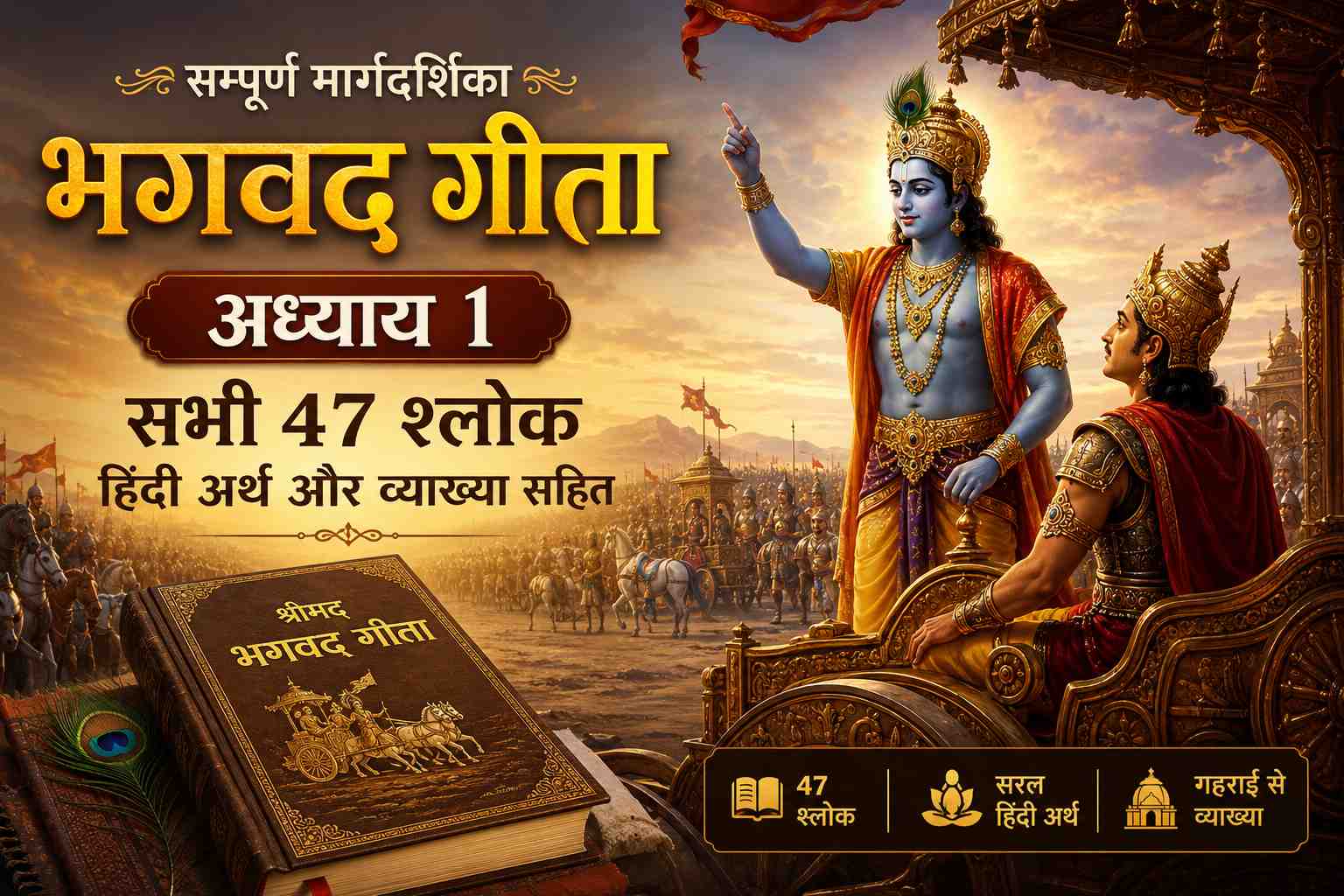
Verse 1.1: Dhritarashtra's Biased Inquiry
Sanskrit:
धृतराष्ट्र उवाच |
धर्मक्षेत्रे कुरुक्षेत्रे समवेता युयुत्सवः |
मामकाः पाण्डवाश्चैव किमकुर्वत सञ्जय || १ ||
Transliteration:
dhṛtarāṣṭra uvāca
dharmakṣetre kurukṣetre samavetā yuyutsavaḥ
māmakāḥ pāṇḍavāścaiva kim akurvata sañjaya (1.1)
English Meaning:
Dhritarashtra said: O Sanjaya, assembled on the sacred field of Kurukshetra, eager for battle, what did my sons and the sons of Pandu do?
Commentary:
The opening word 'Dharmakshetra' pairs with the concluding word 'Mama' in verse 18.78 to define 'Mama Dharma' (My Duty). Dhritarashtra's partisan bias emerges in separating 'my sons' (mamakah) from 'Pandu's sons' (pandavah), fearing the sacred land's righteousness might favor the Pandavas.
Verse 1.2: Duryodhana Approaches Dronacharya
Sanskrit:
सञ्जय उवाच |
दृष्ट्वा तु पाण्डवानीकं व्यूढं दुर्योधनस्तदा |
आचार्यमुपसङ्गम्य राजा वचनमब्रवीत् || २ ||
Transliteration:
sañjaya uvāca
dṛṣṭvā tu pāṇḍavānīkaṁ vyūḍhaṁ duryodhanas tadā
ācāryam upasaṅgamya rājā vacanam abravīt (1.2)
English Meaning:
Sanjaya said: Having seen the army of the Pandavas drawn up in military formation, King Duryodhana approached his teacher, Dronacharya, and spoke these words.
Commentary:
Despite having numerical superiority, Duryodhana is unsettled by the Pandavas' tight formation. He bypasses supreme commander Bhishma to confront his guru Dronacharya, seeking psychological reassurance.
Verse 1.3: Duryodhana's Sarcasm Towards the Teacher
Sanskrit:
पश्यैतां पाण्डुपुत्राणामाचार्य महतीं चमूम् |
व्यूढां द्रुपदपुत्रेण तव शिष्येण धीमता || ३ ||
Transliteration:
paśyaitāṁ pāṇḍu-putrāṇām ācārya mahatīṁ camūm
vyūḍhāṁ drupada-putreṇa tava śiṣyeṇa dhīmatā (1.3)
English Meaning:
Duryodhana said: Behold, O Master, this mighty army of the sons of Pandu, arranged in military formation by your intelligent disciple, the son of Drupada (Dhrishtadyumna).
Commentary:
Duryodhana sarcastically reminds Drona of his past leniency in training Dhrishtadyumna, who was destined to kill Drona, aiming to provoke the guru into showing no mercy to the Pandavas.
Verse 1.4: Pandava Heroes Equal to Bhima and Arjuna
Sanskrit:
अत्र शूरा महेष्वासा भीमार्जुनसमा युधि |
युयुधानो विराटश्च द्रुपदश्च महारथः || ४ ||
Transliteration:
atra śūrā maheṣv-āsā bhīmārjuna-samā yudhi
yuyudhāno virāṭaśca drupadaśca mahā-rathaḥ (1.4)
English Meaning:
Here in this army are heroic warriors and mighty archers equal in battle to Bhima and Arjuna: Yuyudhana (Satyaki), Virata, and the great Maharatha Drupada.
Commentary:
Duryodhana's anxious mind fixates on enemy strengths, naming Satyaki, Virata, and Drupada alongside the gold standards of martial strength: Bhima and Arjuna.
Verse 1.5: Allies of Valor and Righteousness
Sanskrit:
धृष्टकेतुश्चेकितानः काशिराजश्च वीर्यवान् |
पुरुजित्कुन्तिभोजश्च शैब्यश्च नरपुङ्गवः || ५ ||
Transliteration:
dhṛṣṭaketuś cekitānaḥ kāśirājaśca vīryavān
purujit kuntibhojaśca śaibyaśca nara-puṅgavaḥ (1.5)
English Meaning:
Dhrishtaketu, Chekitana, and the valorous King of Kashi; Purujit, Kuntibhoja, and Shaibya, the best of men.
Commentary:
Duryodhana catalogues the kings standing with the Pandavas: Dhrishtaketu of Chedi, Chekitana of the Yadavas, the King of Kashi, Kunti's brothers Purujit and Kuntibhoja, and Shaibya.
Verse 1.6: The Younger Generation of Stalwarts
Sanskrit:
युधामन्युश्च विक्रान्त उत्तमौजाश्च वीर्यवान् |
सौभद्रो द्रौपदेयाश्च सर्व एव महारथाः || ६ ||
Transliteration:
yudhāmanyuśca vikrānta uttamaujāśca vīryavān
saubhadro draupadeyāśca sarva eva mahā-rathāḥ (1.6)
English Meaning:
The courageous Yudhamanyu, the valorous Uttamauja, the son of Subhadra (Abhimanyu), and the sons of Draupadi—all without exception are great Maharathas.
Commentary:
Duryodhana notes that every single Pandava commander, including Arjuna's wheel-protectors Yudhamanyu and Uttamauja, Abhimanyu, and the five Upapandavas, commands the status of a Maharatha.
Verse 1.7: Duryodhana Turns to His Own Forces
Sanskrit:
अस्माकं तु विशिष्टा ये तान्निबोध द्विजोत्तम |
नायका मम सैन्यस्य संज्ञार्थं तान्ब्रवीमि ते || ७ ||
Transliteration:
asmākaṁ tu viśiṣṭā ye tān nibodha dvijottama
nāyakā mama sainyasya saṁjñārthaṁ tān bravīmi te (1.7)
English Meaning:
O best of the twice-born (Dronacharya), know also those who are the most distinguished among us, the leaders of my army. I shall now name them for your information.
Commentary:
Realizing his praise of the Pandavas might dampen spirits, Duryodhana addresses Drona as 'Dvijottama' to honor his priestly status while reminding him of his royal obligations.
Verse 1.8: Pillars of the Kaurava Might
Sanskrit:
भवान्भीष्मश्च कर्णश्च कृपश्च समितिञ्जयः |
अश्वत्थामा विकर्णश्च सौमदत्तिस्तथैव च || ८ ||
Transliteration:
bhavān bhīṣmaśca karṇaśca kṛpaśca samitiñ-jayaḥ
aśvatthāmā vikarṇaśca saumadattis tathaiva ca (1.8)
English Meaning:
Yourself (Dronacharya), Grandfather Bhishma, Karna, and Kripacharya, victorious in battle; as well as Ashwatthama, Vikarna, and the son of Somadatta (Bhurishrava).
Commentary:
Duryodhana lists his primary marshals: Drona, the invincible Bhishma, Karna, Kripacharya ('Samitin-jaya'), Ashwatthama, the just Vikarna, and Bhurishrava.
Verse 1.9: Warriors Ready to Die for Duryodhana
Sanskrit:
अन्ये च बहवः शूरा मदर्थे त्यक्तजीविताः |
नानाशास्त्रप्रहरणाः सर्वे युद्धविशारदाः || ९ ||
Transliteration:
anye ca bahavaḥ śūrā mad-arthe tyakta-jīvitāḥ
nānā-śāstra-praharaṇāḥ sarve yuddha-viśāradāḥ (1.9)
English Meaning:
And there are many other heroes who are prepared to lay down their lives for my sake. They are equipped with diverse weapons and are all accomplished experts in warfare.
Commentary:
Duryodhana boasts that many kings are 'mad-arthe tyakta-jivitah' (ready to surrender their lives for me). Unknowingly, his words pronounce the prophetic doom of his unrighteous army.
Verse 1.10: The Inadequacy of the Kaurava Army
Sanskrit:
अपर्याप्तं तदस्माकं बलं भीष्माभिरक्षितम् |
पर्याप्तं त्विदमेतेषां बलं भीमाभिरक्षितम् || १० ||
Transliteration:
aparyāptaṁ tad asmākaṁ balaṁ bhīṣmābhirakṣitam
paryāptaṁ tv idam eteṣāṁ balaṁ bhīmābhirakṣitam (1.10)
English Meaning:
Our army, protected by Grandfather Bhishma, is immeasurable/insufficient; while their army, protected by Bhima, is easy to measure/fully adequate.
Commentary:
'Aparyāptam' reflects Duryodhana's psychological slip: externally claiming his vast army is limitless, while his inner conscience fears it is inadequate against the moral strength of the Pandavas.
Verse 1.11: Command to Fortify Bhishma
Sanskrit:
अयनेषु च सर्वेषु यथाभागमवस्थिताः |
भीष्ममेवाभिरक्षन्तु भवन्तः सर्व एव हि || ११ ||
Transliteration:
ayaneṣu ca sarveṣu yathā-bhāgam avasthitāḥ
bhīṣmam evābhirakṣantu bhavantaḥ sarva eva hi (1.11)
English Meaning:
Therefore, stationed at your respective strategic positions in all the divisions of the army, all of you must protect Grandfather Bhishma alone from all sides.
Commentary:
Duryodhana orders all commanders to protect Bhishma's flanks, knowing the supreme commander is the singular pillar holding the entire coalition together.
Verse 1.12: Bhishma's Lion-Roar and Conch Blast
Sanskrit:
तस्य सञ्जनयन्हर्षं कुरुवृद्धः पितामहः |
सिंहनादं विनद्योच्चैः शङ्खं दध्मौ प्रतापवान् || १२ ||
Transliteration:
tasya sañjanayan harṣaṁ kuru-vṛddhaḥ pitāmahaḥ
siṁha-nādaṁ vinadyoccaiḥ śaṅkhaṁ dadhmau pratāpavān (1.12)
English Meaning:
Then, to cheer Duryodhana, the glorious grandfather of the Kuru dynasty, the eldest elder, roared loudly like a lion and blew his conch shell.
Commentary:
Sensing Duryodhana's hidden anxiety, Grandfather Bhishma roars like a lion and blows his conch, officially inaugurating the war to inspire his nervous grandson.
Verse 1.13: The Clamour of Kaurava Battle Instruments
Sanskrit:
ततः शङ्खाश्च भेर्यश्च पणवानकगोमुखाः |
सहसैवाभ्यहन्यन्त स शब्दस्तुमुलोऽभवत् || १३ ||
Transliteration:
tataḥ śaṅkhāśca bheryaśca paṇavānaka-gomukhāḥ
sahasaivābhyahanyanta sa śabdas tumulo 'bhavat (1.13)
English Meaning:
Immediately thereafter, conches, kettledrums, tabors, trumpets, and cow-horns blared forth all at once, and the resulting uproar was tumultuous.
Commentary:
The entire Kaurava front line sounds thousands of war drums (Bheri, Panava, Anaka) and trumpets (Gomukha) in a deafening display of military noise.
Verse 1.14: Krishna and Arjuna Sound Their Celestial Conches
Sanskrit:
ततः श्वेतैर्हयैर्युक्ते महति स्यन्दने स्थितौ |
माधवः पाण्डवश्चैव दिव्यौ शङ्खौ प्रदध्मतुः || १४ ||
Transliteration:
tataḥ śvetair hayair yukte mahati syandane sthitau
mādhavaḥ pāṇḍavaścaiva divyau śaṅkhau pradadhmatuḥ (1.14)
English Meaning:
Then, seated in a magnificent chariot drawn by white horses, Madhava (Lord Krishna) and the son of Pandu (Arjuna) blew their divine conch shells.
Commentary:
In contrast to the Kauravas' mortal blare, Krishna (Madhava) and Arjuna, seated upon their divine chariot gifted by Agni, sound their transcendental conches.
Verse 1.15: The Roar of Panchajanya, Devadatta, and Paundra
Sanskrit:
पाञ्चजन्यं हृषीकेशो देवदत्तं धनञ्जयः |
पौण्ड्रं दध्मौ महाशङ्खं भीमकर्मा वृकोदरः || १५ ||
Transliteration:
pāñcajanyaṁ hṛṣīkeśo devadattaṁ dhanañjayaḥ
pauṇḍraṁ dadhmau mahā-śaṅkhaṁ bhīma-karmā vṛkodaraḥ (1.15)
English Meaning:
Hrishikesha (Lord Krishna) blew his conch Panchajanya; Dhananjaya (Arjuna) blew Devadatta; and Bhima, the performer of mighty deeds, blew his colossal conch Paundra.
Commentary:
Lord Krishna blows Panchajanya (sound of primal cosmic order), Arjuna sounds the god-given Devadatta, and the mighty Bhima sounds his colossal conch Paundra.
Verse 1.16: Yudhishthira, Nakula, and Sahadeva Sound Their Conches
Sanskrit:
अनन्तविजयं राजा कुन्तीपुत्रो युधिष्ठिरः |
नकुलः सहदेवश्च सुघोषमणिपुष्पकौ || १६ ||
Transliteration:
anantavijayaṁ rājā kuntī-putro yudhiṣṭhiraḥ
nakulaḥ sahadevaśca sughoṣa-maṇipuṣpakau (1.16)
English Meaning:
King Yudhishthira, the son of Kunti, blew the Anantavijaya; while Nakula and Sahadeva blew the Sughosha and Manipushpaka conches respectively.
Commentary:
King Yudhishthira blows 'Anantavijaya' (Endless Victory of Dharma), Nakula sounds 'Sughosha' (Sweet-sounding), and Sahadeva sounds 'Manipushpaka' (Jewel-decked).
Verses 1.17 & 1.18: The Combined Roar of Pandava Allies
Sanskrit:
काश्यश्च परमेष्वासः शिखण्डी च महारथः |
धृष्टद्युम्नो विराटश्च सात्यकिश्चापराजितः || १७ ||
द्रुपदो द्रौपदेयाश्च सर्वशः पृथिवीपते |
सौभद्रश्च महाबाहुः शङ्खान्दध्मुः पृथक् पृथक् || १८ ||
Transliteration:
kāśyaśca parameṣv-āsaḥ śikhaṇḍī ca mahā-rathaḥ
dhṛṣṭadyumno virāṭaśca sātyakiścāparājitaḥ (1.17)
drupado draupadeyāśca sarvaśaḥ pṛthivī-pate
saubhadraśca mahā-bāhuḥ śaṅkhān dadhmuḥ pṛthak pṛthak (1.18)
English Meaning:
O Lord of the Earth, the King of Kashi, Shikhandi the Maharatha, Dhrishtadyumna, Virata, the unconquered Satyaki, Drupada, the sons of Draupadi, and the mighty Abhimanyu—all blew their conches from every direction.
Commentary:
Every major ally of the Pandavas sounds their conch, presenting an unbroken, harmonized front of righteous resolve.
Verse 1.19: The Conches Shatter the Hearts of Kauravas
Sanskrit:
स घोषो धार्तराष्ट्राणां हृदयानि व्यदारयत् |
नभश्च पृथिवीं चैव तुमुलो व्यनुनादयन् || १९ ||
Transliteration:
sa ghoṣo dhārtarāṣṭrāṇāṁ hṛdayāni vyadārayat
nabhaśca pṛthivīṁ caiva tumulo vyanunādayan (1.19)
English Meaning:
That tumultuous sound, reverberating through earth and sky, shattered the hearts of the sons of Dhritarashtra.
Commentary:
The resonance of Krishna and Pandavas' conches pierces the guilty consciences of Dhritarashtra's sons, breaking their morale before a single weapon is discharged.
Verse 1.20: Arjuna Raises His Bow as Missiles Are Poised to Fly
Sanskrit:
अथ व्यवस्थितान्दृष्ट्वा धार्तराष्ट्रान्कपिध्वजः |
प्रवृत्ते शस्त्रसम्पाते धनुरुद्यम्य पाण्डवः || २० ||
Transliteration:
atha vyavasthitān dṛṣṭvā dhārtarāṣṭrān kapi-dhvajaḥ
pravṛtte śastra-sampāte dhanur udyamya pāṇḍavaḥ (1.20)
English Meaning:
Then, looking at the sons of Dhritarashtra standing arrayed and the flight of missiles about to begin, Arjuna, bearing the monkey banner of Hanuman, raised his bow.
Commentary:
As the battle is about to commence, Arjuna ('Kapidhwaja', on whose flag Lord Hanuman sits) lifts his bow Gandiva to enter the fray.
Verses 1.21 & 1.22: Arjuna Asks Krishna to Place the Chariot in the Middle
Sanskrit:
हृषीकेशं तदा वाक्यमिदमाह महीपते |
अर्जुन उवाच |
सेनयोरुभयोर्मध्ये रथं स्थापय मेऽच्युत || २१ ||
यावदेतान्निरीक्षेऽहं योद्धुकामानवस्थितान् |
कैर्मया सह योद्धव्यमस्मिन् रणसमुद्यमे || २२ ||
Transliteration:
hṛṣīkeśaṁ tadā vākyam idam āha mahī-pate
arjuna uvāca
senayor ubhayor madhye rathaṁ sthāpaya me 'cyuta (1.21)
yāvad etān nirīkṣe 'haṁ yoddhu-kāmān avasthitān
kair mayā saha yoddhavyam asmin raṇa-samudyame (1.22)
English Meaning:
Arjuna said: O Infallible One (Achyuta), please place my chariot between both armies so that I may behold those standing eager to fight, and know with whom I must contend.
Commentary:
Arjuna calls Krishna 'Achyuta' (infallible). Confident in his warrior prowess, Arjuna desires to survey the opposition from the neutral center of the battlefield.
Verse 1.23: Inspecting Duryodhana's Warmongering Allies
Sanskrit:
योत्स्यमानानवेक्षेऽहं य एतेऽत्र समागताः |
धार्तराष्ट्रस्य दुर्बुद्धेर्युद्धे प्रियचिकीर्षवः || २३ ||
Transliteration:
yotsyamānān avekṣe 'haṁ ya ete 'tra samāgatāḥ
dhārtarāṣṭrasya durbuddher yuddhe priya-cikīrṣavaḥ (1.23)
English Meaning:
Let me look upon those who have assembled here to fight, desiring to please the evil-minded son of Dhritarashtra in this battle.
Commentary:
Arjuna refers to Duryodhana as 'Durbuddhi' (evil-minded), viewing the assembled kings as misguided lackeys enabling an unjust regime.
Verse 1.24: Krishna Drives the Chariot Between the Armies
Sanskrit:
सञ्जय उवाच |
एवमुक्तो हृषीकेशो गुडाकेशेन भारत |
सेनयोरुभयोर्मध्ये स्थापयित्वा रथोत्तमम् || २४ ||
Transliteration:
sañjaya uvāca
evam ukto hṛṣīkeśo guḍākeśena bhārata
senayor ubhayor madhye sthāpayitvā rathottamam (1.24)
English Meaning:
Sanjaya said: O descendant of Bharata, thus addressed by Gudakesha (Arjuna), Hrishikesha (Lord Krishna) drove that splendid chariot between both armies.
Commentary:
Krishna (Hrishikesha, master of the senses) obeys Arjuna (Gudakesha, conqueror of sleep), placing the chariot squarely in the middle ground.
Verse 1.25: Facing Bhishma, Drona, and the Assembled Kings
Sanskrit:
भीष्मद्रोणप्रमुखतः सर्वेषां च महीक्षिताम् |
उवाच पार्थ पश्यैतान्समवेतान्कुरूनिति || २५ ||
Transliteration:
bhīṣma-droṇa-pramukhataḥ sarveṣāṁ ca mahī-kṣitām
uvāca pārtha paśyaitān samavetān kurūn iti (1.25)
English Meaning:
Stationed before Bhishma, Drona, and all the rulers of earth, the Lord said: 'O Partha, behold these assembled Kurus!'
Commentary:
Krishna deliberately parks directly before Bhishma and Drona and says 'Behold the Kurus', intentionally triggering Arjuna's dormant emotional attachments.
Verse 1.26: Arjuna Surveys Fathers, Grandfathers, and Kin
Sanskrit:
तत्रापश्यत्स्थितान्पार्थः पितॄनथ पितामहान् |
आचार्यान्मातुलान्भ्रातॄन्पुत्रान्पौत्रान्सखींस्तथा || २६ ||
श्वशुरान्सुहृदश्चैव सेनयोरुभयोरपि |
Transliteration:
tatrāpaśyat sthitān pārthaḥ pitṝn atha pitāmahān
ācāryān mātulān bhrātṝn putrān pautrān sakhīṁs tathā
śvaśurān suhṛdaścaiva senayor ubhayor api (1.26)
English Meaning:
There Arjuna saw stationed in both armies fathers, grandfathers, teachers, maternal uncles, brothers, sons, grandsons, companions, fathers-in-law, and friends.
Commentary:
Arjuna's warrior perspective dissolves as he looks across the lines and realizes the war will annihilate his own teachers, uncles, nephews, and friends.
Verse 1.27: Overwhelmed by Misplaced Compassion and Despair
Sanskrit:
तान्समीक्ष्य स कौन्तेयः सर्वान्बन्धूनवस्थितान् |
कृपया परयाविष्टो विषीदन्निदमब्रवीत् || २७ ||
Transliteration:
tān samīkṣya sa kaunteyaḥ sarvān bandhūn avasthitān
kṛpayā parayāviṣṭo viṣīdann idam abravīt (1.27)
English Meaning:
Seeing all these relatives assembled, the son of Kunti was overwhelmed with deep compassion and spoke thus in anguish.
Commentary:
Arjuna is gripped by 'Kripaya paraya' (intense pity). This is not spiritual empathy, but Moha (attachment born of bodily identification with his clan).
Verse 1.28: Failing Limbs and Parched Mouth
Sanskrit:
अर्जुन उवाच |
दृष्ट्वेमं स्वजनं कृष्ण युयुत्सुं समुपस्थितम् |
सीदन्ति मम गात्राणि मुखं च परिशुष्यति || २८ ||
Transliteration:
arjuna uvāca
dṛṣṭvemaṁ sva-janaṁ kṛṣṇa yuyutsuṁ samupasthitam
sīdanti mama gātrāṇi mukhaṁ ca pariśuṣyati (1.28)
English Meaning:
Arjuna said: O Krishna, seeing my own kinsmen gathered here eager to fight, my limbs give way and my mouth is parched dry.
Commentary:
Arjuna uses the possessive term 'Svajanam' (my people). The acute emotional trauma triggers psychosomatic distress, causing physical weakness and extreme dry mouth.
Verse 1.29: Trembling Body, Horripilation, and the Slipping Bow
Sanskrit:
वेपथुश्च शरीरे मे रोमहर्षश्च जायते |
गाण्डीवं स्रंसते हस्तात्त्वक्चैव परिदह्यते || २९ ||
Transliteration:
vepathuśca śarīre me roma-harṣaśca jāyate
gāṇḍīvaṁ sraṁsate hastāt tvak caiva paridahyate (1.29)
English Meaning:
My body trembles, my hair stands on end, the bow Gandiva slips from my hand, and my skin burns all over.
Commentary:
Arjuna experiences acute autonomic shock: trembling, chills, burning skin, and the loss of physical grip as the celestial Gandiva slips from his hands.
Verse 1.30: Inability to Stand and Adverse Omens
Sanskrit:
न च शक्नोम्यवस्थातुं भ्रमतीव च मे मनः |
निमित्तानि च पश्यामि विपरीतानि केशव || ३० ||
Transliteration:
na ca śaknomy avasthātuṁ bhramatīva ca me manaḥ
nimittāni ca paśyāmi viparītāni keśava (1.30)
English Meaning:
I am unable to stand steady, my mind is reeling, and I see only adverse omens, O Keshava.
Commentary:
Arjuna experiences severe dizziness and disorientation ('bhramativa ca me manah'), projecting his internal grief onto external omens ('viparītāni nimittāni').
Verse 1.31: Renunciation of Victory and Royal Pleasures
Sanskrit:
न च श्रेयोऽनुपश्यामि हत्वा स्वजनमाहवे |
न काङ्क्षे विजयं कृष्ण न च राज्यं सुखानि च || ३१ ||
Transliteration:
na ca śreyo 'nupaśyāmi hatvā sva-janam āhave
na kāṅkṣe vijayaṁ kṛṣṇa na ca rājyaṁ sukhāni ca (1.31)
English Meaning:
I do not see how any good (Shreyas) can come from killing my own kinsmen in battle; nor do I desire victory, O Krishna, nor kingdom, nor pleasures.
Commentary:
Arjuna claims that slaughtering kin yields no spiritual good ('Shreyas'). In pseudo-renunciation, he rejects political victory and worldly delights.
Verse 1.32: What Use is Kingdom or Life Itself?
Sanskrit:
किं नो राज्येन गोविन्द किं भोगैर्जीवितेन वा |
येषामर्थे काङ्क्षितं नो राज्यं भोगाः सुखानि च || ३२ ||
Transliteration:
kiṁ no rājyena govinda kiṁ bhogair jīvitena vā
yeṣām arthe kāṅkṣitaṁ no rājyaṁ bhogāḥ sukhāni ca (1.32)
English Meaning:
O Govinda, of what use to us is kingdom, or pleasures, or even life itself? For those for whose sake we desire kingdom and pleasures stand here in battle.
Commentary:
Arjuna addresses Krishna as 'Govinda' (pleaser of the senses), arguing that power and luxury are meaningless without family to share them with.
Verse 1.33: The Array of Elders and Children
Sanskrit:
त इमेऽवस्थिता युद्धे प्राणांस्त्यक्त्वा धनानि च |
आचार्याः पितरः पुत्रास्तथैव च पितामहाः || ३३ ||
Transliteration:
ta ime 'vasthitā yuddhe prāṇāṁs tyaktvā dhanāni ca
ācāryāḥ pitaraḥ putrās tathaiva ca pitāmahāḥ (1.33)
English Meaning:
Teachers, fathers, sons, and grandfathers—all stand here in battle, having staked their very lives and wealth.
Commentary:
Arjuna laments that three generations of mentors, fathers, sons, and grandfathers are gathered on the battlefield, prepared to perish.
Verse 1.34: Refusing to Strike Even if Struck
Sanskrit:
मातुलाः श्वशुराः पौत्राः श्यालाः सम्बन्धिनस्तथा |
एतान्न हन्तुमिच्छामि घ्नतोऽपि मधुसूदन || ३४ ||
Transliteration:
mātulāḥ śvaśurāḥ pautrāḥ śyālāḥ sambandhinas tathā
etān na hantum icchāmi ghnato 'pi madhusūdana (1.34)
English Meaning:
Maternal uncles, fathers-in-law, grandsons, brothers-in-law, and relatives—even if they kill me, O Madhusudana, I do not wish to slay them.
Commentary:
Arjuna surrenders his warrior instincts, declaring to 'Madhusudana' that he will not strike back even if attacked by his own uncles and relatives.
Verse 1.35: Renouncing the Empire of the Three Worlds
Sanskrit:
अपि त्रैलोक्यराज्यस्य हेतोः किं नु महीकृते |
निहत्य धार्तराष्ट्रान्नः का प्रीतिः स्याज्जनार्दन || ३५ ||
Transliteration:
api trailokya-rājyasya hetoḥ kiṁ nu mahī-kṛte
nihatya dhārtarāṣṭrān naḥ kā prītiḥ syāj janārdana (1.35)
English Meaning:
Even for sovereignty over the three worlds, let alone for this earth, I will not slay them. What joy can be ours, O Janardana, by killing the sons of Dhritarashtra?
Commentary:
Arjuna claims that even cosmic dominion over the three worlds cannot bring joy ('ka pritih syat') if purchased through the massacre of his cousins.
Verse 1.36: Fear of Sin in Slaying Aggressors
Sanskrit:
पापमेवाश्रयेदस्मान्हत्वैतानाततायिनः |
तस्मान्नार्हा वयं हन्तुं धार्तराष्ट्रान्स्वबान्धवान् |
स्वजनं हि कथं हत्वा सुखिनः स्याम माधव || ३६ ||
Transliteration:
pāpam evāśrayed asmān hatvaitān ātatāyinaḥ
tasmān nārha vayaṁ hantuṁ dhārtarāṣṭrān sa-bāndhavān
sva-janaṁ hi kathaṁ hatvā sukhinaḥ syāma mādhava (1.36)
English Meaning:
Sin alone will overtake us if we slay these aggressors (Atatayis). Therefore, we ought not kill our own relatives, the sons of Dhritarashtra. How can we be happy by killing our kin, O Madhava?
Commentary:
Arjuna acknowledges the Kauravas are 'Atatayis' (felons/aggressors), yet his clouded mind fears that executing them will bring spiritual sin ('Papam').
Verses 1.37 & 1.38: Blinding Greed vs. Conscious Wisdom
Sanskrit:
यद्यप्येते न पश्यन्ति लोभोपहतचेतसः |
कुलक्षयकृतं दोषं मित्रद्रोहे च पातकम् || ३७ ||
कथं न ज्ञेयमस्माभिः पापादस्मान्निवर्तितुम् |
कुलक्षयकृतं दोषं प्रपश्यद्भिर्जनार्दन || ३८ ||
Transliteration:
yady apy ete na paśyanti lobhopahata-cetasaḥ
kula-kṣaya-kṛtaṁ doṣaṁ mitra-drohe ca pātakam (1.37)
kathaṁ na jñeyam asmābhiḥ pāpād asmān nivartitum
kula-kṣaya-kṛtaṁ doṣaṁ prapaśyadbhir janārdana (1.38)
English Meaning:
Even if these men, blinded by greed, see no fault in destroying a lineage or sin in treachery to friends, why should we, who clearly see the evil of family destruction, not turn away from this sin, O Janardana?
Commentary:
Arjuna argues that while Kauravas are blinded by greed ('lobhopahata-cetasah'), the Pandavas know better and must actively retreat from fratricide.
Verse 1.39: Destruction of Lineage Destroys Sacred Traditions
Sanskrit:
कुलक्षये प्रणश्यन्ति कुलधर्माः सनातनाः |
धर्मे नष्टे कुलं कृत्स्नमधर्मोऽभिभवत्युत || ३९ ||
Transliteration:
kula-kṣaye praṇaśyanti kula-dharmāḥ sanātanāḥ
dharme naṣṭe kulaṁ kṛtsnam adharmo 'bhibhavaty uta (1.39)
English Meaning:
With the destruction of the family, the eternal family traditions (Kula-dharma) perish. When Dharma is destroyed, unrighteousness overtakes the entire remaining lineage.
Commentary:
Arjuna outlines the sociological fallout of war: the annihilation of elders destroys the transmission of virtues, allowing Adharma to corrupt future generations.
Verse 1.40: Rise of Unrighteousness and Social Disruption
Sanskrit:
अधर्माभिभवात्कृष्ण प्रदुष्यन्ति कुलस्त्रियः |
स्त्रीषु दुष्टासु वार्ष्णेय जायते वर्णसङ्करः || ४० ||
Transliteration:
adharmābhibhavāt kṛṣṇa praduṣyanti kula-striyaḥ
strīṣu duṣṭāsu vārṣṇeya jāyate varṇa-saṅkaraḥ (1.40)
English Meaning:
When unrighteousness prevails, O Krishna, the women of the family become vulnerable and corrupted; and from the degradation of women, O descendant of Vrishni, arises the confusion of lineages (Varna-sankara).
Commentary:
Arjuna emphasizes that the loss of protective righteous male elders leads to the vulnerability and exploitation of women, resulting in social chaos.
Verse 1.41: Deprivation of Ancestral Offerings
Sanskrit:
सङ्करो नरकायैव कुलघ्नानां कुलस्य च |
पतन्ति पितरो ह्येषां लुप्तपिण्डोदकक्रियाः || ४१ ||
Transliteration:
saṅkaro narakāyaiva kula-ghnānāṁ kulasya ca
patanti pitaro hy eṣāṁ lupta-piṇḍodaka-kriyāḥ (1.41)
English Meaning:
Such disorder drags both the destroyers of the family and the lineage into hellish suffering. Deprived of sacred offerings of food and water (Pinda and Tarpana), departed ancestors fall from grace.
Commentary:
Arjuna worries that without righteous descendants to perform annual Shraddha and Tarpan rites, the spiritual connection with ancestors is broken.
Verse 1.42: Eradication of Community and Family Virtues
Sanskrit:
दोषैरेतैः कुलघ्नानां वर्णसङ्करकारकैः |
उत्साद्यन्ते जातिधर्माः कुलधर्माश्च शाश्वताः || ४२ ||
Transliteration:
doṣair etaiḥ kula-ghnānāṁ varṇa-saṅkara-kārakaiḥ
utsādyante jāti-dharmāḥ kula-dharmāśca śāśvatāḥ (1.42)
English Meaning:
Through these evil deeds of the destroyers of the family, causing societal chaos, the eternal community virtues (Jati-dharma) and sacred family traditions (Kula-dharma) are completely ruined.
Commentary:
Arjuna laments that war tears down the two pillars of civilization: Kula-dharma (family values) and Jati-dharma (community civic duties).
Verse 1.43: Scriptural Warning of Abode in Hell
Sanskrit:
उत्सन्नकुलधर्माणां मनुष्याणां जनार्दन |
नरकेऽनियतं वासो भवतीत्यनुशुश्रुम || ४३ ||
Transliteration:
utsanna-kula-dharmāṇāṁ manuṣyāṇāṁ janārdana
narake 'niyataṁ vāso bhavatīty anuśuśruma (1.43)
English Meaning:
O Janardana, we have heard through sacred disciplic tradition that those whose family traditions are destroyed must dwell indefinitely in hell.
Commentary:
Arjuna invokes scriptural authority ('anushushruma'—as we have heard through tradition) to justify his refusal to engage in righteous battle.
Verse 1.44: Grief Over Committing Sins for Royal Luxuries
Sanskrit:
अहो बत महत्पापं कर्तुं व्यवसिता वयम् |
यद्राज्यसुखलोभेन हन्तुं स्वजनमुद्यताः || ४४ ||
Transliteration:
aho bata mahat pāpaṁ kartuṁ vyavasitā vayam
yad rājya-sukha-lobhena hantuṁ sva-janam udyatāḥ (1.44)
English Meaning:
Alas, what a terrible sin we are determined to commit, ready to slaughter our own kinsmen out of greed for royal pleasure!
Commentary:
Arjuna reduces the cosmic battle for universal righteousness into a petty, greedy grab for political territory ('rajya-sukha-lobha').
Verse 1.45: Better to Be Slain Unarmed and Unopposed
Sanskrit:
यदि मामप्रतीकारमशस्त्रं शस्त्रपाणयः |
धार्तराष्ट्रा रणे हन्युस्तन्मे क्षेमतरं भवेत् || ४५ ||
Transliteration:
yadi mām apratīkāram aśastraṁ śastra-pāṇayaḥ
dhārtarāṣṭrā raṇe hanyus tan me kṣemataraṁ bhavet (1.45)
English Meaning:
It would be far better for me if the armed sons of Dhritarashtra should strike me down in battle while I stand unarmed and unresisting.
Commentary:
Arjuna declares that passive execution while unarmed ('ashastram') and unresisting ('apratikaram') is spiritually superior to defending Dharma.
Verse 1.46: Arjuna Sits Down in the Chariot, Casting Down Bow and Arrow
Sanskrit:
सञ्जय उवाच |
एवमुक्त्वार्जुनः सङ्ख्ये रथोपस्थ उपाविशत् |
विसृज्य सशरं चापं शोकसंविग्नमानसः || ४६ ||
Transliteration:
sañjaya uvāca
evam uktvārjunaḥ saṅkhye rathopastha upāviśat
visṛjya sa-śaraṁ cāpaṁ śoka-saṁvigna-mānasaḥ (1.46)
English Meaning:
Sanjaya said: Having spoken thus on the battlefield, Arjuna cast aside his bow and arrows and sat down on the chariot seat, his mind overwhelmed with sorrow.
Commentary:
Arjuna drops his celestial Gandiva bow and arrows ('visrijya sa-sharam chapam') and collapses onto the seat of the chariot, overwhelmed by intense grief.
Verse 1.47: The Concluding Seal of Arjuna Vishada Yoga
Sanskrit Colophon / Verse 1.47 Summary:
तस्मात् न योत्स्ये इति गोविन्दमुक्त्वा तूष्णीं बभूव ह ||
(ॐ तत्सदिति श्रीमद्भगवद्गीतासूपनिषत्सु ब्रह्मविद्यायां योगशास्त्रे श्रीकृष्णार्जुनसंवादे 'अर्जुनविषादयोगो' नाम प्रथमोऽध्यायः ||)
English Meaning:
Having said to Govinda, 'I shall not fight,' Arjuna became completely silent. Thus ends Chapter 1, titled 'Arjuna Vishada Yoga', in the Upanishad of the Bhagavad Gita, the scripture of Yoga.
Commentary:
Chapter 1 concludes with Arjuna's silence. His despair is elevated to a 'Yoga' because it shatters human ego and readies his soul for divine wisdom.