The Science of Sound and Vibrational Healing
Everything in the known universe, including the cells in your physical body and the thoughts in your mind, is fundamentally composed of energy vibrating at specific frequencies. This is not merely a spiritual philosophy, but a proven principle of quantum physics. When we experience physical illness, emotional trauma, or mental exhaustion, our natural vibrational frequency drops, putting us out of harmony with our true, healthy state. The science of sound healing operates on the principle of 'entrainment', where a stronger, rhythmic vibration can synchronize a weaker, chaotic one. When you chant a Sanskrit mantra, you are producing a highly structured, mathematically precise sound wave that reverberates through the water in your body (which constitutes about 70% of your physical form). This resonance massages your internal organs, stimulates the vagus nerve, and activates the parasympathetic nervous system, instantly signaling to your brain that it is safe to relax and heal. Furthermore, the specific phonetic structure of Sanskrit is uniquely designed to stimulate different meridian points (nadis) on the roof of the mouth, which directly communicate with the hypothalamus and pituitary gland in the brain. Thus, mantra chanting is a holistic physiological and neurological therapy that naturally regulates hormones, dramatically lowers cortisol levels, and flushes the body with endorphins, establishing a perfect biological environment for deep spiritual awakening.
The Universal Frequency: Understanding OM (AUM)
The most fundamental and powerful of all mantras is the sacred syllable OM (often spelled AUM). According to ancient yogic texts, OM is the primordial sound of creation—the original vibration from which the entire cosmos emanated and into which it will eventually dissolve. Chanting OM is not tied to any specific religion; it is a universal phonetic phenomenon that aligns the individual soul with the cosmic consciousness. The sound is composed of three distinct syllables, each representing different states of consciousness and aspects of the divine. 'A' (pronounced 'ahh') originates from the base of the throat and represents the waking state and the physical realm. 'U' (pronounced 'ooh') rolls forward through the mouth, symbolizing the dream state and the subtle energetic realm. 'M' (pronounced 'mmm') finishes at the lips, representing the state of deep, dreamless sleep and the causal realm. When chanted together, they transition into a fourth, silent phase known as 'Turiya', which represents the ultimate state of pure, non-dual consciousness—the silent witness behind all existence. Regular chanting of OM clears mental fog, unblocks the Third Eye chakra, and fosters an unshakeable sense of cosmic unity. By dedicating just ten minutes a day to chanting OM, a householder can experience a dramatic reduction in mental chatter and a profound deepening of their daily meditation practice.
How to Establish a Daily Japa Meditation Practice
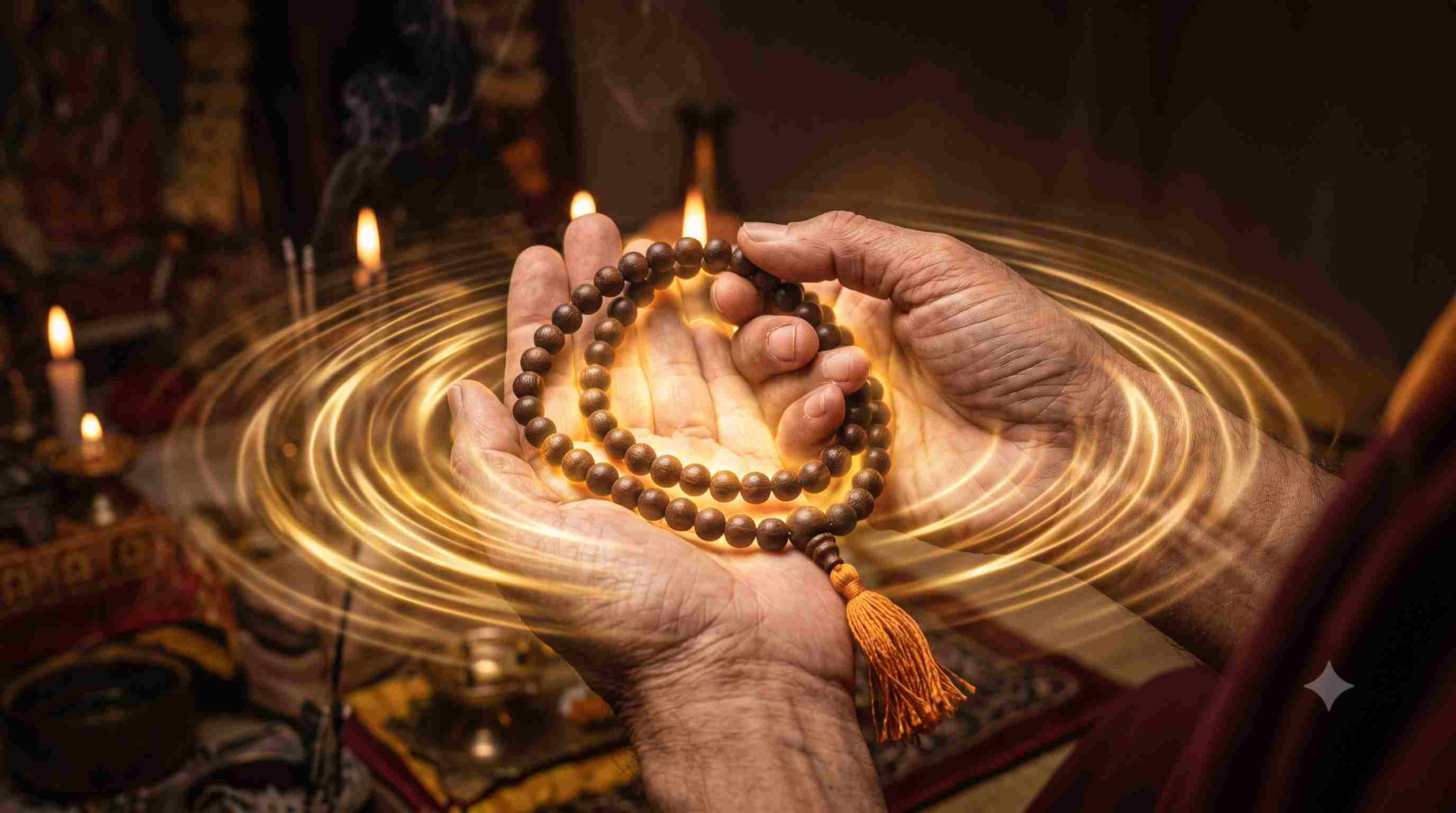
To fully harness the transformative power of sacred sounds, one must engage in 'Japa'—the disciplined, repetitive recitation of a mantra. Establishing a daily Japa meditation practice is remarkably accessible and highly beneficial for busy individuals. Begin by selecting a serene, quiet space in your home, preferably your dedicated altar or mandir, where you will not be disturbed. Sit comfortably with your spine erect to allow energy (Prana) to flow freely. Traditionally, Japa is performed using a Mala—a string of 108 beads, often made of Rudraksha seeds, Tulsi wood, or crystals. Holding the mala in your right hand, use your thumb and middle finger to advance one bead per recitation, deliberately avoiding the use of the index finger, which symbolizes the ego. The number 108 is considered highly auspicious in Vedic mathematics, representing the universe's ultimate reality. If you are a beginner, start with one full round of the mala, which takes roughly ten to fifteen minutes depending on the mantra. Consistency is far more critical than volume; chanting one round every morning at the same time creates a powerful energetic momentum. As you chant, fix your inner gaze on the space between your eyebrows (the Third Eye) and let the vibration of the mantra completely absorb your attention. When the mind inevitably wanders, gently guide it back to the sound, treating the mantra as an anchor in the turbulent sea of thoughts.
Transformative Mantras for Everyday Spiritual Wellness
While OM is the foundational sound, there are numerous other specific mantras tailored for various aspects of spiritual and worldly life. For intellectual clarity, spiritual illumination, and dispelling ignorance, the Gayatri Mantra is unparalleled. It is a powerful solar invocation that asks the divine light to inspire and awaken our intellect. For physical healing, emotional resilience, and overcoming the deep-seated fear of death or failure, the Maha Mrityunjaya Mantra is considered the ultimate shield of protection. If you are seeking to remove obstacles, clear the path for new endeavors, and cultivate a sense of grounded wisdom, chanting the Ganesha Mantra ('Om Gam Ganapataye Namaha') is highly recommended for householders embarking on new business ventures or life transitions. You do not need to learn them all at once. The most effective approach is to choose one mantra that resonates deeply with your current life situation and commit to it exclusively for at least 40 days (a traditional period for breaking old habits and forging new neural pathways). As the sound embeds itself into your subconscious, you will begin to hear it echoing in your mind even when you are not actively chanting—a state known as 'Ajapa Japa'. This continuous inner resonance transforms your everyday activities into an ongoing state of meditation, enveloping your life in a profound, protective field of spiritual grace.