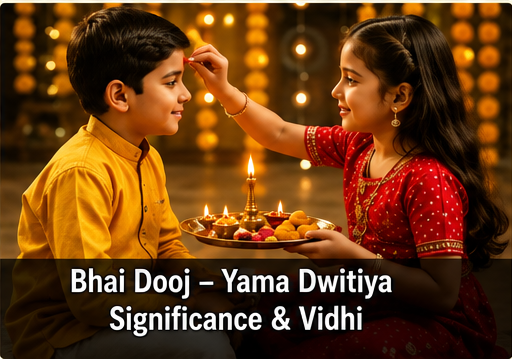
The Eternal Bond of Sibling Love: The Significance of Bhai Dooj (Yama Dwitiya)
As the grand, five-day festival of Diwali draws to a close, the illuminating festivities culminate in a beautiful and deeply emotional celebration known as Bhai Dooj, Yama Dwitiya, or Bhai Tika. Celebrated on the second lunar day (Dwitiya) of the bright fortnight (Shukla Paksha) in the Hindu month of Kartik, this festival honors the unconditional love, protective bond, and lifelong companionship between brothers and sisters. Unlike Raksha Bandhan, where a sacred thread is tied, Bhai Dooj revolves entirely around the application of a holy tilak and a shared feast, symbolizing a sister's powerful prayers for her brother's long, prosperous, and fearless life.
The Mythological Origins: The Immortal Legend of Yama and Yamuna
The deepest spiritual roots of this festival lie in the ancient Puranic story of Yamaraj, the God of Death and Justice, and his beloved sister, Goddess Yamuna (the sacred river). For a very long time, Yamaraj had been unable to visit his sister due to the immense burden of his cosmic duties. Yearning for her brother's presence, Yamuna repeatedly sent him heartfelt invitations.
Finally, on the second day after the new moon of Kartik, Yamaraj found the time to visit her. Overjoyed by his arrival, Yamuna welcomed him with immense devotion. She applied a radiant tilak on his forehead, performed his aarti, and prepared a massive, delicious feast for him with her own hands. Deeply moved by his sister's pure love and the warmth of her hospitality, Yamaraj asked her to ask for any boon.
"O Lord of Justice," Yamuna smiled, "I only ask that you visit me on this day every year. And furthermore, any brother who receives a tilak from his sister on this day, and bathes in my waters, shall never face the fear of premature death (Akal Mrityu) or the torments of hell."
Yamaraj happily granted this profound boon, declaring that the bond of siblings is stronger than death itself. This is why the festival is reverently known as Yama Dwitiya.
Another Legend: Lord Krishna and Mata Subhadra
Another popular legend associated with Bhai Dooj traces back to the Dwapara Yuga. After fiercely battling and defeating the demon king Narakasura (on Naraka Chaturdashi), Lord Krishna visited his beloved sister, Subhadra. Thrilled by her brother's triumphant return and to cool his battle-weary aura, Subhadra welcomed Him with a traditional aarti, applied a protective tilak of victory on His forehead, and showered Him with flowers and sweets. This beautiful gesture of love and triumph continues to inspire the rituals of Bhai Dooj today.
Bhai Dooj 2026: Date & Shubh Muhurat
The timing of the tilak is considered highly auspicious, usually falling in the afternoon (Aparahna time). For the year 2026, following the Diwali celebrations, this heartwarming festival will be observed with great joy:
- Date: Tuesday, November 10, 2026
- Auspicious Tilak Muhurat (Aparahna): Traditionally observed between 1:10 PM and 3:20 PM (exact local timings may vary slightly).
The Sacred Rituals (Tilak Vidhi)
The rituals of Bhai Dooj are simple yet profound, focusing entirely on the purity of intent and familial warmth:
- The Sacred Seat: The brother is seated on a wooden pedestal (Asan), often made of rice flour motifs.
- The Tilak and Aarti: The sister applies a tilak made of vermilion (Roli), sandalwood paste, and unbroken rice (Akshat) on her brother's forehead. She then performs his aarti, holding a plate decorated with flowers, betel nuts, and a lit diya, praying for his long life.
- The Exchange of Sweets and Gifts: The sister feeds her brother a piece of sweet (often placing a dry coconut in his hands in some traditions). In return, the brother touches her feet (if she is older) or blesses her, promising to protect and support her always, and presents her with beautiful gifts as a token of his love.
- The Grand Feast: The day concludes with the siblings enjoying a lavish, home-cooked meal together, reminiscing about their childhood memories.
Bhai Dooj reminds us that no matter how old we grow or how far life takes us, the bond shared with our siblings remains a timeless anchor of love, shared history, and eternal support.