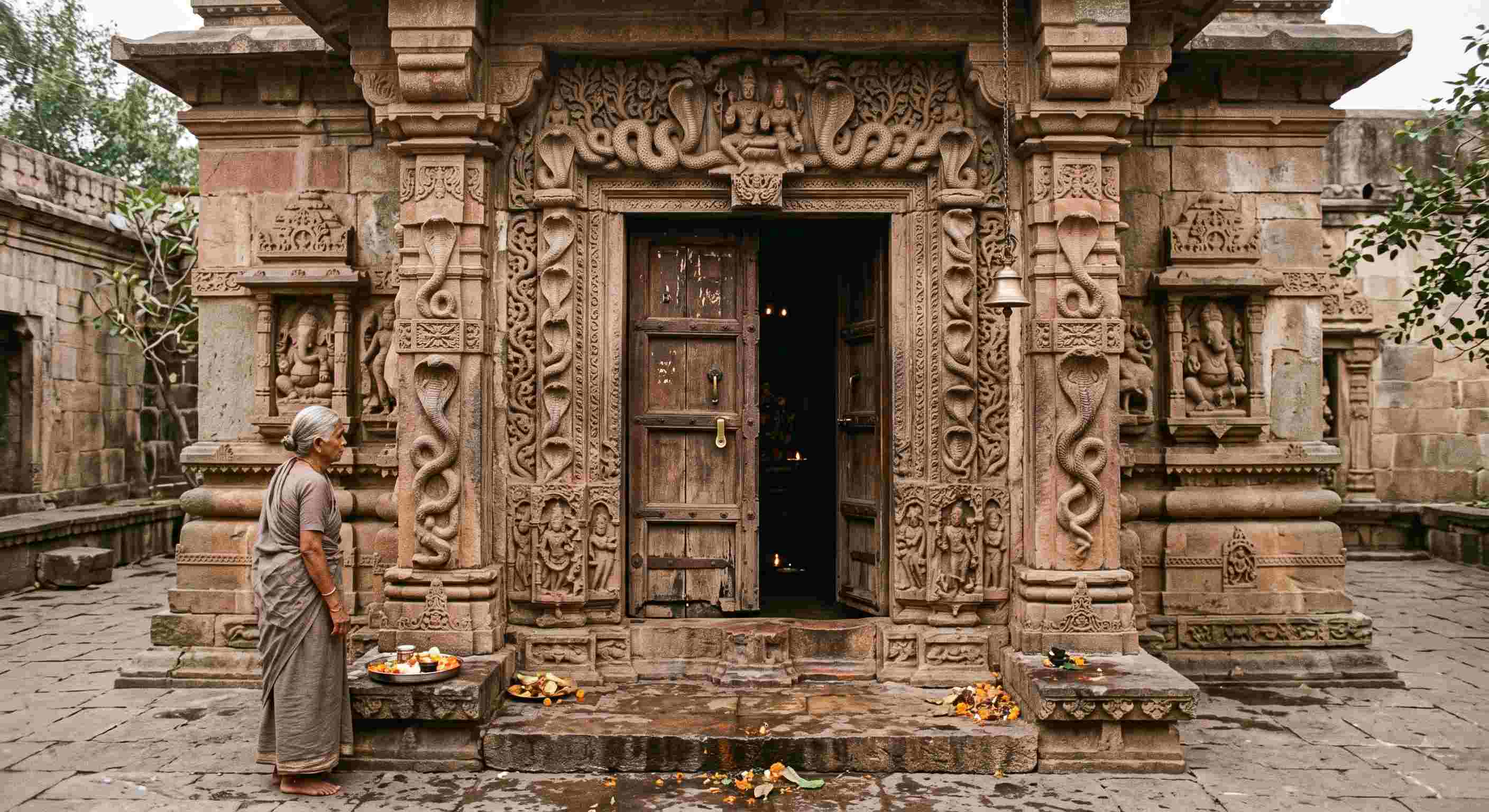
The Legend of Takshak Nag's Penance
According to Hindu scriptures and the Shiva Purana, Takshak Nag—the supreme king of serpents—sought deliverance from mortality and the cosmic conflicts surrounding his lineage. In pursuit of absolute tranquility, Takshak traveled to the sanctified Mahakal forest (Mahakal Van) in Avantika, which is today's Ujjain.
There, he undertook rigorous, unbroken penance for centuries, meditating deeply upon Lord Shiva. Overwhelmed by Takshak's devotion and endurance, Mahadev manifested before him. Lord Shiva bestowed upon him the boon of immortality, appointing him as a revered guardian spirit eternally dwelling within the Mahakal precinct. This profound mythological root significantly shapes the importance of mahakaleshwar temple ujjain for millions of devotees globally.
The Divine Covenant: The Promise of Solitude
Despite receiving immortality, Takshak Nag requested a peaceful sanctuary where his meditation would remain forever undisturbed by mortal noise. Lord Shiva honored this wish by establishing Takshak's divine seat on the topmost floor (third level) of the main complex. This makes it an incredibly unique ujjain temple that stands distinct from every other shrine in India.
To preserve the sanctity of Takshak's eternal meditation, Lord Shiva ordained a strict cosmic rule: humanity would be permitted to enter the sanctum and perform rituals for only one single 24-hour cycle every year, occurring on Shravana Shukla Panchami (Nag Panchami). For the remaining 364 days, the heavy silver doors remain sealed in complete isolation. When exploring the complete nagchandreshwar temple ujjain history, this covenant of solitary confinement is undoubtedly the most captivating element.
A Rare 11th-Century Architectural Masterpiece from Nepal
The highly revered sanctum of Ujjain's Nagchandreshwar Temple houses an exquisite stone sculpture dating back to the 11th century. This stunning artifact was brought to the region from Nepal during the reign of the Parmar dynasty, reputedly under Raja Bhoj. To fully appreciate the folklore and read through the nagchandreshwar mandir history in hindi texts is to discover a remarkable tale of cross-cultural architectural heritage bridging the Himalayas and Central India.
What makes this murti globally unique is its divine iconography. While Sheshashayi Vishnu resting on snake coils is common across many Indian shrines, the ujjain nagchandreshwar temple boasts one of the world's only depictions where Lord Shiva, Mother Parvati, and Lord Ganesha are seated harmoniously atop the spread canopy of a 10-hooded serpent (Takshak Nag), adorned with sacred serpent coils. For those unable to visit on the single open day, viewing official nagchandreshwar mandir photos is the only way to witness this awe-inspiring 11th-century marvel.
Astrological Significance: Relief from Kaal Sarp Dosh
In Vedic astrology, individuals afflicted with Kaal Sarp Dosh or severe Rahu-Ketu planetary misalignments face obstacles in career, marriage, and health. The darshan of Nagchandreshwar Mahadev is considered the pinnacle spiritual remedy for such doshas, reinforcing its reputation as an exceptionally famous temple in ujjain.
Devotees believe that performing prayers or simply catching sight of the deity on Nag Panchami dissolves generational serpent curses (Sarpa Dosha), brings peace to departed ancestors, and bestows longevity and fearless health upon the devotee.
Nag Panchami Darshan Timings & Special Rituals
The temple follows a strict timetable managed jointly by the Shri Mahakaleshwar Temple Management Committee and the Mahanirvani Akhada. If you are checking the ujjain mahakal temple timings today, it is crucial to remember that this specific 3rd-floor sanctum operates on a completely different annual schedule than the main Jyotirlinga below.
Daily Rituals at the Main Mahakaleshwar Complex
To understand the complete mahakaleshwar temple ujjain history, one must experience the daily rhythms of the main Jyotirlinga. While the Nagchandreshwar doors remain shut, the ground floor complex operates daily:
Devotee Guide: How to Visit and Reach nagchandreshwar temple ujjain madhya pradesh
Because 2 to 3 million pilgrims visit the city during Nag Panchami, advance preparation is vital. Dedicated pedestrian foot-bridges and holding zones are constructed through the Mahakal Lok corridor to accommodate queues, with waiting times ranging from 4 to 8 hours. Due to the massive influx of crowds, finding a lodge in ujjain near mahakaleshwar temple can be difficult, so it is highly recommended to book your accommodation months in advance.
Reaching the temple is convenient through several transport hubs:
- By Air: Devi Ahilya Bai Holkar Airport in Indore is approximately 55 km away, with direct cabs and express buses connecting directly to the city.
- By Rail: Ujjain Junction (UJN) is a major Western Railway terminus connected directly to Delhi, Mumbai, Varanasi, and Ahmedabad.
- By Road: Superb 4-lane highways connect the city with Indore, Bhopal, and Omkareshwar.
For pilgrims charting a course through the many spiritual temples in ujjain, this shrine represents an absolute must-visit, provided you can align your journey with Nag Panchami. Even if you consider it just another ujjain famous temple, the electrifying atmosphere and sheer devotion on display will leave a lasting impact.
Official Contact & Location Details
For inquiries, bookings, and administrative help regarding the main complex or the annual Nag Panchami festival, refer to the details below: