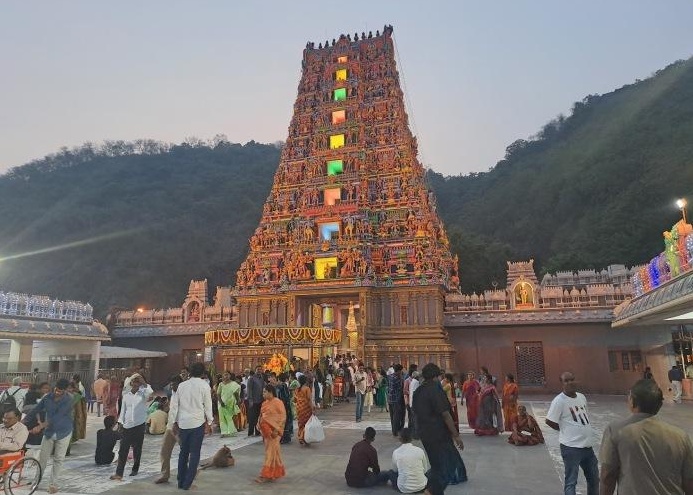
The Sri Kanaka Durga Temple in Vijayawada is a monumental testament to India's rich spiritual heritage, acting not merely as a magnificent architectural structure made of stone and mortar, but as the pulsating spiritual heart of Andhra Pradesh, profoundly steeped in ancient Vedic mythology, divine epics, and awe-inspiring local legends. According to the sacred ancient scriptures, specifically the illustrious Kanaka Durga Mahatmya and chapters of the Skanda Purana, this entire region was once ruthlessly tormented by a terrifying and near-invincible demon king named Mahishasura. Through years of austere penance, Mahishasura had acquired a formidable boon from Lord Brahma that made him immune to death at the hands of any man, deity, or beast, leading him to unleash unparalleled cruelty and absolute chaos upon the three worlds. Unable to withstand his reign of terror and desperate for salvation, the celestial sages (Rishis), the Devas (gods), and even the holy trinity of Brahma, Vishnu, and Shiva pooled their divine cosmic energies together. From this blinding convergence of divine light and pure cosmic rage, Goddess Parvati assumed the spectacularly fierce, omnipotent, and radiant form of Maa Kanaka Durga. Shimmering like molten gold (hence the prefix 'Kanaka', meaning gold), riding a majestic, roaring lion, and armed with a multitude of lethal divine weapons in her eight arms—including the mighty trident (Trishul) of Shiva, the discus (Sudarshana Chakra) of Vishnu, and the thunderbolt (Vajra) of Indra—she descended upon the earth. The Goddess engaged in a ferocious, earth-shattering cosmic battle against the shape-shifting demon Mahishasura upon the rugged terrains of what is now the Indrakeeladri Hill. Following a grueling conflict that shook the foundations of the universe, she successfully pinned down the demon in his buffalo form and decisively pierced his heart with her radiant trident, restoring peace, dharma, and harmony to the cosmos. After her triumphant victory, the compassionate Goddess chose to make this very hill her permanent earthly abode, transforming into the eternal protector and divine mother for all the inhabitants of the region. Today, the awe-inspiring four-foot-high, self-manifested (Swayambhu) stone idol housed inside the temple’s inner sanctum sanctorum vividly and powerfully captures this exact victorious moment—depicting the beautifully adorned, eight-armed Goddess piercing the demon with her trident, serving as the ultimate epitome of breathtaking beauty, supreme feminine power (Shakti), and unwavering courage.
The sacred geography of the temple is just as legendary as the presiding deity herself, with the name 'Indrakeeladri' carrying immense, profound mythological weight that dates back thousands of years. As the ancient legend beautifully dictates, a deeply devoted and righteous Yaksha named 'Keela' performed unimaginably rigorous and agonizing penance on the banks of the mighty River Krishnaveni (now known as the Krishna River) to please Goddess Durga. Day and night, through scorching summers and torrential rains, Keela chanted the Goddess's name. Immensely impressed and moved by his pure, unwavering devotion, the compassionate Mother Goddess appeared before him in all her divine glory and granted him a boon of his choosing. Overwhelmed with love and devotion, Keela asked for nothing but for the Goddess to always reside within his heart for eternity. Touched by his selflessness, she commanded him to transform into a massive, immovable mountain on the riverbank, solemnly promising that after she completed her divine duty of annihilating the demons (specifically Mahishasura), she would return and forever dwell upon his head, thereby fulfilling his wish. Thus, the devoted Keela transformed into the Keeladri Hill. Later, as celestial beings, sages, and prominent gods like Lord Indra frequently descended from the heavens to visit the hill to worship the residing Goddess, the sacred mountain earned the name 'Indrakeeladri' (the hill visited by Indra). Furthermore, the bustling modern city of Vijayawada draws its very name and identity from the Sanskrit word 'Vijaya', which translates to 'Victory'. According to the great Indian epic, the Mahabharata, during the Pandavas' exile, the legendary warrior prince Arjuna performed an incredibly austere penance on this exact same hill to appease the mighty Lord Shiva. He sought the ultimate weapon to guarantee victory in the impending Kurukshetra war. Pleased with his immense dedication, Shiva, disguised as a tribal hunter (Kirata), tested Arjuna in combat before revealing his true divine form and granting him the invincible, world-destroying weapon known as the 'Pasupata Astra'. The city was subsequently named Vijayawada (The Land of Victory or The Place of Triumph) to eternally commemorate this divine triumph and Arjuna's success. Over the passing centuries and millennia, this sacred shrine has been passionately patronized, expanded, and protected by numerous powerful dynasties, including the Vishnukundinas, the Chalukyas, and the great Vijayanagara Empire under Sri Krishnadevaraya. It is also historically recorded that the great 8th-century philosopher and theologian, Adi Shankaracharya, visited this very shrine during his spiritual conquest of India. Recognizing the intense, fierce energy (Ugra Kala) of the deity, he performed Vedic rituals and installed a mathematically perfect, highly sacred 'Sri Chakra' at the lotus feet of the Goddess. This act successfully channeled and pacified her fierce energy into a benevolent, maternal form (Shanta Swaroopini), exponentially amplifying the spiritual aura, peace, and divine magnetism of the sanctum that devotees experience today.