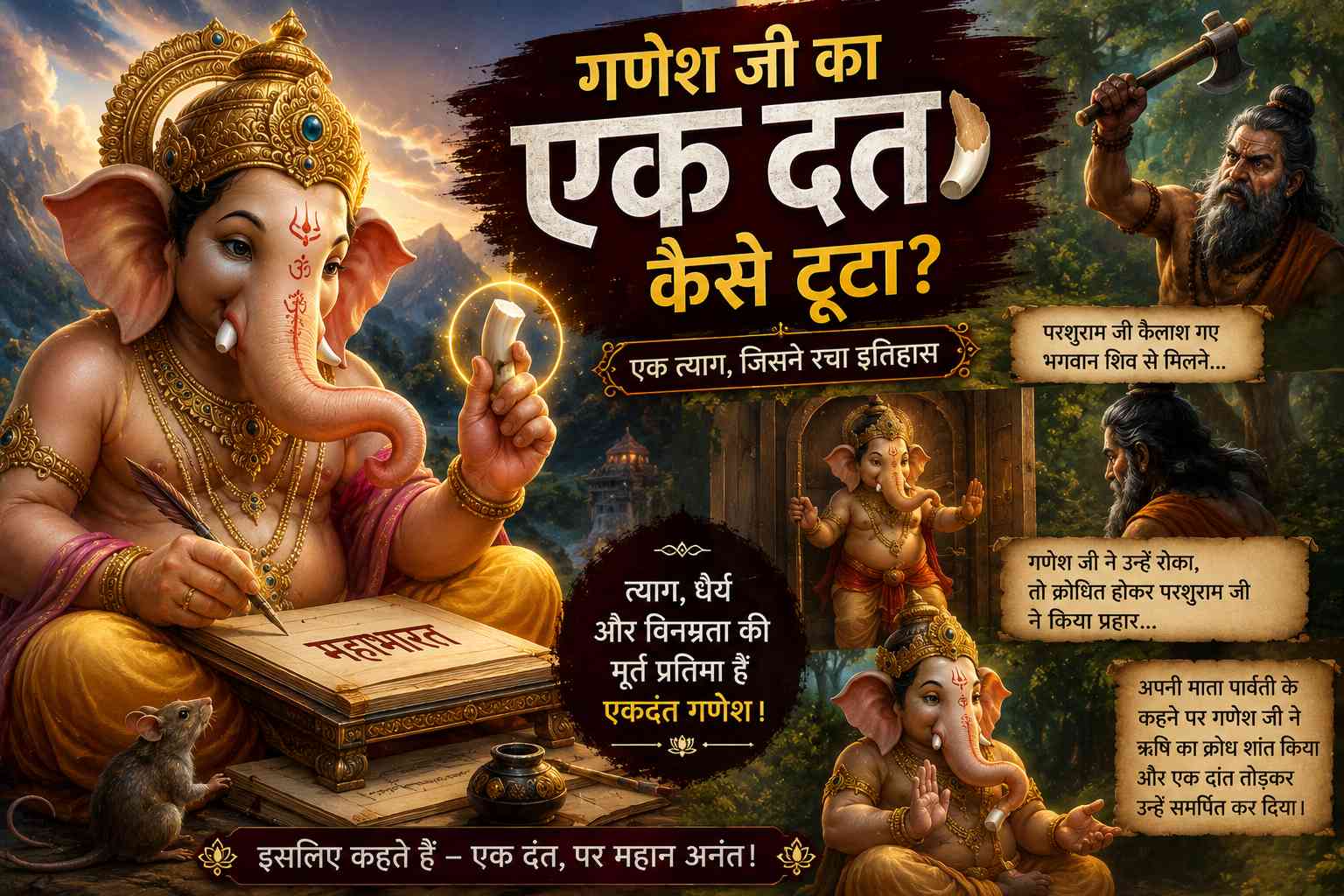
The Real Reason Why Lord Ganesha Has a Broken Tusk: The Complete Story of Ekdanta
When observing a beautiful idol of Ganpati Bappa, the elephant-headed deity of wisdom, intellect, and new beginnings, you will quickly notice a few defining physical traits. The majestic curving trunk, the large ears, the massive belly, and the gentle eyes all carry profound spiritual lessons. However, there is one striking feature that frequently sparks curiosity among devotees and researchers alike: Lord Ganesha’s broken tusk.
This distinct physical trait is not a sculptor's error; it is a highly sacred symbol that earned Him the revered name 'Ekdanta' (The One-Tusked Lord). If you have ever wondered, "why is Ganesha called Ekdanta?" or "why does Lord Ganesha have a broken tusk?", you are not alone. Far from being a physical flaw, this broken tusk represents supreme sacrifice, unwavering devotion, and the absolute victory of wisdom over ignorance. Let's dive deep into the ancient Hindu Puranas to explore the epic Ganesha broken tusk story.
Story 1: The Mahabharata Written by Ganesha (A Sacrifice for Knowledge)
One of the most famous and inspiring legends explaining how Ganesha lost his tusk involves the composition of the greatest Indian epic, the Mahabharata. According to ancient tradition, the great Sage Vyasa had formulated the massive epic poetry in his mind, but he needed a brilliant scribe capable of documenting it without making a single mistake.
Sage Vyasa approached Lord Ganesha to act as his writer. Ganesha, known as the god of supreme intellect, agreed, but He laid down one strict condition: Sage Vyasa must recite the verses continuously, without a single moment's pause. If he stopped, Ganesha would abandon the project.
In return, Sage Vyasa presented a brilliant counter-condition: Ganesha must fully comprehend the deep philosophical meaning of every single verse before writing it down.
As the dictation began, they progressed at a cosmic speed. Suddenly, due to the intense pace and heavy pressure of writing, Ganesha's wooden pen snapped. Realizing that stopping to look for a new stylus would break his vow to maintain the continuous flow of dictation, Ganesha did not hesitate for a second. He immediately reached up, broke off one of his own tusks, and used it as a pen. This is exactly how the Mahabharata written by Ganesha was completed without a single interruption.
The Spiritual Lesson: This extraordinary Ekdanta Ganesha story highlights that no sacrifice is too great in the pursuit of knowledge, literature, and cosmic truth. It teaches us absolute dedication to our duties (Dharma).
Story 2: The Ganesha and Parashurama Story (Reverence for Lord Shiva)
If you search for who broke Ganesha's tusk, you will frequently come across another prominent account found in the Padma Purana. This text details a dramatic and fierce confrontation between Lord Ganesha and Lord Parashurama, an avatar of Lord Vishnu and a fiercely ardent devotee of Lord Shiva.
Once, after a great victory, Lord Parashurama visited Mount Kailash to pay his respects to Lord Shiva. However, Shiva was resting inside his private chambers with Goddess Parvati. Lord Ganesha, acting as the dutiful and unyielding guardian of the inner chambers, respectfully barred Parashurama from entering.
Known for his famously short temper, Parashurama felt deeply insulted by the young guardian and engaged in a fierce duel. Initially, the powerful Ganesha easily overpowered Parashurama using his trunk. In a fit of uncontrollable rage, Parashurama hurled his ultimate divine weapon—the legendary axe (Parashu).
Ganesha could have easily deflected the weapon. However, He recognized that this specific axe was a divine gift bestowed upon Parashurama by His own father, Lord Shiva. To honor His father's weapon and ensure its strike did not go in vain, Ganesha deliberately refused to dodge it. He took the brutal blow directly on His left tusk, causing it to snap instantly.
The Spiritual Lesson: Through the famous Ganesha and Parashurama story, the young deity demonstrated the utmost respect for parental authority and divine grace. It teaches humility—knowing when to yield, even when you possess supreme power.
Story 3: Defeating Gajamukhasura (The Broken Tusk as a Divine Weapon)
In several regional variants and ancient texts like the Mudgala Purana, another thrilling tale attributes the loss of the tusk to a cosmic battle with powerful demons. This is a favorite among those reading Lord Ganesha stories in English.
A powerful demon named Gajamukhasura (who also possessed the head of an elephant) was causing massive havoc across the three worlds, terrorizing sages and gods alike. He had obtained a dark boon that made him invincible to standard divine weapons like swords and arrows.
During a fierce, earth-shattering combat, when traditional weapons failed, Ganesha realized that only a part of His own divine body could bypass the demon's boon. He snapped off His own right tusk and launched it as a divine, heat-seeking missile against the demon.
The sheer spiritual force of the tusk shattered the demon's ego and dark magic. Realizing his absolute folly, the demon surrendered to Ganesha's supreme power. He was transformed into a giant mouse (Mooshika) and became Ganesha's eternal vehicle (Vahana). Because the divine tusk was hurled as a weapon, it remained broken, permanently sealing His physical identity as Ekdanta.
The Complete Symbolism of Lord Ganesha's Physical Form
To truly understand Ganpati Bappa, one must look beyond just the Ekdanta meaning. Every single aspect of His unique physical body is a repository of deep psychological and spiritual data. Below is a comprehensive table detailing the hidden knowledge behind His divine form:
The Ultimate Spiritual Significance of Ganesha's Broken Tusk
Beyond the thrilling mythological narratives and physical symbolism, the spiritual significance of the broken tusk carries a message of profound liberation.
- Embracing Imperfection: The broken tusk teaches us absolute detachment from the illusion of physical perfection. True power lies in inner wisdom, sacrifice, and strength of character, rather than outward flawlessness.
- Overcoming Duality (Advaita): The two tusks of an elephant represent duality (Dvaita)—such as joy and sorrow, success and failure, good and bad. By having only one tusk, Ganesha achieves non-duality (Advaita), a state of mind where one remains perfectly balanced and unaffected by the polarities of life.
- Retaining the Good: An elephant uses its tusks to root out trees, retaining the good (the nutritious roots) and discarding the bad (the bark). The single tusk reminds devotees to hold onto the single, supreme truth of the universe and discard worldly illusions.
Whenever we look at the loving, smiling face of Ekdanta holding His broken tusk in His hand, we are beautifully reminded that true greatness is forged through selfless actions, continuous learning, and unyielding dedication to righteousness.