
Dussehra Guide: Victory of Good Over Evil, Aparajita Puja & Vidyarambham
Explore the complete Vijayadashami guide. Learn about Dussehra's Ravana Dahan, Ayudha Puja rituals, Aparajita worship, Shami tree significance, and Vidyarambham.
Vedic Rituals & Panchang Editorial Desk
Writer & Research Team
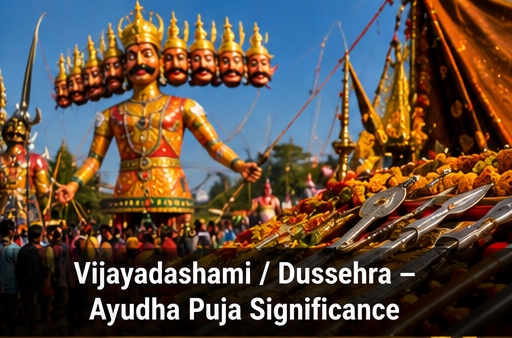
Vijayadashami, popularly known as Dussehra or Dasara, is celebrated on the tenth day (Dashami) of the Shukla Paksha in the month of Ashvin, marking the grand culmination of the nine-day Navratri festival. Translating to 'The Victory on the Tenth', this pan-Indian festival commemorates two monumental triumphs of righteousness: Lord Rama's defeat of the ten-headed demon king Ravana, and Goddess Durga's slaying of the buffalo demon Mahishasura. Across India, the day is marked by the burning of towering effigies of Ravana, vibrant Ramlila performances, Ayudha Puja (worship of tools and weapons), and Vidyarambham (initiation of learning).
Sacred Heritage
Timeless Temple Tradition
Architectural Wonder
Ancient Vedic Mastery
Scriptural Origin
Puranic & Epic History
Spiritual Sadhana
Living Faith & Wisdom
Celebrated when Dashami Tithi prevails during the afternoon (Aparahna Kaal).
The Triumph of Righteousness: The Glory of Vijayadashami and Dussehra
As the vibrant, nine-night festival of Navaratri reaches its crescendo, the tenth day dawns with a universal message of hope, courage, and the ultimate victory of good over evil. Celebrated across the Indian subcontinent with breathtaking diversity, this auspicious day is known as Dussehra in the North and Vijayadashami in the East and South. Though the legends vary by region, the spiritual heartbeat of the festival remains the same: the restoration of cosmic dharma and the eradication of darkness by the forces of divine light.
The Legend of Ramayana and the Flames of Ravana Dahan
In the northern and western regions of India, Dussehra (derived from the Sanskrit words Dasha meaning ten, and Hara meaning defeat) commemorates the epic victory of Maryada Purushottam Lord Rama over the tyrannical demon king of Lanka, Ravana.
According to the epic Ramayana, Ravana was a scholar of immense intellect and a fierce devotee of Lord Shiva. However, his profound knowledge was overshadowed by his colossal ego, represented by his ten heads. These ten heads symbolize the ten debilitating human vices: Kama (lust), Krodha (anger), Moha (attachment), Lobha (greed), Mada (pride), Matsarya (jealousy), Swartha (selfishness), Anyaaya (injustice), Amanavta (cruelty), and Ahankara (ego).
After a grueling battle to rescue His beloved wife Mata Sita, Lord Rama, with the guidance of Vibhishana, fired the fatal Brahmastra into Ravana's navel, bringing the invincible tyrant to the ground. Today, this epic triumph is reenacted through Ravana Dahan. Towering, explosive-filled effigies of Ravana, his brother Kumbhakarna, and his son Meghanada are set ablaze in open grounds (Ramlila maidans) amidst the ecstatic cheers of millions.
"The burning of Ravana's effigy is not merely the celebration of a historical victory; it is a spectacular visual reminder to identify and burn the ten-headed demon of ego residing within our own minds."
The Cosmic Victory of Goddess Durga: Vijayadashami
In the eastern and southern states, the day is celebrated as Vijayadashami (the Victorious Tenth). Puranic legends recount the terrifying reign of the shape-shifting buffalo demon, Mahishasura, who had secured a boon that no man or god could defeat him. To save creation, the holy trinity (Brahma, Vishnu, and Shiva) combined their divine energies to manifest Goddess Durga.
Armed with the celestial weapons of all the gods and riding a fierce lion, the supreme mother fought Mahishasura for nine days and nights. On the tenth day, She pierced his chest with Her trident, restoring peace to the heavens and the earth.
Vijayadashami is marked by deeply emotional rituals. In Bengal, married women engage in Sindoor Khela, smearing each other with vibrant red vermilion in joyous celebration of the Goddess's married life. This is followed by the grand Visarjan (immersion), where the beautiful clay idols of Maa Durga are bid a tearful farewell and submerged in rivers, symbolizing Her return to Mount Kailash.
Ayudha Puja: Revering the Instruments of Life
Another profound aspect of this festival, especially prominent in South India and Maharashtra, is Ayudha Puja (the Worship of Weapons and Instruments). Its mythological roots trace back to the Mahabharata. Before going into exile for a year in disguise, the Pandavas hid their celestial weapons in the branches of a Shami tree. On the day of Vijayadashami, they successfully retrieved their weapons and proceeded to win the Kurukshetra war.
Today, Ayudha Puja represents a beautiful spiritual acknowledgment of the tools that help us navigate and sustain our lives. The rituals include:
- Worship of Tools and Machinery: Artisans, mechanics, farmers, and software engineers clean their tools, machines, and computers, anointing them with sandalwood paste, turmeric, and kumkum.
- Vahana Puja (Vehicle Worship): Cars, buses, and bicycles are washed, decorated with flower garlands and mango leaves, and blessed with the breaking of a coconut or a lemon under the wheels to ward off negative energy.
- Vidyarambham: The day is considered highly auspicious to initiate learning. Books, pens, and musical instruments are placed before Goddess Saraswati to seek Her blessings for intellect and creativity.
The Universal Message of the Victorious Tenth
Whether it is Rama defeating Ravana, Durga slaying Mahishasura, or the Pandavas reclaiming their weapons, the essence of Vijayadashami and Dussehra is a call to action. It teaches us that evil, no matter how powerful, intelligent, or invincible it may appear, carries the seeds of its own destruction. The festival inspires us to purify our hearts, honor the tools of our livelihood, and step forward into the world with renewed courage and unshakable righteousness.
Why this matters today
Explore the complete Vijayadashami guide. Learn about Dussehra's Ravana Dahan, Ayudha Puja rituals, Aparajita worship, Shami tree significance, and Vidyarambham.
Frequently asked questions
What is the significance of Shami tree worship on Dussehra?
During their exile, the Pandavas hid their divine weapons in a Shami tree. Worshipping the Shami tree on Vijayadashami grants victory, prosperity, and neutralizes the malefic effects of Saturn (Shani).
Why is Neelkanth (Indian Roller bird) sighting considered auspicious?
Sighting the Neelkanth bird on Dussehra is believed to bring good fortune, as it is associated with Lord Shiva, whose blessings Lord Rama sought before marching to Lanka.
What is Ayudha Puja?
Ayudha Puja is the honoring of tools, machinery, books, and weapons, acknowledging them as manifestations of divine energy (Shakti) that help humans achieve success in their respective karmas.