
Paryushan Parva Guide: Micchami Dukkadam, Das Dharma & Soul Purification
Explore the significance of Jainism's Paryushan and Das Lakshana Parva. Learn about intense fasting, Pratikraman, the ten virtues (Dharmas), and the universal forgiveness mantra Micchami Dukkadam.
Vedic Rituals & Panchang Editorial Desk
Writer & Research Team
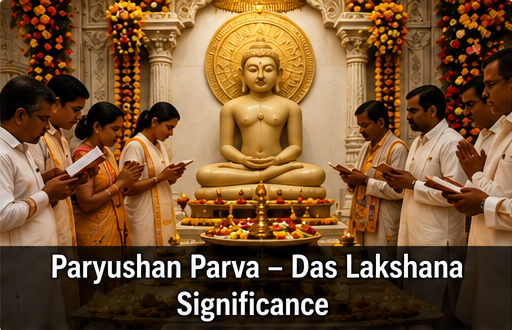
Paryushan Parva (celebrated by Shwetambar Jains for 8 days) and Das Lakshana Parva (celebrated by Digambar Jains for 10 days) is the most profound spiritual festival in Jainism. Falling in the monsoon months of Shravana and Bhadrapada, it is not a festival of external rejoicing, but an intense period of introspection, self-purification, and shedding accumulated karmas. Devotees undertake severe fasting, practice prolonged meditation, recite the holy Kalpa Sutra, and observe silence. The festival culminates in 'Samvatsari' (or Kshamavani), the day of universal forgiveness, where Jains seek pardon from all living beings uttering the sacred phrase 'Micchami Dukkadam' (May all my wrongdoings be forgiven).
Sacred Heritage
Timeless Temple Tradition
Architectural Wonder
Ancient Vedic Mastery
Scriptural Origin
Puranic & Epic History
Spiritual Sadhana
Living Faith & Wisdom
Dates slightly vary between Shwetambar (8 days) and Digambar (10 days) sects starting in late Shravan or early Bhadrapada.
Paryushan and Das Lakshana Parva: The Supreme Festival of Spiritual Cleansing, Fasting, and Universal Forgiveness
In a world where most festivals celebrate external triumphs, historical events, or seasonal harvests with grand feasts and revelry, the Jain festival of Paryushan and Das Lakshana Parva stands as a rare and sublime spiritual phenomenon. Celebrated during the holy monsoon period of Chaturmas (specifically in the Hindu month of Bhadrapada, corresponding to August–September), this period is not about social entertainment. Instead, it is an intense, introspective journey inward—a period of rigorous fasting (Tapasya), self-restraint (Sanyama), scriptural study (Swadhyaya), and the supreme act of seeking and granting unconditional forgiveness (Kshama).
Paryushan is widely revered as the Parvaraj—the "King of all Festivals." For Jains across the globe, whether belonging to the Svetambara or Digambara tradition, these days represent an annual spiritual retreat. The goal is singular and profound: to shed heavy layers of accumulated karma, subdue the inner enemies of anger, ego, deceit, and greed, and awaken the innate purity of the soul (Jiva).
"Khamemi Savve Jive, Savve Jiva Khamantu Me. Mitti Me Savva-bhuesu, Veram Majjham Na Kenai."
(I grant forgiveness to all living beings, may all living beings forgive me. I have friendship with all souls, and enmity toward none.)
The Spiritual Meaning of Paryushan and Das Lakshana
The word Paryushan is derived from two Sanskrit roots: Pari (meaning "all-around" or "from all directions") and Vash (meaning "to dwell" or "to stay"). Thus, Paryushan signifies residing within one’s own soul, turning the mind away from external worldly attractions. Another classical interpretation translates it as Pari-shamana, meaning the complete subsiding and burning away of the passions (Kashayas) and karmic impurities.
For the Digambara tradition, this period is commemorated as Das Lakshana Parva, directly celebrating the ten inherent, eternal virtues (Dharmas) of the pure soul as expounded by Acharya Umasvati in the sacred text Tattvartha Sutra. Rather than worshiping an external deity, the festival worships the supreme virtues that lead to liberation (Moksha).
Svetambara Paryushan vs. Digambara Das Lakshana: Key Distinctions
While both traditions share the identical spirit of non-violence, soul-purification, and universal forgiveness, they observe the festival through distinct liturgical schedules and focus areas:
| Aspect | Svetambara Tradition (Paryushan) | Digambara Tradition (Das Lakshana) |
|---|---|---|
| Duration | Observed for 8 continuous days | Observed for 10 continuous days |
| Timing | Starts on Bhadrapada Krishna Trayodashi and concludes on Bhadrapada Shukla Panchami | Begins immediately after Svetambara Paryushan, from Bhadrapada Shukla Panchami to Chaturdashi (Anant Chaturdashi) |
| Primary Scripture Read | Sri Kalpasutra (life stories of Tirthankaras, monastic rules) and Antagada Dasao | Tattvartha Sutra (Chapter 9) and Uttam Kshama discourses based on ten dharmas |
| Pinnacle Day | Samvatsari (8th day) | Anant Chaturdashi (10th day), followed by Kshamavani Diwas |
| Forgiveness Greeting | "Michhami Dukkadam" | "Uttama Kshama" |
| Central Ritual | Samvatsari Pratikramana (annual introspective repentance lasting over 3 hours) | Dhyana, Pooja of the Ten Dharmas, and continuous Swadhyaya |
The 8 Days of Svetambara Paryushan: Journey to Samvatsari
The eight days of Svetambara Paryushan follow a carefully designed spiritual trajectory that elevates the devotee from external non-violence to absolute internal purity:
- Day 1 (Amari Pravartana & Ahimsa): Devotees take vows to protect all living beings, promote non-injury to single-sensed and multi-sensed organisms, and begin their penance.
- Day 2 (Vardhamana Tap & Self-Purification): Dedication to spiritual endurance, reducing physical comforts, and reading devotional biographies.
- Day 3 (Atthai Tap & Guru Vandan): Many lay devotees begin their multi-day fasts (Atthai); special veneration is offered to monastic preceptors (Acharyas and Gurus).
- Day 4 (Commencement of Kalpasutra Recitation): Monks open and read aloud the holy scripture Kalpasutra, describing the five auspicious life events (Kalyanaks) of the Tirthankaras.
- Day 5 (Janma Vachan & The 14 Sacred Dreams): The most jubilant liturgical day. The birth celebration of Lord Mahavira is commemorated, and the 14 auspicious dreams (Swapnas) witnessed by Mother Trishala prior to His birth are displayed and celebrated.
- Day 6 (Spiritual Restraint & Dhyan): Devotees transition from celebratory rituals to deep meditation, silencing the senses and practicing introspection.
- Day 7 (Samadhi & Reading of the Monastic Code): Reading the rules of ascetic life, cultivating non-attachment (Aparigraha), and preparing mentally for the final day.
- Day 8 (Samvatsari - The Supreme Day): The absolute climax of the festival. Total fasting is observed. The day is dedicated to the annual Samvatsari Pratikramana, concluding with the universal forgiveness declaration of Michhami Dukkadam.
The 10 Supreme Virtues of Digambara Das Lakshana Parva
In the Digambara tradition, each of the ten days is dedicated to contemplating, embodying, and meditating upon one specific cardinal virtue of the soul, known as the Dasa Dharma:
| Day & Virtue | Sanskrit Term | Spiritual Significance & Daily Practice |
|---|---|---|
| Day 1: Supreme Forgiveness | Uttama Kshama | Eradicating anger (Krodha), developing supreme patience, and seeing every soul as equal. |
| Day 2: Supreme Humility | Uttama Mardava | Destroying pride, arrogance, and ego (Mana); cultivating absolute simplicity and gentleness. |
| Day 3: Supreme Straightforwardness | Uttama Arjava | Eliminating deceit, cunningness, and hypocrisy (Maya); aligning mind, speech, and action in pure honesty. |
| Day 4: Supreme Purity | Uttama Saucha | Overcoming greed (Lobha) and mental defilements; finding complete inner contentment (Santosha). |
| Day 5: Supreme Truthfulness | Uttama Satya | Speaking only that which is truthful, gentle, beneficial, and rooted in universal righteousness. |
| Day 6: Supreme Self-Restraint | Uttama Sanyama | Restraining the five senses, controlling the wandering mind, and protecting all living beings. |
| Day 7: Supreme Austerity | Uttama Tapa | Practicing external and internal penance to burn away residual karmic matter and master desires. |
| Day 8: Supreme Renunciation | Uttama Tyaga | Giving away wealth, knowledge, and material comforts to worthy souls and the needy without attachment. |
| Day 9: Supreme Non-Possessiveness | Uttama Akinchanya | Transcending the feeling of "this is mine" (Aparigraha); realizing that the soul owns nothing material. |
| Day 10: Supreme Celibacy / Purity | Uttama Brahmacharya | Remaining rooted in the nature of pure consciousness; abstaining from sensual and carnal desires. |
The Sacred Tapasya: Fasting Practices During the Parva
Fasting (Tapa) in Jainism is not a form of physical self-torture; it is a conscious, joyous method of disciplining the physical senses so the spiritual self can dominate. Fasting during Paryushan ranges from mild dietary restrictions to heroic austerities:
- Chauvihar Upvas: A complete 24-hour fast where not even a single drop of water is consumed from sunset of the previous day until 48 minutes after sunrise of the following day.
- Tivihar Upvas: A fast where no food is taken, but boiled water (cooled naturally) may be consumed strictly between sunrise and sunset.
- Bela, Tela, & Atthai:
- Bela: Continuous fasting for 2 consecutive days.
- Tela: Continuous fasting for 3 consecutive days.
- Atthai: A landmark penance of 8 continuous days of fasting without solid food.
- Masakshaman: A monumental penance where a devotee fasts continuously for an entire month (30 days), surviving only on boiled water consumed during daylight hours.
- Ayambil: Consuming only one meal a day consisting of bland, boiled grains and pulses without salt, sugar, oil, ghee, spices, milk, curd, or fruits. It is specifically intended to conquer the sense of taste.
- Ekashana & Biyashana: Taking food and water only once (Ekashana) or twice (Biyashana) in a day while seated in a single posture before sunset.
Pratikramana: The Sacred Confession and Soul Inventory
The centerpiece of daily devotion during Paryushan is Pratikramana, which literally means "turning back" or returning to the pure nature of the soul from the wandering pathways of sin and distraction. While householders practice short daily Pratikramana, the Samvatsari Pratikramana performed on the final day is the most exhaustive, lasting over three hours.
During Pratikramana, devotees perform the Six Essential Duties (Shad-Avashyaka):
- Samayika: Attaining mental equanimity and detachment from all worldly likes and dislikes for 48 minutes.
- Chauvisantho: Singing praises and offering veneration to the 24 Tirthankaras.
- Vandana: Paying humble obeisance to spiritual preceptors and ascetics.
- Pratikramana: Reflecting upon, confessing, and repenting for all physical, vocal, and mental misdeeds committed consciously or unconsciously.
- Kayotsarga: Standing or sitting completely motionless, relinquishing all bodily attachment to enter pure spiritual awareness.
- Pratyakhyana: Taking formal vows to abstain from specific sins, pleasures, or foods for defined periods.
Samvatsari and Kshamavani: The Miracle of Universal Forgiveness
The final phase of Paryushan and Das Lakshana transforms the individual penance into a universal wave of reconciliation. On Samvatsari (Svetambara) and Kshamavani Diwas (Digambara), Jains perform an act that is virtually unique in world religions: they actively approach family members, friends, business associates, servants, and adversaries to ask for genuine, unconditional pardon.
The True Meaning of "Michhami Dukkadam":
The sacred Prakrit phrase "Michhami Dukkadam" is comprised of two words: Mithya (meaning fruitless, null, or void) and Dushkruta (meaning misdeeds, sins, or errors). When a Jain utters this phrase, it means:
"May all the wrong, hurtful, unloving, or disrespectful actions I have committed against you—whether through thought, speech, or physical deed, whether knowingly or unknowingly—be completely forgiven and rendered null and void."
The Philosophy Behind Universal Pardon:
Forgiveness in Jainism is not an act of condescending charity performed by a superior toward an inferior. It is an act of spiritual self-defense. Harbouring resentment, grudges, and enmity binds the soul with heavy, dense karmic particles (known as Apratyakhyanavarana Kashaya) that obstruct spiritual liberation. By forgiving all souls and asking all souls for forgiveness, the devotee cleanses the mirror of consciousness, dissolving psychological toxicity and generating universal harmony.
Strict Dietary Discipline and Daily Conduct During the Parva
Because non-violence (Ahimsa) is the absolute foundation of Jainism, dietary discipline during these holy days becomes exceptionally rigorous:
- Complete Ban on Root Vegetables (Zaminkand): Potatos, onions, garlic, carrots, radishes, and ginger are strictly prohibited because their excavation and consumption cause the destruction of countless microscopic living organisms (Nigoda).
- Avoidance of Green Vegetables (Hari): Many observant Jains completely abstain from leafy green vegetables during the Parva to minimize injury to botanical life, relying exclusively on dried grains and lentils.
- Consumption of Boiled Water Only: Water is boiled, cooled, and filtered to eliminate bacterial growth. Drinking unboiled or raw municipal water is avoided, and no water is ever consumed after sunset.
- Strict Sunset Eating Rules (Chauvihar): All eating and drinking cease completely before the sun dips below the horizon, avoiding the inadvertent consumption or harm of nocturnal insects and micro-organisms.
- Silence and Celibacy: Devotees practice periods of total silence (Maun), practice strict celibacy (Brahmacharya), avoid television and digital entertainment, and refrain from engaging in trade, business expansion, or legal conflicts.
Frequently Asked Questions (FAQs)
1. What is the fundamental difference between Paryushan and Das Lakshana?
Paryushan is the 8-day festival celebrated primarily by the Svetambara Jain community focusing on the recitation of the Kalpasutra and concluding with Samvatsari. Das Lakshana is the 10-day festival observed by the Digambara community immediately following Paryushan, focusing on the ten supreme virtues of the soul outlined in the Tattvartha Sutra. Both festivals share the identical spiritual goal of soul-purification and forgiveness.
2. Why is water strictly boiled before consumption during Paryushan?
Boiling water purifies it, arrests the regeneration of microbial life for a fixed period (usually up to 6 hours or until sunset), and aligns with the Jain vow of Ahimsa by preventing the internal ingestion of live microorganisms. Boiled water is also easier on the digestive system of individuals observing intense fasting.
3. Can non-Jains participate in the spirit of Paryushan?
Yes, absolutely. The underlying principles of Paryushan—forgiveness, non-violence, environmental sensitivity, conquering personal ego, and practicing self-discipline—are universal human values. Anyone seeking peace of mind, emotional healing, and reconciliation can observe fasting, refrain from violence, and share the spirit of Michhami Dukkadam.
4. What is the ritual of Parna (breaking the fast)?
The breaking of a multi-day fast is known as Parna. It is conducted with deep reverence on the morning following the fast's conclusion. Devotees break their fast gently using warm, boiled water infused with dry fruits, light herbal broths, or boiled lentil water (Mung water), usually fed by family members in the presence of traditional devotional chants.
The Living Legacy of Paryushan
Paryushan and Das Lakshana Parva remind humanity that genuine victory is not won on battlefields, in stock markets, or through material acquisitions. The greatest victory is the conquest of one’s own base instincts—anger, vanity, deceit, and possessiveness. When millions of individuals bow their heads, put aside ancient grudges, and genuinely embrace every living entity with the greeting of Michhami Dukkadam, the world becomes a more compassionate, peaceful, and harmonious sanctuary for all souls.
Why this matters today
Explore the significance of Jainism's Paryushan and Das Lakshana Parva. Learn about intense fasting, Pratikraman, the ten virtues (Dharmas), and the universal forgiveness mantra Micchami Dukkadam.
Frequently asked questions
What is the meaning of 'Micchami Dukkadam'?
It is an ancient Prakrit phrase that translates to: 'If I have caused you offense in any way, knowingly or unknowingly, in thought, word, or deed, then I seek your forgiveness.' It is a profound practice of dissolving the ego.
What are the ten virtues celebrated during Das Lakshana Parva?
The ten supreme virtues (Das Dharma) are: Forgiveness (Kshama), Humility (Mardava), Straightforwardness (Aarjava), Contentment (Shaucha), Truth (Satya), Self-restraint (Samyam), Penance (Tapa), Renunciation (Tyaga), Non-attachment (Akinchanya), and Celibacy (Brahmacharya).
What is 'Pratikraman'?
Pratikraman means 'turning back'. It is a meditative ritual of confessing one's sins, repenting for negative thoughts or actions committed throughout the year, and resolving not to repeat them, thereby purifying the soul.