
Bathukamma Guide: Worship of Goddess Maha Gauri Through Nature's Flowers
Explore the Bathukamma floral festival of Telangana. Learn about stacking vivid seasonal flowers to invoke Goddess Maha Gauri, traditional dances, and the final Saddula Bathukamma.
Vedic Rituals & Panchang Editorial Desk
Writer & Research Team
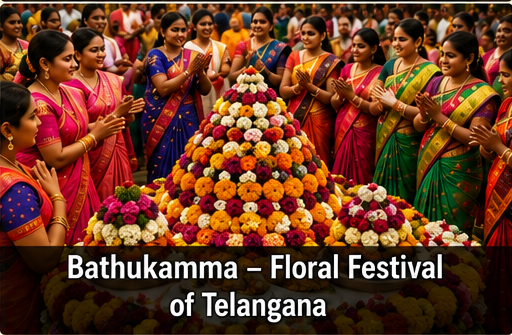
Bathukamma is a vibrant and unique nine-day floral festival celebrated predominantly by women in Telangana, coinciding with the Sharad Navratri (starting on Mahalaya Amavasya and ending on Durgashtami). In Telugu, 'Bathukamma' means 'Mother Goddess, come alive!' The festival is a profound celebration of nature, the life-giving properties of water, and feminine energy. Women meticulously arrange vibrant, medicinal seasonal flowers (like Gunugu, Tangedu, and Marigold) in concentric layers forming a conical mound representing Goddess Maha Gauri, dancing around it in harmonious circles while singing traditional folk songs.
Sacred Heritage
Timeless Temple Tradition
Architectural Wonder
Ancient Vedic Mastery
Scriptural Origin
Puranic & Epic History
Spiritual Sadhana
Living Faith & Wisdom
Starts on Bhadrapada Amavasya (Mahalaya) and ends on Ashvin Shukla Ashtami.
The Celebration of Life: Bathukamma, Telangana's Vibrant Floral Festival
As the monsoon rains retreat, leaving behind lush green landscapes and blooming fields, the state of Telangana bursts into a mesmerizing display of colors, songs, and sisterhood. Bathukamma is a breathtaking floral festival celebrated by women, corresponding with the nine days of Navaratri. The name itself is profoundly poetic: in Telugu, Bathuku means "life" and Amma means "mother." Thus, Bathukamma is an earnest invocation meaning "Mother Goddess, come alive."
This festival is a beautiful tribute to the patron Goddess of womanhood, Maha Gauri, who is revered as the life-giver. More than just a religious observance, Bathukamma is a powerful celebration of the inherent, undeniable connection between human beings, the earth, and water.
"Bathukamma is not carved in stone or molded in clay; She is woven from the earth's freshest blooms. It is a beautiful reminder that divinity is naturally present in the blooming life all around us."
The Art of Making Bathukamma: Nature's Temple
The creation of the Bathukamma is a delicate, deeply artistic, and communal process. Men and young boys venture into the wild fields to gather vibrant, seasonal wildflowers, which are then meticulously arranged by the women of the household. The arrangement represents a temple Gopuram (tower) and is prepared using:
- A Sacred Base: A large brass or silver plate, known as a Thambalam, is used as the foundation.
- Concentric Circles of Flora: Distinct, medicinal wildflowers like Gunuka (Celosia), Tangedu (Cassia auriculata), Banthi (Marigold), and Chamanthi (Chrysanthemum) are layered in perfect concentric circles.
- The Divine Crown: The conical floral stack is traditionally topped with a pumpkin flower and a symbolic idol of Gauramma, lovingly crafted from turmeric.
Rhythmic Devotion: The Dance and Songs of Bathukamma
As dusk approaches, women dress in their finest traditional handloom sarees, adorned with traditional jewelry. They gather in communal spaces, placing their vibrant Bathukammas in the center. Forming large circles, they clap rhythmically and sing enchanting folk songs, dancing in unison.
The songs often end with the soothing, rhythmic refrain of "Uyyalo" or "Chandamama." These folk songs are completely unwritten, passed down from generation to generation through oral tradition. They narrate tales of women's lives, the heroics of local legends, historical struggles, and the profound love for the Mother Goddess. It is an extraordinary display of women's empowerment, unity, and cultural pride.
Saddula Bathukamma: The Grand Finale and Eco-Spirituality
The nine-day festival culminates on Durgashtami with the grand celebration of Saddula Bathukamma. On this final day, massive floral stacks are created. As the sun sets, a grand procession of singing and dancing women carries the Bathukammas to local lakes, rivers, or ponds for immersion (Visarjan).
The immersion holds a brilliant ecological secret: the specific wildflowers used in Bathukamma, particularly Gunuka and Tangedu, possess immense water-purifying and medicinal properties. By immersing thousands of these floral stacks into the water bodies, the community naturally cleanses the lakes after the monsoon, preparing fresh, clean water for the upcoming winter.
Bathukamma is a radiant reminder of how our ancestors seamlessly blended deep spiritual devotion with environmental conservation. Have you ever participated in a tradition that beautifully honors both the divine and the local ecosystem?
Why this matters today
Explore the Bathukamma floral festival of Telangana. Learn about stacking vivid seasonal flowers to invoke Goddess Maha Gauri, traditional dances, and the final Saddula Bathukamma.
Frequently asked questions
What is the structure of the Bathukamma flower arrangement?
It is built on a brass or steel plate (thambalam). Flowers are carefully stacked in concentric circular layers, tapering upwards to form a colorful, cone-shaped mound topped with a symbolic turmeric idol of Goddess Gauri (Gauramma).
What happens on the final day, Saddula Bathukamma?
On the ninth day (coinciding with Durgashtami), large and majestic Bathukammas are created. Women celebrate till dusk and then carry them to local ponds or lakes for immersion (Nimarjanam), celebrating the water's purification by floral medicinal properties.
Why are specific wild flowers used in Bathukamma?
Flowers like Tangedu, Gunugu, and Banti possess immense medicinal and water-purifying properties. Immersing them in water bodies purifies the local lakes after the monsoon, reflecting deep ecological wisdom.