
Why Jagannath Prasad is Called Mahaprasad: The Divine Secret of Puri
Discover the divine secrets behind Puri Jagannath Temple's Mahaprasad (Abadha). Learn why the Chhappan Bhog is offered to Goddess Bimala and its miraculous kitchen.
Vedic Wisdom
Writer & Research Team
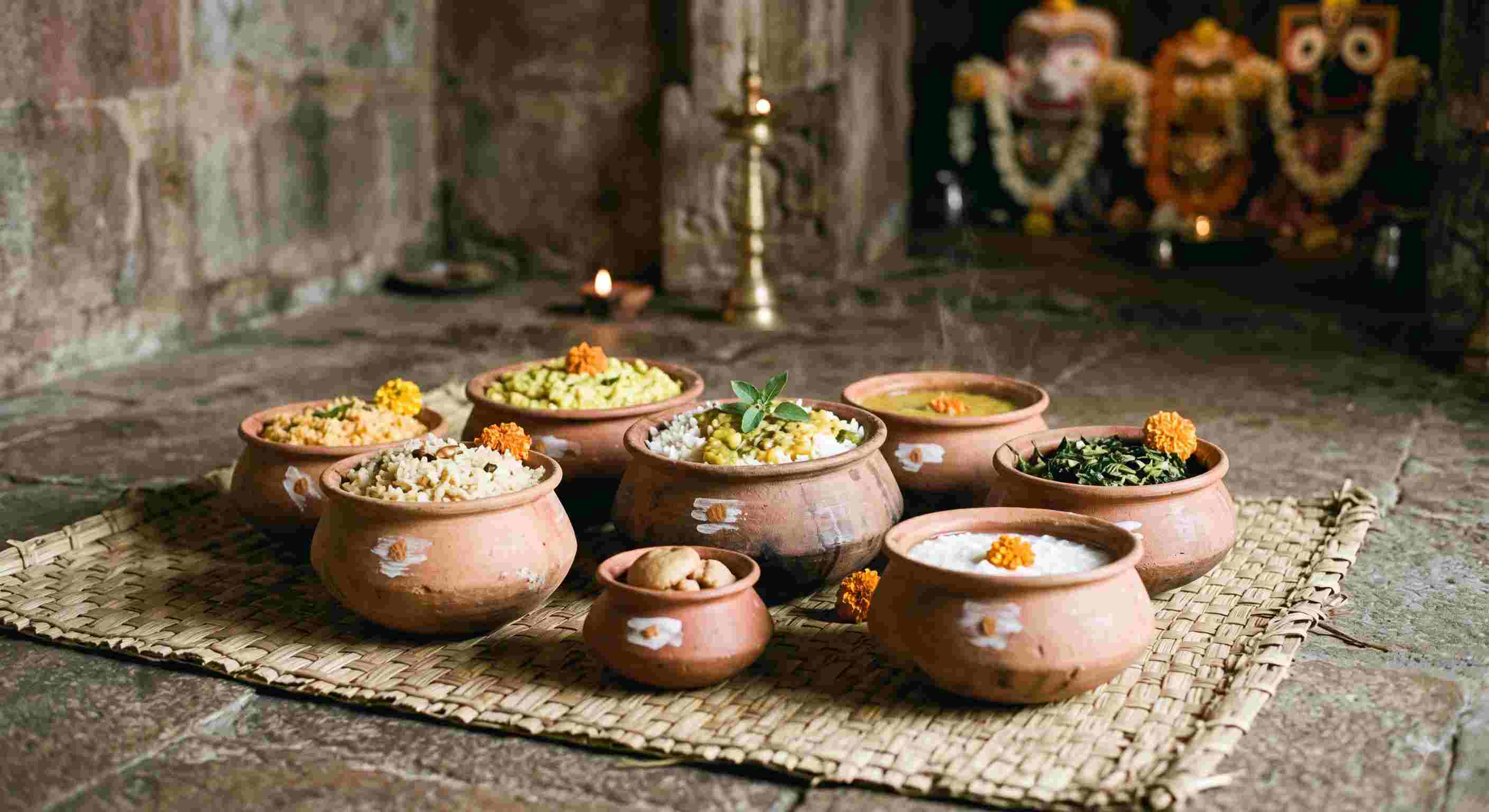
The Jagannath Temple in Puri is renowned worldwide not just for its magnificent Rath Yatra, but also for its sacred food offering, deeply revered as 'Mahaprasad', 'Abadha', or 'Kaibalya'. In every other Hindu temple across the globe, food offered to deities is simply called 'Prasad'. However, the offering at Puri holds an elevated, supreme cosmic status. But what exactly transforms this sacred food into 'Mahaprasad'? The answer is a fascinating blend of ancient Skanda Purana mythology, the miraculous Rosaghara (temple kitchen), and an eternal divine pact with Goddess Bimala.
Sacred Heritage
Timeless Temple Tradition
Architectural Wonder
Ancient Vedic Mastery
Scriptural Origin
Puranic & Epic History
Spiritual Sadhana
Living Faith & Wisdom
The Divine Mystery of Jagannath Temple Mahaprasad: Miracles, Myths, and the World's Largest Ancient Kitchen
If you have ever visited the sacred city of Puri in Odisha, or if you are simply fascinated by the profound mysteries of ancient Indian temples, there is one word you will hear echoing through the vibrant streets: Mahaprasad. The Mahaprasad of Puri Jagannath Temple is not just a sacred offering; it is a profound emotion, a miraculous culinary feat, and a deeply rooted spiritual tradition that has baffled scientists and devotees alike for centuries.
Every single day, the Jagannath Temple in Puri feeds thousands—sometimes hundreds of thousands—of devotees. But how is this massive feat achieved without modern technology? Why does the food cook in reverse? And why is the offering here called 'Mahaprasad' instead of just 'Prasad'? In this comprehensive guide, we will dive deep into the history of Mahaprasad, the mind-boggling miracles of the Rosaghara temple kitchen, the legend of Goddess Bimala, and the spiritual equality found in the famous Ananda Bazaar Puri.
The Blessing of Goddess Bimala: The Skanda Purana Legend
To understand the true essence of the Puri Jagannath temple food, we must first answer a fundamental question: Why is it elevated to the status of 'Mahaprasad'? The most significant theological reason behind this supreme title involves Goddess Bimala. Inside the sprawling Jagannath Temple complex resides the sacred shrine of Maa Bimala, recognized in Hindu scriptures as a highly powerful manifestation of Goddess Shakti.
According to ancient temple traditions and the revered texts of the Skanda Purana, the exquisite 56 food items—famously known as the Chhappan Bhog—are first offered to Lord Jagannath, Lord Balabhadra, and Goddess Subhadra inside the main sanctum sanctorum. However, at this precise stage, the sacred offering is merely considered 'Prasad'.
The Divine Covenant of Lord Shiva and Goddess Parvati
The transformation from Prasad to Mahaprasad is rooted in a fascinating mythological tale. After the Lords have partaken of the food, this exact Prasad is carefully carried over to the shrine of Goddess Bimala and offered to her. It is only after Maa Bimala accepts this offering that the food is fully consecrated and officially becomes 'Mahaprasad' (also known locally as 'Kaibalya' or 'Abadha').
Legend states that Lord Shiva once requested Lord Vishnu to grant him a portion of His leftover food. Hearing this, Goddess Parvati (manifested as Bimala) also demanded her rightful share. Deeply moved by her devotion, Lord Vishnu blessed her and laid down a cosmic decree: His Prasad would only attain the supreme, ultimate status of Mahaprasad after she consumes it first. To this day, this unbending rule is followed flawlessly, making the Goddess Bimala shrine Puri an integral part of the Jagannath worship.
The Miraculous Rosaghara: Secrets of the World's Largest Temple Kitchen
When we talk about the making of Mahaprasad, the process is heavily steeped in miracles, unyielding devotion, and sheer, unimaginable scale. The temple kitchen, famously known as the 'Rosaghara', is globally recognized as the largest functioning ancient kitchen in the world. It is a bustling, sacred space employing hundreds of Mahasuaras (traditional, highly skilled temple cooks) who have inherited this divine duty through generations.
The strict Sattvic Rules of Cooking
The food prepared inside the Rosaghara is a masterclass in ancient culinary purity. It is cooked exclusively in specially crafted earthen pots known as Kudua, over roaring open wood fires. The recipes adhere strictly to ancient Sattvic principles. This means you will find absolutely no onion or garlic in the food. Furthermore, foreign or "new world" vegetables that were introduced to India later in history—such as potatoes, tomatoes, cabbage, or green chilies—are strictly banned from the temple kitchen. Only indigenous spices and native vegetables are used.
The Baffling 7 Pots Miracle in Puri
Perhaps the most astonishing phenomenon—and one of the most searched mysteries of Jagannath Temple—occurs right over the hearths of the Rosaghara. The Mahasuaras stack seven earthen pots vertically, directly on top of each other, over a single open wood fire.
According to conventional physics and thermodynamics, the food in the bottom pot (closest to the fire) should cook first. However, the exact opposite happens. Defying all scientific logic, the food in the topmost pot cooks first! The cooking then follows sequentially downward, finishing with the bottom pot last. Devotees and locals firmly believe this is absolute proof that Goddess Lakshmi herself is cooking the food, with the Mahasuaras merely acting as her physical instruments. The food never falls short, and it never goes to waste, no matter how many unexpected pilgrims arrive.
Types of Mahaprasad: Sankudi and Sukhila
The legendary Chhappan Bhog offered at the temple is vast and varied. To make it easier for devotees to understand and transport, the Mahaprasad is broadly categorized into two distinct types: Sankudi Mahaprasad and Sukhila Mahaprasad.
| Feature | Sankudi Mahaprasad | Sukhila Mahaprasad |
|---|---|---|
| Definition | Wet, boiled, or freshly cooked meals. | Dry, baked, or fried sweet offerings. |
| Popular Items | Anna (sweetened rice), Dal, Dalma (lentils with native vegetables), and Besara (mustard-based curry). | The world-famous 'Khaja', 'Gaja', 'Magaja Ladu', and other dry sweets. |
| Shelf Life | Highly perishable; must be consumed within a day. | Can be preserved for weeks without spoiling. |
| Best Way to Consume | Eaten fresh inside the temple premises (Ananda Bazaar). | Carried by pilgrims to all corners of the world as divine souvenirs for family and friends. |
Ananda Bazaar: A Symbol of Supreme Equality
Beyond its divine origins, nutritional value, and miraculous cooking methods, the Jagannath Temple Mahaprasad serves as a profound equalizer of humanity. In a society that has historically been divided by rigid caste and class systems, the Jagannath Temple in Puri breaks down all societal barriers.
The Mahaprasad is sold and consumed in the Ananda Bazaar (translated as 'The Market of Joy'), a massive, open-air courtyard situated inside the temple premises. This sacred marketplace is a sight to behold.
Breaking the Concept of Impurity (Jutha)
In Ananda Bazaar, people of all castes, cultural backgrounds, and financial statuses sit together cross-legged on the stone floor. Here, they share the Mahaprasad, often eating from the very same earthen leaf or pot. In traditional Indian culture, eating from someone else's plate is considered Jutha (defiled or impure). However, inside the Ananda Bazaar, this concept ceases to exist.
The sanctity of the Abadha is so supreme that a high priest might happily accept and eat a morsel of Mahaprasad straight from the hands of a commoner. It is deeply believed in Odia culture that consuming this sacred Kaibalya destroys the human ego, cleanses the soul of all worldly sins, and ultimately grants the devotee Moksha (liberation from the cycle of birth and death).
Conclusion: An Experience Beyond Food
The Mahaprasad of Puri Jagannath is not merely a meal to satiate physical hunger; it is a divine nectar that feeds the soul. From the unexplainable physics of the Rosaghara kitchen to the beautiful egalitarian philosophy practiced in the Ananda Bazaar, every grain of this sacred food tells a story of devotion, equality, and supreme cosmic love. The next time you find yourself in the holy city of Puri, make sure to sit on the warm stone floors of the Ananda Bazaar and experience this worldly miracle for yourself.
Why this matters today
Discover the divine secrets behind Puri Jagannath Temple's Mahaprasad (Abadha). Learn why the Chhappan Bhog is offered to Goddess Bimala and its miraculous kitchen.
Related Topics
Frequently asked questions
Can we take Jagannath Mahaprasad outside the temple?
Yes, devotees can take the dry Mahaprasad (known as Sukhila, such as Khaja, Gaja, and Ladu) outside the temple to share with family. It remains fresh for days and is highly revered as 'Nirmalya'.
Who cooks the Mahaprasad in Puri Jagannath Temple?
The Mahaprasad is physically prepared by traditional temple cooks known as 'Mahasuaras'. However, scriptural belief states that Goddess Lakshmi herself cooks the food, and the Mahasuaras are merely her earthly assistants.
What is the difference between Sankudi and Sukhila Mahaprasad?
Sankudi Mahaprasad includes wet, cooked items like rice (Anna), Dal, and vegetable curries (Besara) that are consumed immediately in the Ananda Bazaar. Sukhila Mahaprasad consists of dry sweets and baked items that can be preserved and transported long distances.
Does Jagannath Mahaprasad ever fall short?
Miraculously, no. Whether the temple is visited by 50,000 devotees or 500,000 devotees on a festival day, the exact same quantity of Mahaprasad is cooked daily, yet it never falls short, nor does a single grain go to waste.