
The Deep Meaning Behind Lord Shiva's Title: Mahadev
Discover why Lord Shiva is revered as Mahadev, the God of Gods. Explore the mythological stories, spiritual significance, and profound symbolism in Hinduism.
Bhakti Voice
Writer & Research Team
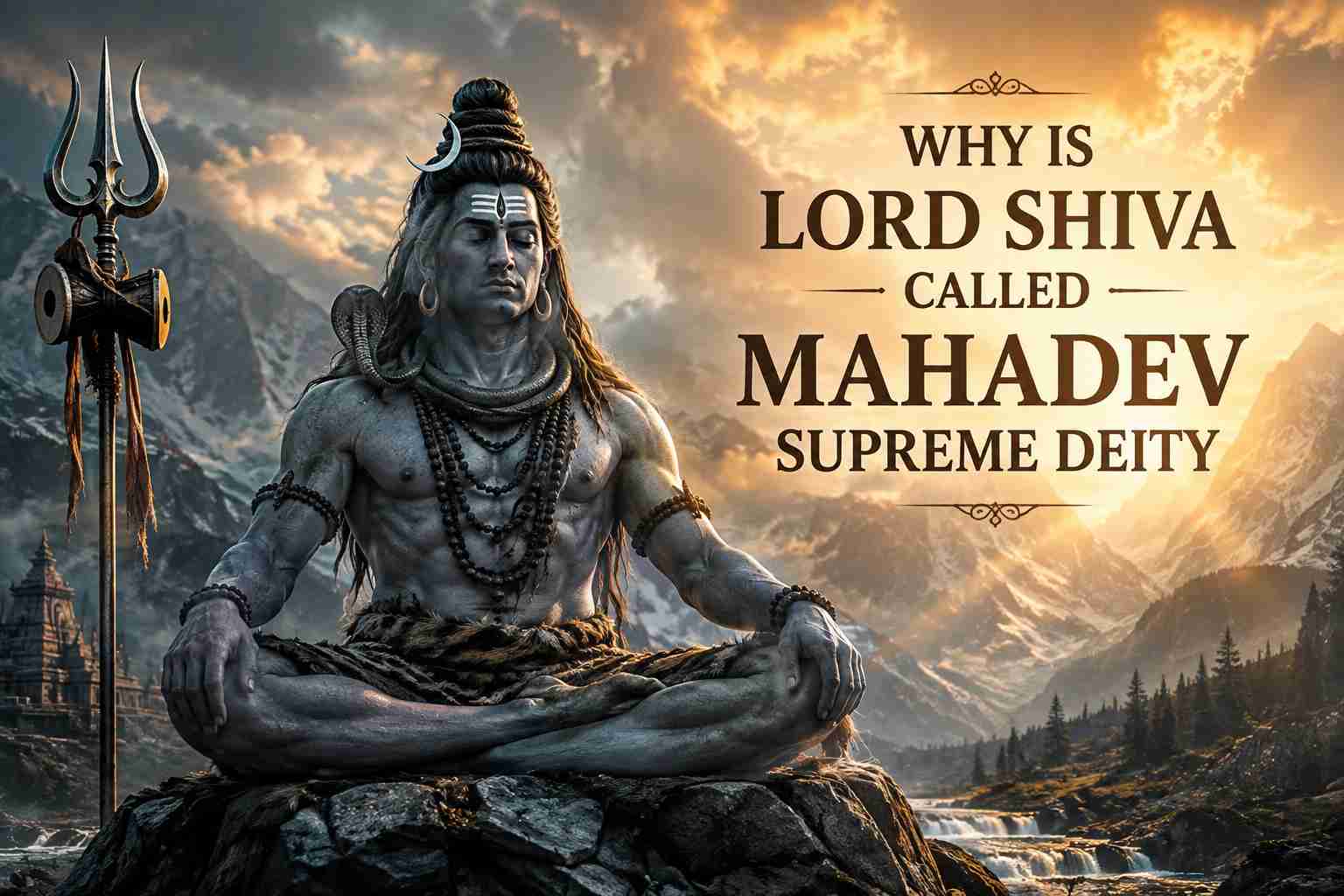
In the vast and intricate pantheon of Hindu deities, Lord Shiva occupies a paramount position as part of the Holy Trinity (Trimurti) alongside Lord Brahma and Lord Vishnu. While he is famously known as the destroyer, his most reverent title is 'Mahadev,' which translates to 'The Great God' or 'God of Gods.' But why is this specific title bestowed solely upon him? The answer lies not just in ancient scriptures and mythological tales, but in the profound philosophical symbolism that Shiva represents. This comprehensive guide dives deep into the origins, stories, and spiritual meaning behind why Lord Shiva is eternally known as Mahadev.
Sacred Heritage
Timeless Temple Tradition
Architectural Wonder
Ancient Vedic Mastery
Scriptural Origin
Puranic & Epic History
Spiritual Sadhana
Living Faith & Wisdom
The Mythological Origins: The Churning of the Ocean
One of the most prominent stories explaining why Shiva is called Mahadev stems from the Samudra Manthan, or the Churning of the Cosmic Ocean. During this monumental event, the Devas (gods) and Asuras (demons) worked together to churn the ocean in pursuit of Amrita, the divine nectar of immortality. However, before the nectar could appear, a terrifying and highly volatile poison known as Halahala emerged from the depths of the ocean. This lethal substance was so immensely toxic that its mere fumes began to destroy the cosmos, causing unimaginable panic among all celestial and mortal beings. Neither the powerful Devas nor the mighty Asuras possessed the strength or capability to contain this apocalyptic threat, leading them to seek divine intervention.
In this moment of absolute despair and cosmic crisis, all the celestial beings rushed to Mount Kailash to seek the help of Lord Shiva. Displaying ultimate compassion and unmatched supreme power, Shiva willingly agreed to consume the Halahala poison to save the universe from total annihilation. To prevent the venom from entering his stomach and destroying the countless universes residing within him, Goddess Parvati quickly placed her hands around his throat, freezing the poison right there. This act caused his neck to turn a deep, radiant blue, earning him the famous name Neelkanth. Witnessing this unparalleled act of selfless sacrifice, where he absorbed the universe's ultimate suffering to protect all living entities, the gods recognized his absolute supremacy and universally hailed him as 'Mahadev'—the greatest of all gods.
The Philosophical Significance of the Supreme Being
Beyond the captivating mythological narratives, the title Mahadev carries immense and profound philosophical weight in Hindu theology. Within the framework of Shaivism, Lord Shiva is not viewed merely as the god of destruction within the Trimurti, but rather as the absolute Supreme Being who encompasses all cosmic functions. He is responsible for the continuous cycle of creation, preservation, dissolution, concealing grace, and revealing grace, known as the Panchakritya. He is the infinite, formless, and transcendent reality known as Brahman, from which the entire universe emanates and into which it ultimately dissolves. This all-encompassing nature makes him the deity who stands above all earthly and celestial limitations.
Furthermore, Lord Shiva perfectly embodies the state of pure, untainted consciousness and ultimate detachment. Unlike other deities who are often associated with specific royal attributes, kingdoms, or jurisdictions, Shiva exists simultaneously as everything and nothing (Shunya). His austere ascetic lifestyle, spending eons meditating in the freezing Himalayas while covered in cremation ash, signifies his utter detachment from material wealth and worldly illusions. To be Mahadev means to exist far beyond the everyday dualities of life and death, joy and immense sorrow, or what society deems pure and impure. It is this absolute supremacy over the restless mind, the fragile ego, and the entire physical universe that elevates his spiritual status, making him the undisputed God of Gods.
Why this matters today
Discover why Lord Shiva is revered as Mahadev, the God of Gods. Explore the mythological stories, spiritual significance, and profound symbolism in Hinduism.
Related Topics
Frequently asked questions
What does the word 'Mahadev' literally mean?
The word 'Mahadev' is derived from Sanskrit, where 'Maha' means Great and 'Dev' means God. Thus, it translates to 'The Great God' or 'The Supreme Deity'.