
The Deep Meaning of Lord Vishnu Resting on the Cosmic Serpent
Discover the profound Hindu cosmology behind Lord Vishnu resting on the multi-headed serpent Sheshnag in the cosmic ocean of milk (Kshirasagara).
Bhakti Voice
Writer & Research Team
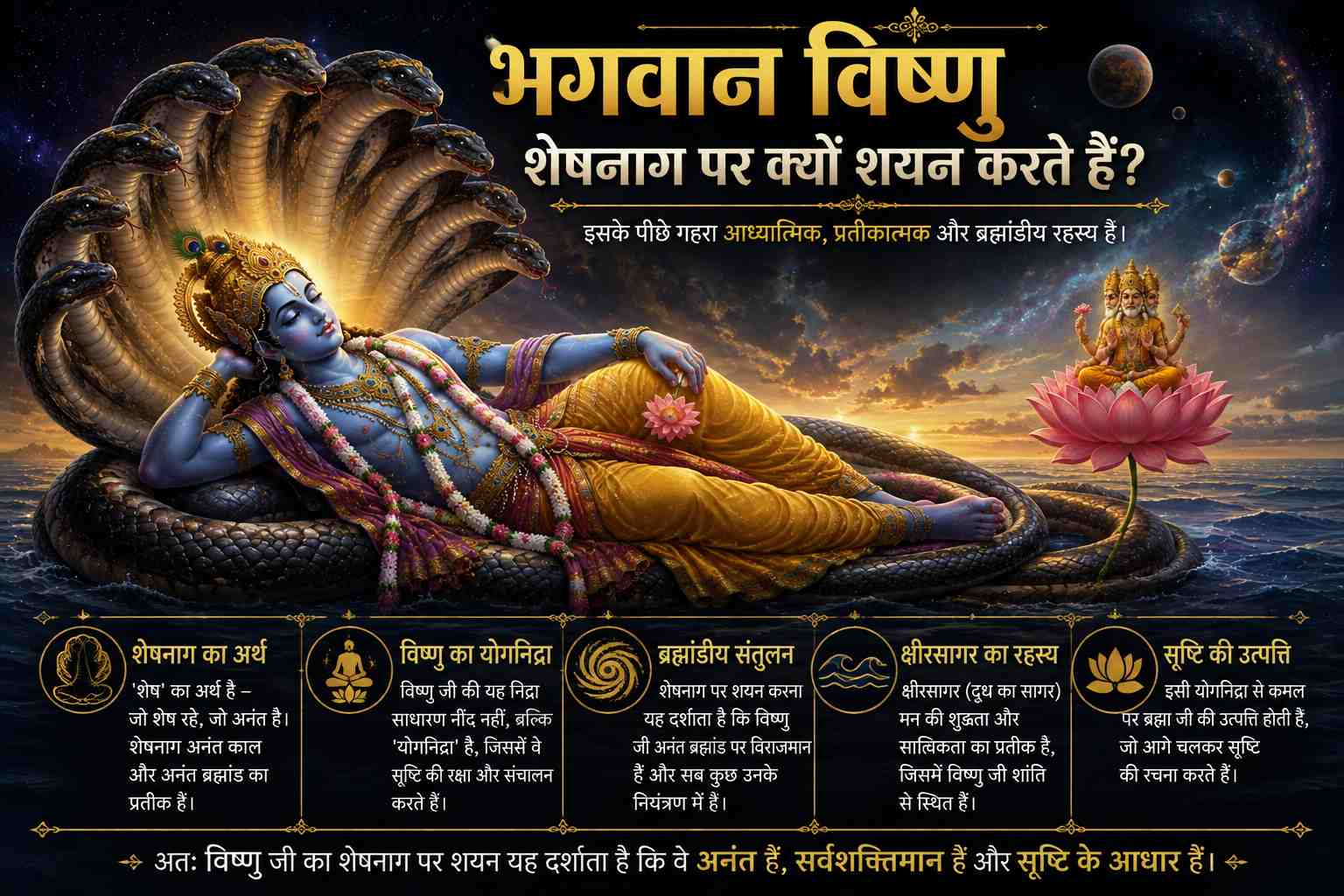
The visual representation of Lord Vishnu, the preserver of the universe, is both majestic and enigmatic. He is often depicted in a state of tranquil slumber (Yoga Nidra), resting upon the coils of a giant, multi-headed serpent known as Sheshnag or Ananta Shesha, floating on the Kshirasagara (the Cosmic Ocean of Milk). Goddess Lakshmi gently massages his feet while a lotus emerges from his navel, seating Lord Brahma. To the uninitiated, sleeping on a fierce serpent in a chaotic ocean might seem bizarre. However, in Hindu philosophy, this imagery is a magnificent blueprint of cosmic balance, time, and the state of enlightenment.
Sacred Heritage
Timeless Temple Tradition
Architectural Wonder
Ancient Vedic Mastery
Scriptural Origin
Puranic & Epic History
Spiritual Sadhana
Living Faith & Wisdom
The Symbolism of Sheshnag as Infinite Time
The ancient Sanskrit word 'Shesha' profoundly translates to 'the remainder' or 'that which is ultimately left over.' According to complex Hindu cosmology, when the entire physical universe is completely destroyed at the dramatic end of an immensely long aeon (a cosmic cycle known as a Kalpa), absolutely everything dissolves back into a dark, formless, unmanifested void. However, the one single entity that consistently remains completely unaffected after this total universal dissolution is Shesha. The massive, awe-inspiring serpent with its multiple, towering hoods directly and perfectly represents the infinite, unending, and cyclical nature of time itself, rightfully earning the alternative title of Ananta, which translates to endless or boundless.
The iconic image of Lord Vishnu resting entirely peacefully and comfortably on the massive coils of this terrifying serpent profoundly signifies that the Supreme Divine Consciousness (represented by Vishnu) exists entirely beyond the strict, binding limitations of physical time. He is the ultimate master who governs, observes, and directs time, rather than being a mortal subject subjected to its relentless ravages. Furthermore, the thousand magnificent hoods of the serpent pointing steadily inwards act as an invincible cosmic canopy of supreme protection. They symbolically represent the countless myriad desires, chaotic thoughts, and volatile gravitational forces of the active universe that are ultimately controlled, perfectly balanced, and effortlessly harmonized by the calm will of the Supreme Lord.
Maintaining Supreme Peace Amidst Worldly Chaos
The vast, turbulent expanse known as the Ocean of Milk (Kshirasagara) effectively represents the inherently chaotic, ever-churning mind of an ordinary human being, as well as the deeply tumultuous nature of the material world. This world is constantly filled with endless, crashing waves of birth, painful death, fleeting joy, and profound sorrow that rock the human soul. A snake, by its very biological nature, is universally considered a creature heavily associated with lethal poison, sudden danger, and deep instinctual fear. Yet, despite being surrounded by crashing cosmic waves and resting on a creature of death, Lord Vishnu lies comfortably upon it with an incredibly serene, deeply blissful smile radiating eternally on his divine face.
This striking, deliberate visual contrast imparts a profoundly important and highly practical spiritual lesson to all serious seekers. It beautifully teaches that even while existing directly amidst the poisonous fears, intense anxieties, and chaotic, unpredictable waves of modern worldly life, a person who is firmly established in eternal truth and higher inner consciousness can remain completely peaceful. Vishnu is definitely not idly sleeping or ignoring the universe; he is engaged in Yoga Nidra, a highly advanced state of hyper-aware, dynamic meditative rest. In this remarkable state, he is constantly preserving the delicate balance of the vast universe without ever being mentally or emotionally disturbed by its relentless turbulence and noise.
Why this matters today
Discover the profound Hindu cosmology behind Lord Vishnu resting on the multi-headed serpent Sheshnag in the cosmic ocean of milk (Kshirasagara).
Related Topics
Frequently asked questions
What does Sheshnag represent?
Sheshnag represents infinite time (Ananta) and the cosmic energy on which the universe rests.