
The Mythological and Symbolic Reasons Behind Ganesha's Elephant Head
Read the fascinating story of how Lord Ganesha got his elephant head. Discover the profound symbolism of wisdom, intelligence, and removing obstacles.
Bhakti Voice
Writer & Research Team
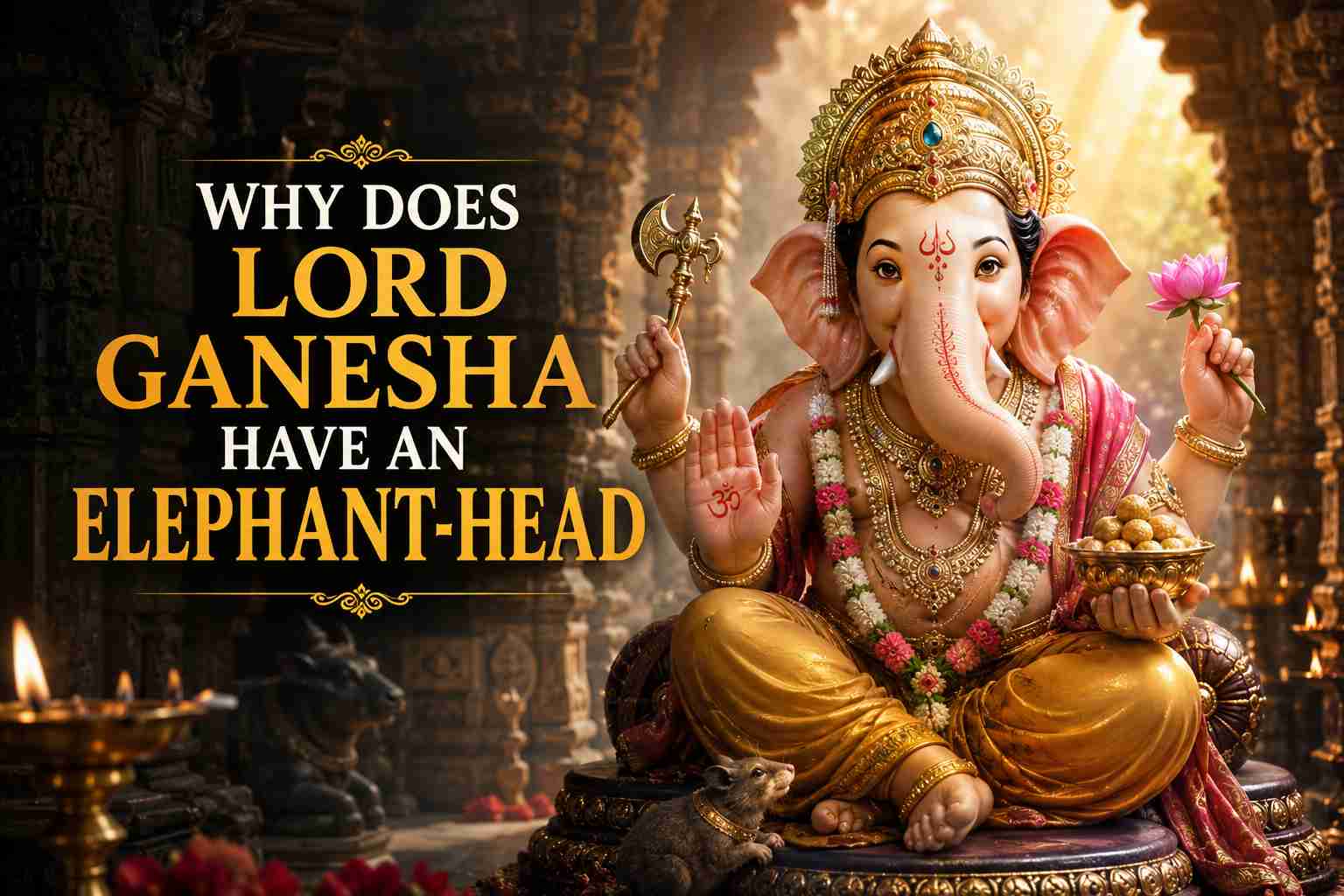
Lord Ganesha, the remover of obstacles and the god of wisdom, is arguably one of the most recognizable and beloved deities in the Hindu pantheon. His unique appearance—a human body adorned with the head of an elephant—captivates devotees and curious minds alike. While it might seem like a whimsical mythological quirk, the story of how Ganesha acquired this head is a profound tale of duty, anger, sorrow, and divine intervention. Beyond the literal story, the elephant head is laden with philosophical symbolism, representing the highest ideals of wisdom and intellect.
Sacred Heritage
Timeless Temple Tradition
Architectural Wonder
Ancient Vedic Mastery
Scriptural Origin
Puranic & Epic History
Spiritual Sadhana
Living Faith & Wisdom
The Legend of the Tragic Beheading
According to the sacred texts of the Shiva Purana, Goddess Parvati intensely desired a loyal guardian who would answer only to her commands without question. While she was preparing for a ceremonial bath, she gathered the fragrant dirt and sandalwood paste from her own divine body to sculpt the remarkably lifelike form of a young boy. With her immense divine power, she breathed life into this sculpture, lovingly claiming him as her loyal son, and instructed him to fiercely guard the entrance to her bath. She explicitly commanded him that under no circumstances should anyone be allowed to enter the premises while she was inside. Shortly after, when Lord Shiva, Parvati’s formidable husband, returned from his eons-long deep meditation in the mountains, he surprisingly found his familiar path blocked by this strange, defiant young boy. Completely unaware that this brave child was actually his own son, and being entirely accustomed to having unimpeded access to his own dwelling, Shiva sternly demanded immediate entry, but the young Ganesha, completely unwavering in his absolute devotion to his mother's strict command, firmly refused to step aside.
What started as a simple refusal rapidly escalated into a fierce and chaotic battle outside the divine dwelling. The incredibly mighty Lord Shiva, temporarily blinded by momentary anger, immense ego, and the frustration of being denied entry into his own home, ultimately used his invincible and terrifying trident (Trishul) to violently sever the courageous boy's head from his shoulders. When Goddess Parvati finally emerged from her bath and saw her beloved son lying tragically lifeless on the ground, she was instantly consumed by unimaginable maternal grief and an apocalyptic fury that severely threatened to destroy the entire fabric of the universe. Realizing the devastating magnitude of his grave mistake, a deeply remorseful Shiva immediately ordered his loyal followers (the Ganas) to journey north and bring back the head of the first living creature they found sleeping with its head facing the auspicious northern direction. They soon encountered a majestic elephant, respectfully brought its massive head back, and Shiva gracefully placed it upon the young boy's body, fully restoring his vibrant life and officially naming him Ganapati—the undisputed leader of the Ganas.
The Profound Symbolism of the Elephant Head
In deeply rooted Hindu philosophical thought, a magnificent elephant intrinsically represents immense, unmatched intelligence, unwavering loyalty, and formidable, quiet strength. The distinctively large elephant head adorning Lord Ganesha beautifully symbolizes his supreme, all-encompassing wisdom and a vast, unparalleled intellect that is absolutely necessary to comprehend the most profound and complex truths of the universe. His remarkably large, fan-like ears continuously encourage all devotees to listen much more than they speak—to actively absorb valuable spiritual knowledge, closely pay attention to the subtle teachings of the gurus, and compassionately hear the heartfelt prayers of those who are suffering. Furthermore, his relatively small, highly focused eyes masterfully represent razor-sharp concentration and the unique, critical ability to look far past the deceptive illusion (Maya) of the surrounding material world to clearly see the underlying, eternal spiritual reality.
The incredibly versatile elephant's trunk is a remarkable and highly sophisticated natural tool, powerfully capable of violently uprooting massive, deeply rooted trees, yet delicate enough to gently pick up a tiny, fragile needle from the ground. This extraordinary physical feature perfectly symbolizes supreme adaptability and high functional efficiency, constantly teaching his devoted followers that a truly enlightened and balanced mind can easily tackle massive, overwhelming earthly problems while simultaneously remaining acutely attuned to the most minute, delicate, and subtle spiritual details of daily life. Thus, through profound divine intervention, the elephant head miraculously transforms what initially appears to be a deeply tragic, violent family story into an eternal, masterclass lesson on achieving a balanced, spiritually rich living and attaining ultimate divine wisdom.
Why this matters today
Read the fascinating story of how Lord Ganesha got his elephant head. Discover the profound symbolism of wisdom, intelligence, and removing obstacles.
Related Topics
Frequently asked questions
Who severed Ganesha's original head?
Lord Shiva severed Ganesha's original human head in a fit of rage.