
The Mystical Secrets of Nidhivan in Vrindavan: The Midnight Raas Leela
Explore the chilling and profound mysteries of Nidhivan in Vrindavan, where trees turn into Gopis and Lord Krishna performs Raas Leela every single night.
Vedic Wisdom
Writer & Research Team
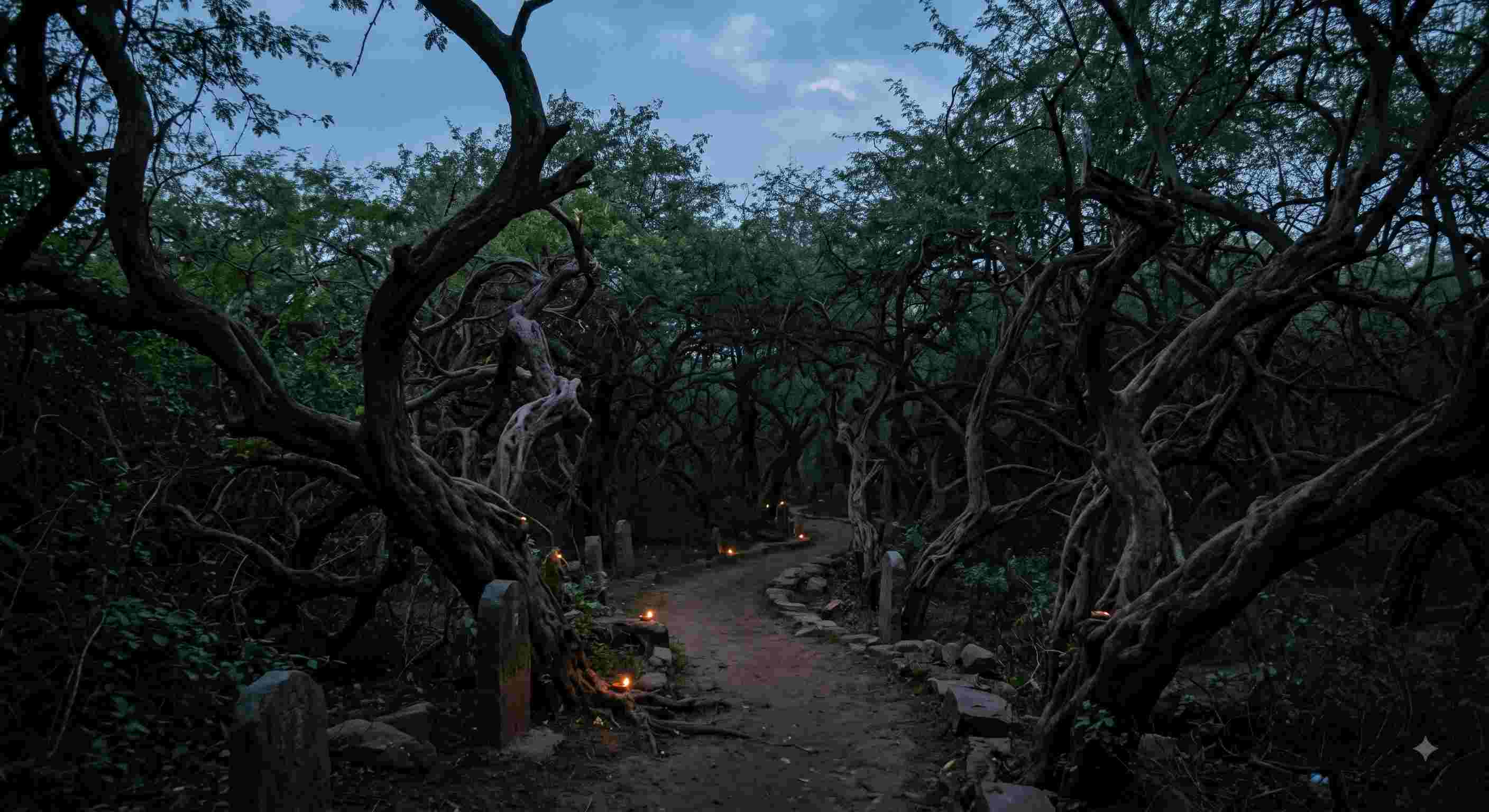
Vrindavan is a sacred city echoing with the divine pastimes of Lord Krishna. However, amidst its crowded streets and magnificent temples lies a dense, quiet forest wrapped in profound and chilling mystery—Nidhivan (The Forest of Treasures). It is firmly believed by locals, priests, and saints alike that even today, Lord Krishna and Radha Rani descend into this exact forest every single night to perform the divine 'Raas Leela' (the cosmic dance of love) with the Gopis. The energy of this place is so potent and secretive that strict rules govern the space. After sunset, the gates are locked, and no human, animal, or even a bird is allowed to stay inside. Let's explore the unexplainable, spine-tingling mysteries of Nidhivan.
Sacred Heritage
Timeless Temple Tradition
Architectural Wonder
Ancient Vedic Mastery
Scriptural Origin
Puranic & Epic History
Spiritual Sadhana
Living Faith & Wisdom
The Shape-Shifting Trees of Nidhivan
The flora of Nidhivan completely defies basic botany. The forest is predominantly filled with Tulsi (basil) trees. Unusually, these trees do not grow straight up towards the sunlight; instead, their branches bend downwards to touch the dry soil, tangling with neighboring trees to form dense, impassable canopies.
Furthermore, these Tulsi plants always grow in pairs. Despite the soil of Vrindavan being dry in this area, the leaves remain vibrantly green throughout the year. Devotees believe that these pairs of trees represent the Gopis. As night falls, a divine illusion (Maya) envelops the forest, and these trees transform into human forms to partake in the ecstatic dance of Raas Leela with Krishna, only to return to their wooden, tangled forms by dawn.
The Unexplainable Miracles of the 'Rang Mahal'
At the very heart of Nidhivan lies a small, beautifully decorated shrine known as the 'Rang Mahal' (The Colorful Palace). This is believed to be the resting place for Radha and Krishna after their exhausting midnight dance.
Every evening before the temple priests lock the heavy wooden gates, they meticulously prepare the room. They set up a bed decorated with fresh flowers, lay out a clean saree and bangles for Radha Rani, and leave behind a silver glass of water, neem twigs for brushing teeth (Daatun), paan (betel leaves), and some sweets.
Miraculously, when the priests unlock the doors the next morning at 5:30 AM, the scene is astonishing. The bed looks slept in and crushed, the water has been consumed, the datun is chewed, the bangles are scattered, and the paan is half-eaten. This daily phenomenon remains scientifically unexplainable and cements the faith of millions.
The Rule of Complete Evacuation
Because the Raas Leela is a profoundly intimate and cosmic event, no mortal eyes are permitted to witness it. After the evening Aarti around 8:00 PM, a strict evacuation protocol is followed. Not a single priest, saint, or tourist is allowed to remain inside the premises.
Even more surprisingly, the monkeys, birds, and insects that heavily populate the forest during the day mysteriously vacate the area before nightfall. The houses built around the perimeter of Nidhivan have a strict rule: windows overlooking the forest are either permanently bricked up, or the residents voluntarily close their thick curtains, refusing to look out, respecting the divine privacy of their beloved Lord.
The Fate of Those Who Stayed Behind
Human curiosity is boundless, and over the centuries, several people—ranging from skeptical researchers to overzealous devotees—have attempted to hide inside Nidhivan after dark to capture or witness the truth.
According to local police records and deeply held folklore, the results have always been tragic. Anyone found inside the forest the next morning has either lost their eyesight, lost their ability to speak, or suffered a complete mental breakdown, unable to narrate what they saw. The overwhelming, raw divine energy of the Supreme Lord is simply too much for the mortal body and mind to process.
The Birthplace of Banke Bihari
Nidhivan is not just the site of the Raas Leela; it holds immense historical significance. In the 15th century, the great saint and musician Swami Haridas (the guru of Tansen) used to sit in Nidhivan and sing devotional songs (Bhajans) to please Lord Krishna.
Pleased by his pure, unadulterated devotion, Lord Krishna and Radha Rani physically appeared before him. Realizing that common people would not be able to handle their divine brilliance, Swami Haridas requested them to merge into a single form. Thus, a beautiful black idol emerged from the earth of Nidhivan. Today, this exact idol sits in the world-famous Banke Bihari Temple in Vrindavan.
Why this matters today
Explore the chilling and profound mysteries of Nidhivan in Vrindavan, where trees turn into Gopis and Lord Krishna performs Raas Leela every single night.
Related Topics
Frequently asked questions
What happens if someone stays in Nidhivan at night?
According to deeply held local legends, anyone who has secretly stayed behind at night to witness the Raas Leela has suffered severe consequences. They are found the next morning having lost their sight, hearing, speech, or their mental balance due to the overwhelming, unbearable divine energy.
Why are the trees in Nidhivan so uniquely shaped?
The flora in Nidhivan consists entirely of Tulsi (basil) trees. Uniquely, their branches grow downwards towards the earth and are tangled in pairs. Locals believe these pairs represent the Gopis, and at night, they transform into human forms to dance with Lord Krishna.
Is there a scientific explanation for Nidhivan's mysteries?
Botanists suggest the downward growth of trees could be due to phototropism or specific soil conditions. However, science cannot fully explain how the items left in the locked Rang Mahal (like half-eaten paan and crushed beds) are found consumed every morning.
Who was Swami Haridas and what is his connection to Nidhivan?
Swami Haridas was a great saint, musician, and the guru of Tansen. He used to meditate in Nidhivan. Pleased by his devotion, Lord Krishna and Radha appeared before him. It was in Nidhivan that the famous idol of 'Banke Bihari' physically manifested from the earth.