
Maa Kali Ka Rahasya: Unlocking the Deep Spiritual Symbolism of Goddess Kali
Discover the profound spiritual symbolism and mystery of Maa Kali. Uncover the real meaning behind her dark complexion, protruding tongue, and garland of skulls.
Spiritual Insight
Writer & Research Team
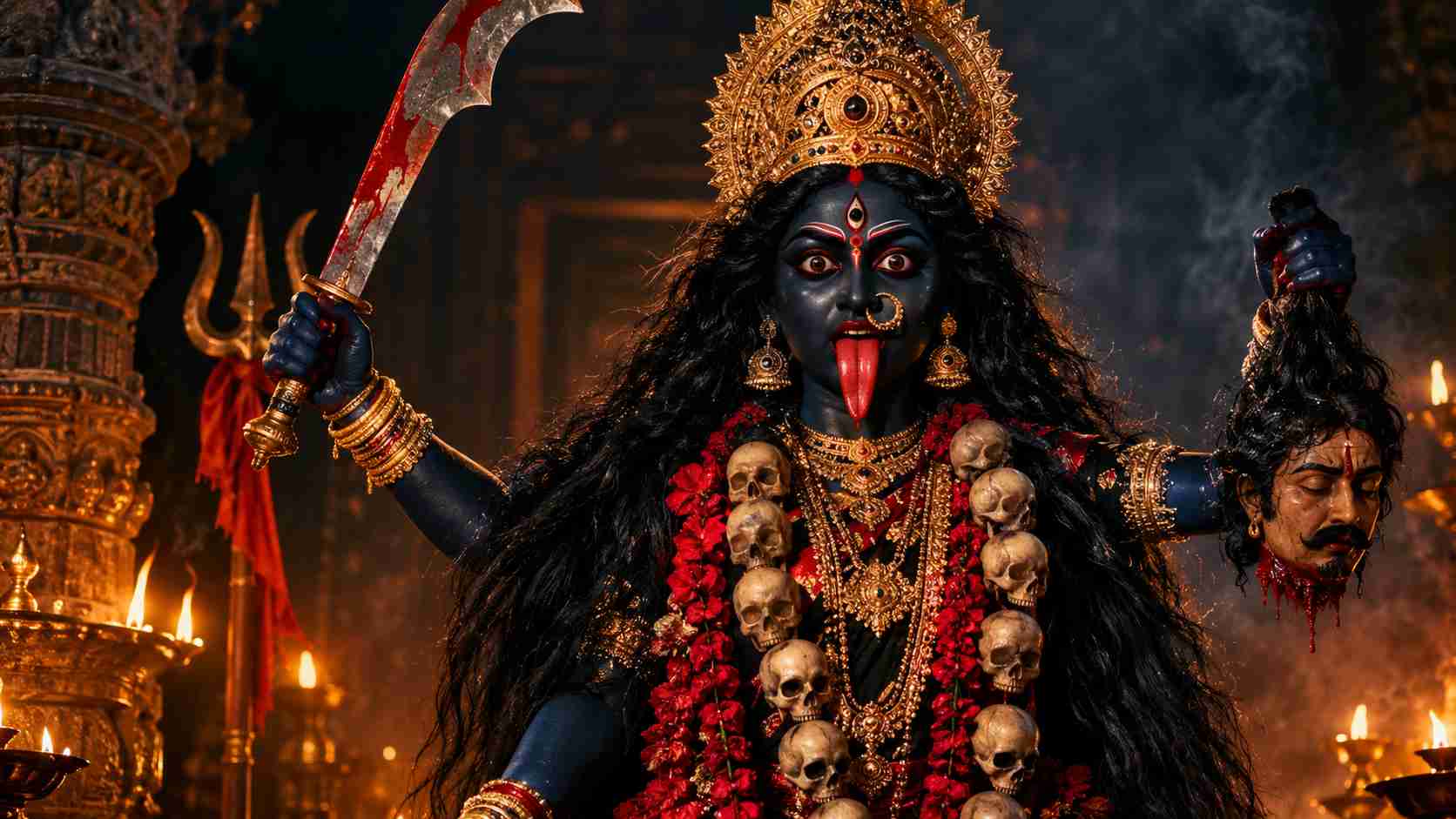
To the uninitiated eye, the form of Goddess Kali might appear terrifying, chaotic, and fierce. However, Maa Kali ka rahasya (The mystery of Mother Kali) is one of the most profound spiritual concepts in Hinduism. Every terrifying element of her iconography is a deeply coded symbol of cosmic truth, liberation, and ultimate maternal compassion.
Sacred Heritage
Timeless Temple Tradition
Architectural Wonder
Ancient Vedic Mastery
Scriptural Origin
Puranic & Epic History
Spiritual Sadhana
Living Faith & Wisdom
The Divine Paradox: Understanding the Mystery of Maa Kali
Maa Kali is arguably the most misunderstood deity in the Hindu pantheon. At a glance, her imagery is violent, bloody, and formidable. She is depicted standing on the chest of Lord Shiva, her tongue protruding, holding a severed head, wearing a garland of skulls and a skirt of severed arms. For centuries, this has sparked a central question: Maa Kali ka rahasya kya hai (What is the mystery of Mother Kali)? Why is the ultimate divine mother portrayed in such a frightening manner?
To understand Goddess Kali, one must look past the literal interpretation and delve into the esoteric realms of Advaita Vedanta and Tantric philosophy. Her form is not a depiction of evil or malevolence; rather, it is a masterclass in profound spiritual symbolism. She represents the unmanifested energy of the universe, the raw, unfiltered truth of existence, and the ultimate dissolution of the ego.
As the goddess of Time (Kala) and Change, she is the eternal void from which all creation springs and into which all creation must eventually return. In this comprehensive guide, we will break down every element of her divine form to reveal the ultimate compassion that lies hidden within her fierce exterior.
Why is Goddess Kali Black? (The Symbolism of Darkness)
The name 'Kali' is derived from the Sanskrit word 'Kala', which means both Time and Darkness. Her dark blue or pitch-black complexion is not an earthly color but a representation of the infinite, formless cosmos.
- The Infinite Void: Just as infinite space appears black and mysterious to the human eye, Kali is the boundless void. She is Nirguna (beyond attributes).
- Absorption of All Colors: In science, black is the absorption of all colors. Similarly, Goddess Kali absorbs all energies, all worldly illusions, and all dualities (good/bad, light/dark) into herself.
- Timelessness: She existed before the creation of the universe when there was nothing but absolute darkness, and she will remain after the universe is destroyed.
Her nakedness (Digambari - clad in space) further emphasizes this point. She is infinite and cannot be clothed or bound by finite, worldly garments. She is the raw, unconditioned reality.
The Protruding Tongue: A Dance of Passion and Purity
One of the most striking features of Maa Kali's iconography is her protruding red tongue, clamped between her white teeth. Mythologically, this moment captures the climax of her battle with the demon Raktabija.
Intoxicated by the blood of the demons and the frenzy of battle, Kali's destructive dance threatened to destroy the entire universe. To stop her, Lord Shiva threw himself among the corpses on the battlefield. When Kali inadvertently stepped on her husband's chest, she realized her mistake. The shock brought her out of her battle trance, and she bit her tongue in shame.
The Philosophical Meaning:
From a spiritual perspective, the red tongue represents Rajasic Guna (passion, action, and kinetic energy). The white teeth represent Sattvic Guna (purity, peace, and spiritual wisdom). By biting her tongue with her teeth, Kali teaches us that our unchecked desires and wild actions (Rajas) must always be controlled and conquered by pure, spiritual wisdom (Sattva).
The Garland of Severed Heads (Mundamala): Slaying the Ego
Perhaps the most terrifying aspect of Maa Kali is the garland of severed heads she wears around her neck. This garland, known as the Mundamala, typically consists of exactly 50 or 108 heads. While it looks gruesome, its meaning is entirely liberating.
The heads represent the human Ego (Ahamkara). When Kali severs a head, she is not killing a human being; she is cutting off the false sense of "I" and "Mine" that binds the soul to the material world. The ego is the greatest demon a spiritual seeker must face. Mother Kali, in her infinite compassion, destroys this ego so the soul can achieve Moksha (liberation).
Furthermore, the 50 heads correspond to the 50 letters of the Sanskrit alphabet (Varnamala). Sanskrit is considered the language of vibration and creation. By wearing the letters around her neck, Kali demonstrates that she is the mother of all sound, all vibration, and all knowledge. Once the illusion of the physical world is destroyed, absolute wisdom remains.
The Skirt of Severed Arms: Freedom from Karma
Maa Kali wears a skirt made entirely of severed human arms. To understand this, we must look at what arms and hands represent in Hindu philosophy. Hands are the primary instruments of Karma (action). Through our hands, we work, we build, we grasp, and we accumulate karmic debt.
The skirt of severed arms symbolizes that Maa Kali frees her devotees from the endless cycle of Karma. When a devotee surrenders to her completely, she severs their attachment to their actions and the fruits of their actions. She cuts away the karmic bonds that tie the soul to the cycle of birth and death (Samsara).
By wearing our karmic deeds around her waist, she takes the burden of karma upon herself, protecting her children and allowing them to walk the path of spiritual freedom unhindered.
The Four Arms: The Balance of Creation and Destruction
Maa Kali is often depicted with four arms, holding distinct items that represent the dual nature of the divine—both destructive and protective.
- Upper Left Hand (Holding a bloodied sword - Khadga): This sword is the sword of divine knowledge. It cuts through the veil of ignorance (Maya) and severs the bonds of materialistic attachment.
- Lower Left Hand (Holding a severed demon head): The severed head is the ego, completely detached from the physical body by the sword of knowledge.
- Upper Right Hand (Abhaya Mudra): This hand gesture signifies "Fear not." Despite her terrifying form, she is reassuring her devotees that they are protected from all fears and negativities.
- Lower Right Hand (Varada Mudra): This is the gesture of granting boons. She offers blessings, spiritual wealth, and ultimate liberation to those who seek her with a pure heart.
Standing on Lord Shiva: The Union of Consciousness and Energy
The imagery of Goddess Kali standing on the chest of a supine Lord Shiva is deeply symbolic in Tantric philosophy. Shiva represents Purusha (pure consciousness, the passive, unmoving, static aspect of reality). Kali represents Prakriti or Shakti (kinetic energy, the active, moving, dynamic force of creation).
Without Shakti, Shiva is 'Shava' (a corpse). Consciousness without energy cannot manifest or act. Conversely, energy without consciousness is pure, chaotic destruction. By standing on Shiva's chest, Kali shows the perfect balance: the dynamic energy of the universe (Kali) must be grounded and supported by ultimate, peaceful consciousness (Shiva).
They are not two separate entities but one unified whole. The divine play of the cosmos only exists because of the union of Shiva and Shakti.
Conclusion: The Ultimate Mother
The Maa Kali Ka Rahasya teaches us not to judge by external appearances. What looks like death and destruction to the physical eyes is actually the highest form of spiritual purification. She is the loving mother who does not hesitate to take extreme measures to discipline her children and save them from the demons of their own minds.
Worshipping Maa Kali is not about dark magic or invoking fear; it is the ultimate act of surrender. It is asking the Divine Mother to strip away everything that is false, to destroy our egos, and to liberate us from the painful cycle of karma. She is fierce because the forces of ignorance she battles are fierce. But to her devotees, she is the most compassionate and loving Mother of the Universe.
Why this matters today
Discover the profound spiritual symbolism and mystery of Maa Kali. Uncover the real meaning behind her dark complexion, protruding tongue, and garland of skulls.
Related Topics
Frequently asked questions
Why is Maa Kali depicted with a black complexion?
The word 'Kali' comes from 'Kala', meaning time and darkness. Her black or dark blue complexion represents the infinite space and the ultimate void. Just as all colors disappear into black, all universe and elements merge back into her at the end of time.
What is the meaning of Maa Kali's protruding tongue?
Her protruding tongue is a symbol of stepping out of extreme rage into realization. Mythologically, it happened when she accidentally stepped on her husband, Lord Shiva, and bit her tongue in shame. Philosophically, the red tongue represents Rajas (activity/passion) clamped by the white teeth representing Sattva (purity).
Why does she wear a garland of skulls?
Maa Kali wears a garland of exactly 108 or 50 severed heads (Mundamala). These represent the letters of the Sanskrit alphabet, the vibrations of the universe, and ultimately the destruction of human ego and false identification with the physical body.