
The Hidden Mystery of Kalkaji Mandir Delhi: Uncovering its Ancient Secrets
Explore the ancient mystery of Kalkaji Mandir in Delhi. Discover the history of the Swayambhu idol, its Mahabharata connection, and the legend of Maa Kali.
Spiritual Insight
Writer & Research Team
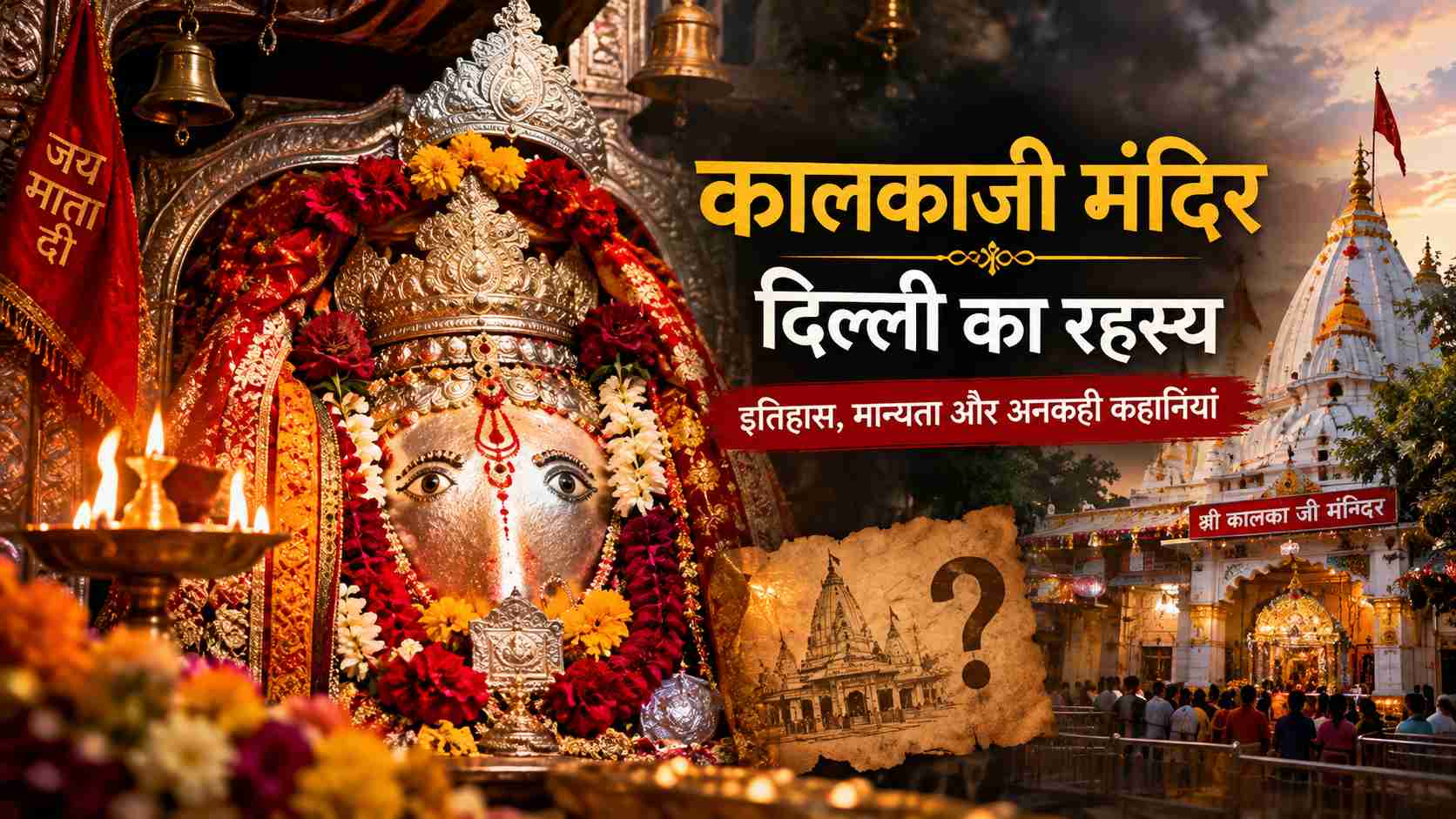
Situated in the bustling heart of South Delhi, the Kalkaji Mandir stands as a beacon of ancient spiritual power amidst a modern metropolis. Dedicated to Goddess Kali, this temple is not just a place of worship; it is a Swayambhu (self-manifested) shrine with roots tracing back to the Satya Yuga. The Kalkaji Mandir ka rahasya (mystery) lies in its unbroken lineage of cosmic energy, its connections to the Mahabharata, and its status as a Manokamna Siddha Peetha.
Sacred Heritage
Timeless Temple Tradition
Architectural Wonder
Ancient Vedic Mastery
Scriptural Origin
Puranic & Epic History
Spiritual Sadhana
Living Faith & Wisdom
The Origin: A Self-Manifested Shrine on Surya Koota Parvata
The most profound rahasya (mystery) of the Kalkaji Mandir is the origin of the deity herself. Unlike most temples where priests consecrate an idol through the Prana Pratishtha ceremony, the focal point of the Kalkaji Mandir is a Swayambhu (self-manifested) stone rock. This sacred rock, representing Goddess Kali, emerged naturally from the earth thousands of years ago on the Surya Koota Parvata, a part of the ancient Aravalli hill range.
Legend dictates that millions of years ago, during the Satya Yuga, the gods (Devtas) were being relentlessly tormented by two powerful demons, Raktabija and his associates. When the Devtas approached Lord Brahma for help, he directed them to Goddess Parvati. To answer their prayers, Goddess Parvati manifested a beautiful and fierce form from her own aura—Goddess Kaushiki. However, the battle birthed an even greater challenge.
The Mythological Secret: The Slaying of Raktabija
The core mythological secret tied directly to the Kalkaji region is the slaying of the demon Raktabija. Raktabija possessed a terrifying boon: whenever a drop of his blood fell to the earth, a clone of equal strength would instantly spring forth. As Goddess Kaushiki battled him, millions of demon clones covered the battlefield, rendering the fight impossible to win through normal combat.
In a moment of cosmic necessity, Goddess Kaushiki expanded her brow, and from her intense wrath emerged Goddess Kali—dark, ferocious, and unbound by the laws of nature. Maa Kali spread her massive tongue over the entire battlefield, ensuring that not a single drop of Raktabija's blood touched the ground. She consumed the demon's clones and drank Raktabija's blood entirely, slaying him and restoring balance to the universe.
It is strictly believed in Hindu scriptures that the very spot where Maa Kali manifested and ultimately rested after this ferocious battle is the exact location of the present-day Kalkaji Mandir in Delhi.
The Mahabharata Connection: The Pandavas' Worship
The history of Kalkaji Mandir bridges mythology and ancient history, bringing us to the Dwapara Yuga—the era of the Mahabharata (around 3000 BCE). Historical texts and strong local traditions assert that before the great Kurukshetra war, Lord Krishna brought the five Pandavas to this very shrine on the Aravalli hills.
Yudhishthira, Arjuna, and their brothers organized a massive holy ritual (Yagya) here. They prayed to the Swayambhu Goddess Kali, seeking her divine blessing to ensure the victory of Dharma (righteousness) over Adharma (injustice). The Goddess blessed them, and their subsequent victory in the Mahabharata further cemented the temple's reputation as a Jayanti Peetha—a place of ultimate victory.
Architectural Evolution: The 12 Doors and the Maratha Restoration
While the spiritual presence here is eternal, the physical structure of the temple has seen numerous transformations. The original ancient structure was lost to the ravages of time and foreign invasions. In the 18th century, the Maratha rulers recognized the immense spiritual power of the site and took the initiative to reconstruct the temple.
Later, the mid-19th century saw extensive renovations by Seth Kedarnath, the treasurer of Emperor Akbar II. A unique architectural feature of the Kalkaji Mandir is its 12-sided (dodecagonal) structure, made entirely of marble and black pumice stones. The temple has 12 historical doors representing the 12 months of the year, symbolizing that the Goddess is accessible to her devotees at all times, across all seasons. The sanctum sanctorum (Garbhagriha) contains the ancient Swayambhu rock, now adorned with eyes, a protruding tongue, and a silver canopy.
Manokamna Siddha Peetha: The Modern Day Miracle
Today, the ultimate mystery that draws millions of devotees to Kalkaji Mandir is its reputation as a Manokamna Siddha Peetha. This Sanskrit term translates to 'the shrine where all wishes are fulfilled.' Devotees from all walks of life report experiencing inexplicable peace and witnessing miracles in their personal lives after visiting the temple.
Particularly during the festival of Navratri, the temple turns into a vortex of immense spiritual energy. It is said that Maa Kali's presence is so dense here that one who sincerely meditates within the temple premises can feel a distinct vibrational shift in their consciousness. The rahasya of Kalkaji is not just in its past; it is in the active, living energy of the Divine Mother who continues to listen to and protect her children in the heart of modern Delhi.
Why this matters today
Explore the ancient mystery of Kalkaji Mandir in Delhi. Discover the history of the Swayambhu idol, its Mahabharata connection, and the legend of Maa Kali.
Related Topics
Frequently asked questions
What is the mystery of the idol at Kalkaji Mandir?
The main mystery is that the idol of Goddess Kali in the temple is 'Swayambhu' or self-manifested. It was not carved or installed by any human. It is believed to have appeared on its own on the Surya Koota Parvata (part of the Aravalli hills) thousands of years ago.
Did the Pandavas visit Kalkaji Mandir?
Yes, according to historical and mythological records, the Pandavas along with Lord Krishna visited this shrine to worship Goddess Kali and seek her blessings before the epic battle of Kurukshetra.
Why is Kalkaji Mandir called a Jayanti Peetha?
It is called a Jayanti Peetha or Manokamna Siddha Peetha because it is deeply believed that whatever a devotee truly desires and prays for at this shrine with a pure heart is invariably fulfilled by Maa Kali.