
Kailash Temple at Ellora: The Ancient Architectural Miracle Science Cannot Explain
Explore the engineering mysteries of Kailash Temple (Cave 16) at Ellora. Discover how 400,000 tons of rock were scooped from top to bottom in 18 years, subterranean tunnel secrets, and why Aurangzeb failed to destroy it.
Vedic Megalithic Research Group
Writer & Research Team
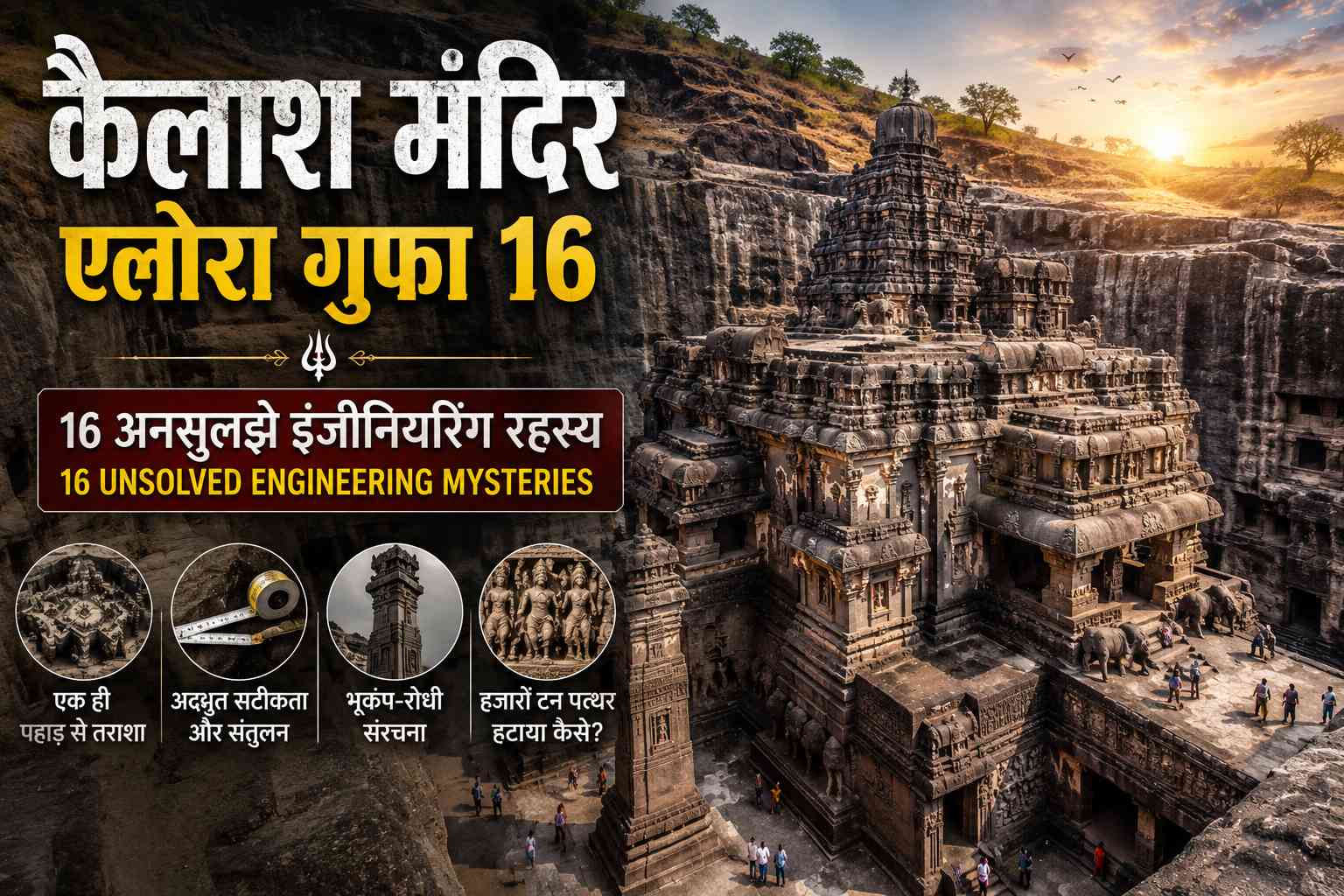
Carved straight out of the Charanandri hills in the Aurangabad (Chhatrapati Sambhaji Nagar) district of Maharashtra, Cave 16 of the Ellora complex—universally known as the **Kailashnath Temple**—stands as the most breathtaking, mind-boggling, and technologically confounding megalithic monument on planet Earth. Unlike virtually every other traditional architectural masterpiece created across human history, which was erected sequentially from the foundation stone upwards, the Kailash Temple was constructed in absolute reverse: **from the top of the mountain downwards**. Master sculptors chiseled away more than 200,000 to 400,000 tons of solid volcanic basalt rock with astonishing mathematical precision, carving out multi-story shrines, intricate drainage channels, expansive courtyards, life-sized war elephants, and two 50-foot freestanding victory pillars (Kirti Stambhas) without adding a single individual block of mortar or stone. Attributed officially to the Rashtrakuta monarch Krishna I in the 8th century CE, mainstream modern civil engineers, CAD architectural designers, and laser scanning experts remain paralyzed when attempting to calculate how such an astronomical excavation could be drafted, aligned, and completed in less than two decades using only primitive handheld hammers and chisels. This master guide explores the jaw-dropping geometry, missing excavated rock mystery, subterranean acoustic tunnels, and the spiritual energy that makes the Kailash Temple an enduring eternal portal to Shiva's celestial abode.
Sacred Heritage
Timeless Temple Tradition
Architectural Wonder
Ancient Vedic Mastery
Scriptural Origin
Puranic & Epic History
Spiritual Sadhana
Living Faith & Wisdom
The Impossible Monument: Why the Kailash Temple at Ellora Will Break Your Brain
Have you ever looked at a historical monument and thought, "There is absolutely no way humans built this"?
If you haven't, you need to look at the Kailash Temple at Ellora (Cave 16). Located in Maharashtra, India, this isn't just a beautiful piece of ancient history. It is a staggering, logic-defying masterpiece of ancient Indian engineering that continues to baffle modern architects, geologists, and historians today.
Let’s dive into why this UNESCO World Heritage site is arguably the most mind-bending piece of monolithic rock-cut architecture on the planet.
1. They Built It Backward (The Top-Down Mystery)
In literally every civil engineering project in human history, you start at the bottom. You lay a foundation on the bedrock, and you build your way up to the sky. If you make a mistake, you swap out a brick or patch it with mortar.
The architects of the Kailash Temple completely ignored that rule.
Instead of building up, they dug three massive trenches into the side of a solid basalt mountain, isolating a giant block of rock. Then, they started carving from the top down. The roof, the intricate spires, and the stone elephants were carved in the open air long before the ground floor or the supporting pillars even existed.
Think about the sheer precision required here. There was zero margin for error. If a sculptor struck the chisel too hard and cracked a load-bearing pillar, the entire temple would collapse. You can't glue a mountain back together. Yet, walking through its massive halls today, you won't find a single structural flaw.
2. The Math Simply Doesn't Add Up
Official historical records tell us that the temple was commissioned by the Rashtrakuta dynasty around 756–774 CE. It is estimated that it took roughly 18 to 20 years to complete.
Sounds reasonable, right? Until you do the math.
To hollow out the courtyards and shrines, workers had to excavate roughly 400,000 tons of solid volcanic rock. If they finished this in 18 years, workers would have had to manually chisel, crush, and haul away about 50 to 60 tons of rock every single day, working 12-hour shifts without a single day off.
That is 5 tons of solid rock removed per hour. All of this was done without steam power, dynamite, or modern machinery. It is a feat of human endurance that completely defies modern project management.
3. The 400,000-Ton Disappearing Act
Here is where things shift from "impressive" to downright mysterious.
When you dig 400,000 tons of dense basalt out of a mountain, it leaves a massive pile of rubble. You would expect to find a mountain of debris, or at least evidence that the crushed stone was used to build nearby roads or villages.
Yet, comprehensive geographical surveys around the Ellora Caves have found nothing. There is no dumping ground. There is no trail of debris. The rock just vanished. To this day, archaeologists have no concrete answer as to where half a million tons of mountain went, fueling wild theories ranging from lost medieval cities to ancient alien technology.
4. Art Woven into the Bedrock
It’s not just a big building; it’s an artistic triumph. The sculptures at Ellora are breathtaking, but none more so than the massive panel depicting Ravana shaking Mount Kailash.
The artists managed to carve a scene filled with frantic, dynamic energy—a demon king straining his muscles, a terrified goddess, and a perfectly calm Lord Shiva neutralizing the threat with a single toe—all out of dead, unyielding stone. The way the shadows fall across the 3D figures makes them look like they are about to step right out of the wall.
5. The Temple That Refused to Die
If you need proof of how indestructible this place is, just look at the year 1682. The Mughal Emperor Aurangzeb, notorious for destroying temples, sent an army of over 1,000 men to wipe the Kailash Temple off the map.
They hacked at it with axes, sledgehammers, and fire for three exhausting years.
The result? They barely made a dent. Because the temple isn't made of stacked stones that can be toppled over—it is literally part of the Earth's crust—the army could only deface a few statues and chip the outer walls. Exhausted and defeated by the mountain, Aurangzeb eventually gave up and called off the demolition.
Next time you hear about the wonders of the ancient world, make sure the Kailash Temple at Ellora is at the top of your list. It is a monument to human willpower, flawless mathematics, and a deeply held spiritual vision that literally moved mountains.
Why this matters today
Explore the engineering mysteries of Kailash Temple (Cave 16) at Ellora. Discover how 400,000 tons of rock were scooped from top to bottom in 18 years, subterranean tunnel secrets, and why Aurangzeb failed to destroy it.
Related Topics
Frequently asked questions
How was the Kailash Temple at Ellora constructed from top to bottom?
Master sculptors excavated deep trench cuts into the mountain to create a solid central rectangular rock mass. They then carved the finials, towers, ceilings, pillars, and finally the ground-level sanctum from top down, eliminating the need for wooden scaffolding.
Where did the 400,000 tons of excavated rock debris go?
This remains an unsolved archaeological riddle. No surrounding valleys, villages, or historical sites within a 50 km radius contain basalt debris matching the mineral footprint of the excavated mountain volume.
Why did Mughal Emperor Aurangzeb fail to destroy the Kailash Temple?
In 1682 CE, Aurangzeb sent over 1,000 workers to demolish the temple. After three years of continuous labor, they managed to disfigure only a few statues and deface some outer carvings because the solid mountain bedrock could not be brought down without explosives.
What is the Katha Kalpataru legend regarding the temple's rapid construction?
A local medieval text narrates that the queen of the realm took a vow to fast until she saw the temple's Shikhara (pinnacle). To save her life, master architect Kokasa devised the revolutionary top-down carving method to complete the Shikhara in just a few days.
Are there subterranean tunnels beneath Cave 16?
Yes, several narrow tunnels and blocked ventilation shafts lead into the mountain bedrock underneath the main plinth. Many are sealed off by the Archaeological Survey of India (ASI) due to oxygen deprivation and structural preservation.