
Why Did Lord Ganesha Lose One of His Tusks? 3 Fascinating Stories Behind It
जानें गणेश जी का एक दांत कैसे टूटा था। परशुराम जी से युद्ध, महाभारत लेखन या गजमुख असुर - जानिए भगवान गणेश के एकदंत होने की सभी पौराणिक कथाएं और उनके रहस्य।
Bhakti Voice Editorial Team
Writer & Research Team
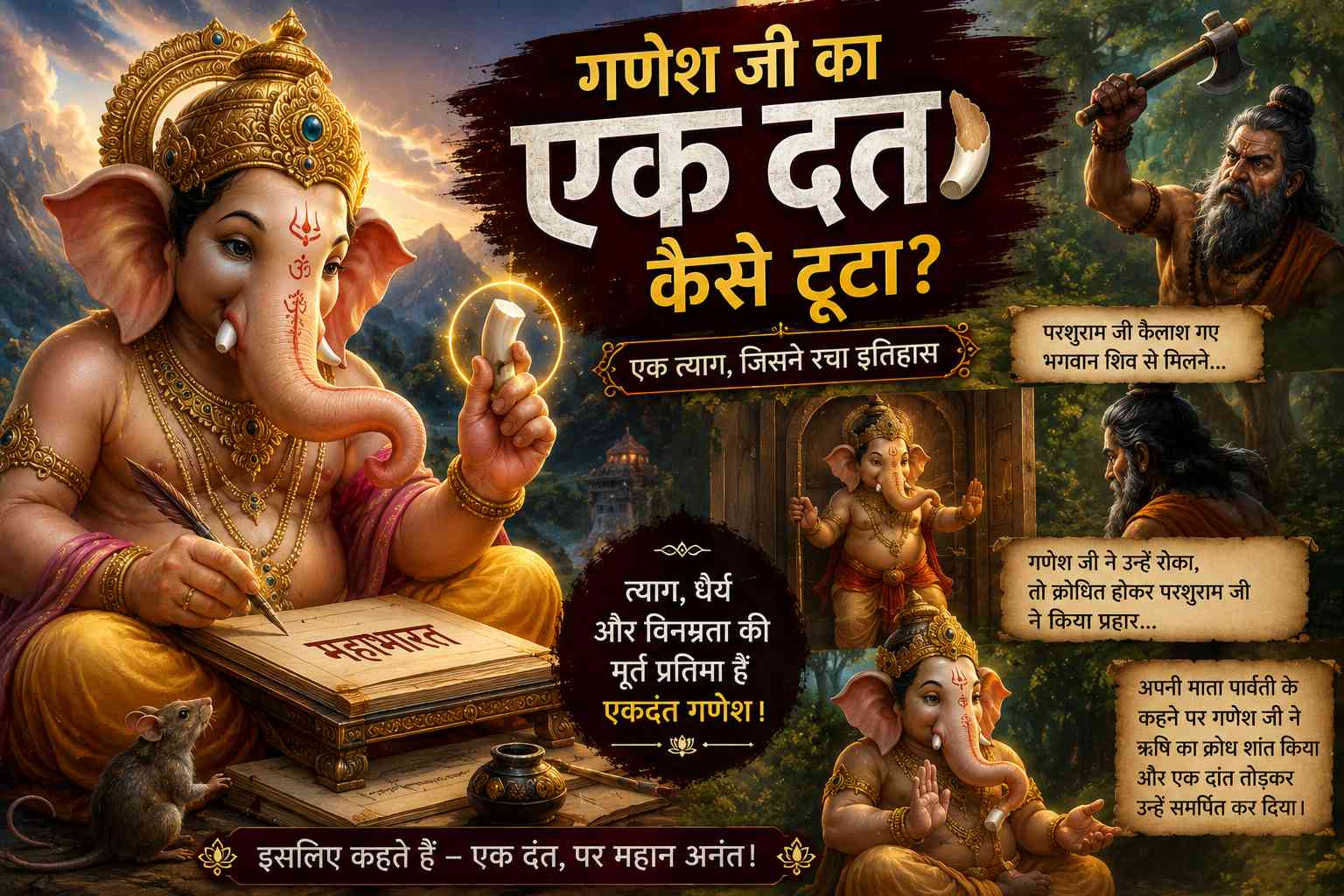
प्रथम पूज्य, विघ्नहर्ता और बुद्धि के देवता भगवान गणेश को हिंदू धर्म में सर्वोच्च स्थान प्राप्त है। उनकी हर एक विशेषता, रूप और स्वरूप के पीछे कोई न कोई गहरा आध्यात्मिक रहस्य छुपा हुआ है। गणपति के स्वरूप में सबसे विशिष्ट बात यह है कि उनका एक दांत पूर्ण है और दूसरा खंडित (टूटा हुआ) है। इसी वजह से उन्हें 'एकदंत' भी कहा जाता है। लेकिन क्या आपने कभी सोचा है कि भगवान गणेश का यह दांत कैसे टूटा था? क्या यह किसी भयानक युद्ध का परिणाम था, या फिर किसी महान उद्देश्य के लिए किया गया त्याग? आइए इस लेख में विस्तार से जानते हैं गणेश जी के एकदंत होने की सभी पौराणिक कथाओं के पीछे छिपे रहस्यों को।
Sacred Heritage
Timeless Temple Tradition
Architectural Wonder
Ancient Vedic Mastery
Scriptural Origin
Puranic & Epic History
Spiritual Sadhana
Living Faith & Wisdom
The Real Reason Why Lord Ganesha Has a Broken Tusk: The Complete Story of Ekdanta
When observing a beautiful idol of Ganpati Bappa, the elephant-headed deity of wisdom, intellect, and new beginnings, you will quickly notice a few defining physical traits. The majestic curving trunk, the large ears, the massive belly, and the gentle eyes all carry profound spiritual lessons. However, there is one striking feature that frequently sparks curiosity among devotees and researchers alike: Lord Ganesha’s broken tusk.
This distinct physical trait is not a sculptor's error; it is a highly sacred symbol that earned Him the revered name 'Ekdanta' (The One-Tusked Lord). If you have ever wondered, "why is Ganesha called Ekdanta?" or "why does Lord Ganesha have a broken tusk?", you are not alone. Far from being a physical flaw, this broken tusk represents supreme sacrifice, unwavering devotion, and the absolute victory of wisdom over ignorance. Let's dive deep into the ancient Hindu Puranas to explore the epic Ganesha broken tusk story.
Story 1: The Mahabharata Written by Ganesha (A Sacrifice for Knowledge)
One of the most famous and inspiring legends explaining how Ganesha lost his tusk involves the composition of the greatest Indian epic, the Mahabharata. According to ancient tradition, the great Sage Vyasa had formulated the massive epic poetry in his mind, but he needed a brilliant scribe capable of documenting it without making a single mistake.
Sage Vyasa approached Lord Ganesha to act as his writer. Ganesha, known as the god of supreme intellect, agreed, but He laid down one strict condition: Sage Vyasa must recite the verses continuously, without a single moment's pause. If he stopped, Ganesha would abandon the project.
In return, Sage Vyasa presented a brilliant counter-condition: Ganesha must fully comprehend the deep philosophical meaning of every single verse before writing it down.
As the dictation began, they progressed at a cosmic speed. Suddenly, due to the intense pace and heavy pressure of writing, Ganesha's wooden pen snapped. Realizing that stopping to look for a new stylus would break his vow to maintain the continuous flow of dictation, Ganesha did not hesitate for a second. He immediately reached up, broke off one of his own tusks, and used it as a pen. This is exactly how the Mahabharata written by Ganesha was completed without a single interruption.
The Spiritual Lesson: This extraordinary Ekdanta Ganesha story highlights that no sacrifice is too great in the pursuit of knowledge, literature, and cosmic truth. It teaches us absolute dedication to our duties (Dharma).
Story 2: The Ganesha and Parashurama Story (Reverence for Lord Shiva)
If you search for who broke Ganesha's tusk, you will frequently come across another prominent account found in the Padma Purana. This text details a dramatic and fierce confrontation between Lord Ganesha and Lord Parashurama, an avatar of Lord Vishnu and a fiercely ardent devotee of Lord Shiva.
Once, after a great victory, Lord Parashurama visited Mount Kailash to pay his respects to Lord Shiva. However, Shiva was resting inside his private chambers with Goddess Parvati. Lord Ganesha, acting as the dutiful and unyielding guardian of the inner chambers, respectfully barred Parashurama from entering.
Known for his famously short temper, Parashurama felt deeply insulted by the young guardian and engaged in a fierce duel. Initially, the powerful Ganesha easily overpowered Parashurama using his trunk. In a fit of uncontrollable rage, Parashurama hurled his ultimate divine weapon—the legendary axe (Parashu).
Ganesha could have easily deflected the weapon. However, He recognized that this specific axe was a divine gift bestowed upon Parashurama by His own father, Lord Shiva. To honor His father's weapon and ensure its strike did not go in vain, Ganesha deliberately refused to dodge it. He took the brutal blow directly on His left tusk, causing it to snap instantly.
The Spiritual Lesson: Through the famous Ganesha and Parashurama story, the young deity demonstrated the utmost respect for parental authority and divine grace. It teaches humility—knowing when to yield, even when you possess supreme power.
Story 3: Defeating Gajamukhasura (The Broken Tusk as a Divine Weapon)
In several regional variants and ancient texts like the Mudgala Purana, another thrilling tale attributes the loss of the tusk to a cosmic battle with powerful demons. This is a favorite among those reading Lord Ganesha stories in English.
A powerful demon named Gajamukhasura (who also possessed the head of an elephant) was causing massive havoc across the three worlds, terrorizing sages and gods alike. He had obtained a dark boon that made him invincible to standard divine weapons like swords and arrows.
During a fierce, earth-shattering combat, when traditional weapons failed, Ganesha realized that only a part of His own divine body could bypass the demon's boon. He snapped off His own right tusk and launched it as a divine, heat-seeking missile against the demon.
The sheer spiritual force of the tusk shattered the demon's ego and dark magic. Realizing his absolute folly, the demon surrendered to Ganesha's supreme power. He was transformed into a giant mouse (Mooshika) and became Ganesha's eternal vehicle (Vahana). Because the divine tusk was hurled as a weapon, it remained broken, permanently sealing His physical identity as Ekdanta.
The Complete Symbolism of Lord Ganesha's Physical Form
To truly understand Ganpati Bappa, one must look beyond just the Ekdanta meaning. Every single aspect of His unique physical body is a repository of deep psychological and spiritual data. Below is a comprehensive table detailing the hidden knowledge behind His divine form:
| Physical Attribute | Spiritual Meaning & Cosmic Symbolism | Practical Lesson for Human Life |
|---|---|---|
| Large Elephant Head | Represents supreme intellect, wisdom (Buddhi), and the ability to think big. | Always use your intellect to analyze situations deeply before acting. Think beyond narrow boundaries. |
| Small Eyes | Represents sharp focus, concentration, and looking inward. | Do not get distracted by the illusions of the outer world. Focus entirely on your goals. |
| Large Ears | Symbolizes the capacity to listen to others, absorb knowledge, and hear the prayers of devotees. | Listen more, speak less. True wisdom comes from absorbing information and understanding others. |
| The Broken Tusk (Ekdanta) | Represents overcoming duality (Advaita), supreme sacrifice, and retaining the good while discarding the bad. | Sacrifice your ego for higher knowledge. Stay balanced during both success and failure. |
| Flexible Trunk | Represents high adaptability and efficiency—an elephant can uproot a tree or pick up a needle with the same trunk. | Be adaptable. Be strong enough to handle massive problems, yet gentle enough to handle delicate relationships. |
| Large Belly (Lambodara) | The cosmic womb containing all universes. It signifies the ability to digest all good and bad experiences. | Learn to peacefully digest all the challenges, insults, and joys of life without losing your inner peace. |
| Mouse Vehicle (Mooshika) | The mouse represents wandering human desires and the ego, which gnaws away at our peace in the dark. | Do not let your desires ride you. You must master and control your ego, just as Ganesha rides the mouse. |
The Ultimate Spiritual Significance of Ganesha's Broken Tusk
Beyond the thrilling mythological narratives and physical symbolism, the spiritual significance of the broken tusk carries a message of profound liberation.
- Embracing Imperfection: The broken tusk teaches us absolute detachment from the illusion of physical perfection. True power lies in inner wisdom, sacrifice, and strength of character, rather than outward flawlessness.
- Overcoming Duality (Advaita): The two tusks of an elephant represent duality (Dvaita)—such as joy and sorrow, success and failure, good and bad. By having only one tusk, Ganesha achieves non-duality (Advaita), a state of mind where one remains perfectly balanced and unaffected by the polarities of life.
- Retaining the Good: An elephant uses its tusks to root out trees, retaining the good (the nutritious roots) and discarding the bad (the bark). The single tusk reminds devotees to hold onto the single, supreme truth of the universe and discard worldly illusions.
Whenever we look at the loving, smiling face of Ekdanta holding His broken tusk in His hand, we are beautifully reminded that true greatness is forged through selfless actions, continuous learning, and unyielding dedication to righteousness.
Why this matters today
जानें गणेश जी का एक दांत कैसे टूटा था। परशुराम जी से युद्ध, महाभारत लेखन या गजमुख असुर - जानिए भगवान गणेश के एकदंत होने की सभी पौराणिक कथाएं और उनके रहस्य।
Related Topics
Frequently asked questions
Why is Lord Ganesha called Ekdant?
Lord Ganesha is called Ekdant because he has only one full tusk while the other tusk is broken or fractured, symbolizing various legendary events like writing the Mahabharata or his encounter with Parashurama.
Did Ganesha break his own tusk to write the Mahabharata?
Yes, according to popular Hindu legend, when Sage Vyasa was dictating the Mahabharata, Ganesha's pen broke. To ensure the continuous flow of the epic without breaking his vow, Ganesha snapped off his own tusk and used it as a pen.