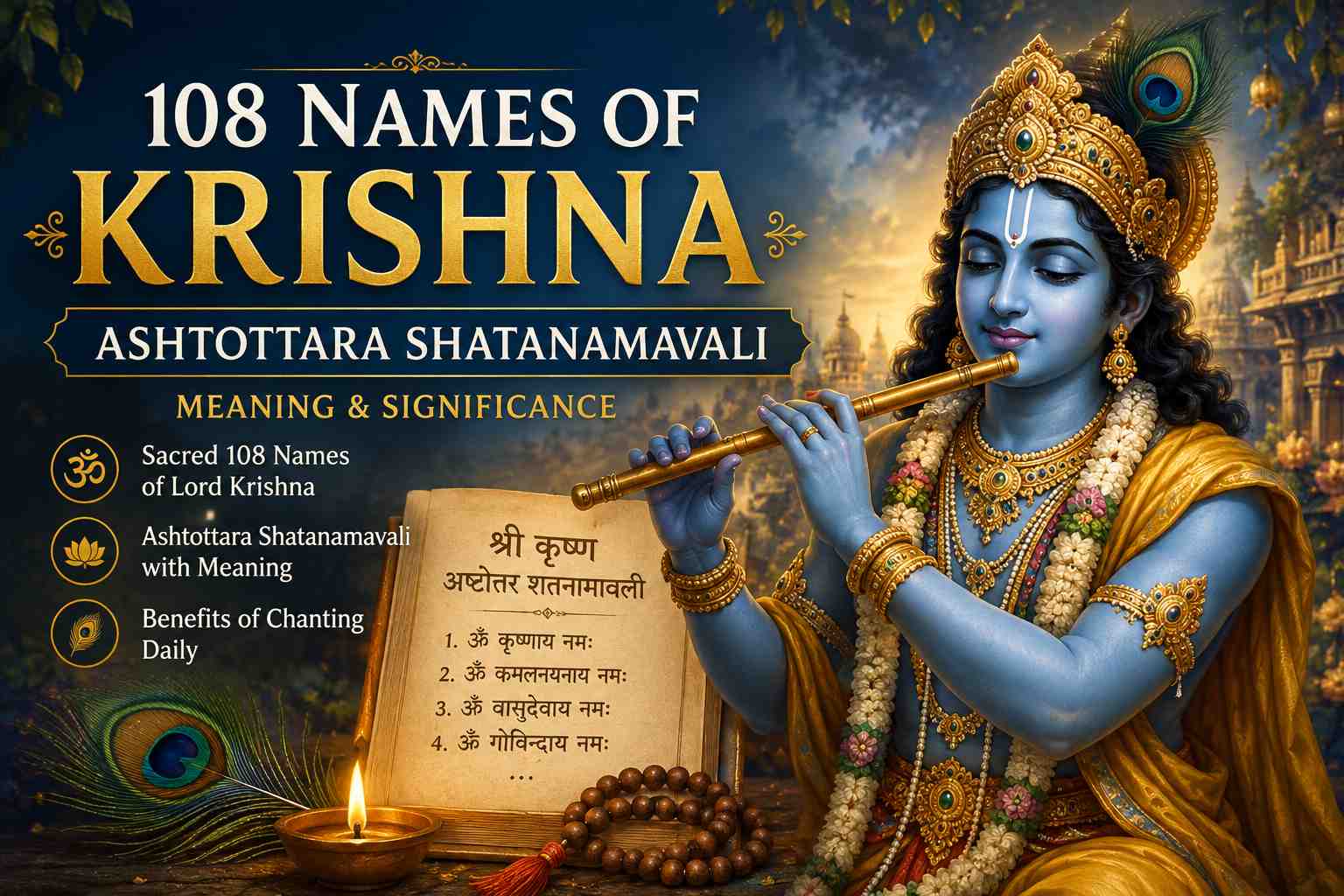
108 Names of Lord Krishna (Ashtottara Shatanamavali) | Meaning & Benefits | Bhakti Voice
Mantra & Stotra
108 Divine Names of Lord Krishna
Bhakti Voice · 6 min · Updated 2026-08-20
Chanting the 108 names of Lord Krishna, widely known as the Krishna Ashtottara Shatanamavali, is a deeply purifying spiritual practice. Each of these names represents a unique divine quality, beautiful pastime, or supreme attribute of Lord Krishna. By remembering and reciting these names, devotees invoke boundless grace, peace, and eternal devotion in their hearts.
The Power of the Ashtottara Shatanamavali
In the Bhakti tradition, reciting the names of the Lord is considered the supreme yajna (sacrifice) in the age of Kaliyuga. The Ashtottara Shatanamavali consisting of the 108 names of Lord Krishna encapsulates His divine cosmic plays (Lilas), His supreme qualities, and His role as the protector of the universe.
Below is the complete list of the 108 names along with their profound meanings:
The 108 Names of Lord Krishna
Krishna — The all-attractive one
Kamalanatha — Lord of Goddess Lakshmi
Vasudeva — Son of Vasudeva
Sanatana — The eternal one
Vasudevatmaja — Son of Vasudeva
Punya — The supremely pure one
Lila-manusha-vigraha — One who assumes a human form for divine play
Shrivatsa-kaustubha-dhara — Bearer of Shrivatsa and Kaustubha
Yashoda-vatsala — Beloved of Mother Yashoda
Hari — Remover of sins and suffering
Chaturbhuja — The four-armed one
Devaki-nandana — Son of Devaki
Shrisha — Lord of Shri/Lakshmi
Nandagopa-priyatmaja — Beloved son of Nanda
Yamuna-vega-samharin — One who subdued the Yamuna's force
Balabhadra-priyanuga — Dear companion of Balabhadra
Putana-jivita-hara — Destroyer of Putana
Shakatasura-bhanjana — Destroyer of Shakatasura
Nanda-vraja-jananandi — One who delights the people of Nanda's Vraja
Sachidananda-vigraha — Embodiment of existence, consciousness and bliss
Frequently asked questions
What is the significance of chanting the 108 names of Krishna?
Chanting the 108 names purifies the mind, removes negative energies, and helps one connect deeply with the divine consciousness of Lord Krishna.
How many times should I chant these names daily?
It is traditionally recommended to chant the entire Ashtottara Shatanamavali at least once daily. Using a tulsi mala with 108 beads can help maintain focus.
Navanita-viliptanga — One whose body is smeared with butter
Navanita-nata — One who dances for butter
Anagha — The sinless one
Navanita-navahara — One who lovingly steals fresh butter
Muchukunda-prasada — One who blessed King Muchukunda
Shodasha-stri-sahasresha — Lord of sixteen thousand wives
Tribhangi — One who stands in the threefold-bending posture
Madhurakriti — One of exceedingly sweet form
Shuka-vag-amritabdhi-indu — Moon of the ocean of Shuka's nectarean words
Govinda — Protector of cows and senses
Yoginampati — Lord of yogis
Vatsa-pala — Protector of calves
Punya-shravana-kirtana — One whose hearing and chanting brings purity
Tirthapada — One whose feet are themselves a sacred pilgrimage
Vedavedya — One who is known through the Vedas
Dayanidhi — Treasure-house of compassion
Sarva-tirthatmaka — Essence of all sacred places
Sarva-graha-rupin — One who encompasses all cosmic influences
Paratpara — The supreme beyond the supreme
Shyamala — The dark-hued one
Gopika-natha — Lord of the Gopis
Parabrahma — The Supreme Absolute Reality
Putana-moksha-da — Giver of liberation even to Putana
Mukunda — Giver of liberation
Govardhanadhara — Lifter of Govardhana Hill
Gopala — Protector of cows
Sarva-pala — Protector of all beings
Aja — The unborn one
Niranjana — The spotless and pure one
Kama-janaka — Source of divine love
Kanjalochana — Lotus-eyed one
Madhusudana — Destroyer of the demon Madhu
Mathuranatha — Lord of Mathura
Dvarakanayaka — Lord of Dwaraka
Balin — The mighty one
Vrindavananta-sanchari — One who wanders throughout Vrindavan
Tulasidama-bhushana — Adorned with a garland of Tulasi
Syamantaka-mani-hara — One associated with the Syamantaka jewel
Nara-narayanatmaka — Embodiment of Nara and Narayana
Kubja-kripa — One who blessed Kubja
Yajna-bhokta — Enjoyer of sacrificial offerings
Yajna-pati — Lord of sacrifices
Yajna-bhava — Essence of sacrifice
Venu-nada-visharada — Expert in playing the flute
Vrishabhasura-vinashaka — Destroyer of Vrishabhasura
Banasura-bala-antaka — Destroyer of Banasura's power
Narakasura-vinashaka — Destroyer of Narakasura
Murari — Enemy of the demon Mura
Kamsari — Enemy of Kamsa
Mushtikasura-mardana — Crusher of Mushtikasura
Chanura-mardana — Destroyer of Chanura
Kesi-nishudana — Destroyer of the demon Kesi
Kaliya-mardana — Subduer of Kaliya
Dhenukasura-bhanjana — Destroyer of Dhenukasura
Pralambasura-bhanjana — Destroyer of Pralambasura
Arishtasura-vinashaka — Destroyer of Arishtasura
Vyomasura-vinashaka — Destroyer of Vyomasura
Yamalaarjuna-bhanjana — Uprooter of the twin Arjuna trees
Damodara — One bound around the waist by Mother Yashoda
Madhava — Lord of Lakshmi and spring
Madhava-priya — Beloved of Lakshmi
Madhusudana — Destroyer of Madhu
Hrishikesha — Lord of the senses
Padmanabha — Lotus-naveled one
Janardana — Protector and benefactor of humanity
Achyuta — The infallible one
Keshava — Slayer of Keshi; Lord with beautiful hair
Janaki-vallabha — Beloved of Janaki (used in some broader Vaishnava traditions)
Purushottama — The Supreme Person
Adhokshaja — One beyond material perception
Narayana — The supreme refuge of all beings
Madhava — Consort of Lakshmi
Govardhana-dhara — Bearer of Govardhana Hill
Gopijanavallabha — Beloved of the Gopis
Radha-ramana — One who delights Radha
Radha-vallabha — Beloved of Radha
Gopinatha — Lord of the Gopis
Gopika-kanta — Beloved of the Gopis
Murali-manohara — Enchanter with the flute
Venugopala — Gopala who plays the flute
Radhika-ramana — Delight of Radhika
Vrindavaneshvara — Lord of Vrindavan
Yadunandana — Delight of the Yadu dynasty
Yaduvansha-pradipa — Light of the Yadu dynasty
Parthasarathi — Charioteer of Arjuna
Gitacharya — Teacher of the Bhagavad Gita
Jagannatha — Lord of the universe
Devakinandana — Beloved son of Devaki
Can anyone chant the Krishna Ashtottara Shatanamavali?
Yes, absolutely. Anyone, regardless of age, gender, or background, can chant these holy names with devotion and sincerity.
What is the best time to chant these names?
While the names can be chanted at any time, early morning (Brahmamuhurta) or evening dusk (Sandhya time) are considered highly auspicious.
Why are there exactly 108 names?
The number 108 is highly sacred in Hinduism. It represents the wholeness of existence, correlates with the 108 Upanishads, and represents the 108 energy lines converging to form the heart chakra.