Shiva
The Infinite Glory of Lord Shiva
A clear Indian narrator will read this katha in English or Hindi. Tap again to stop.
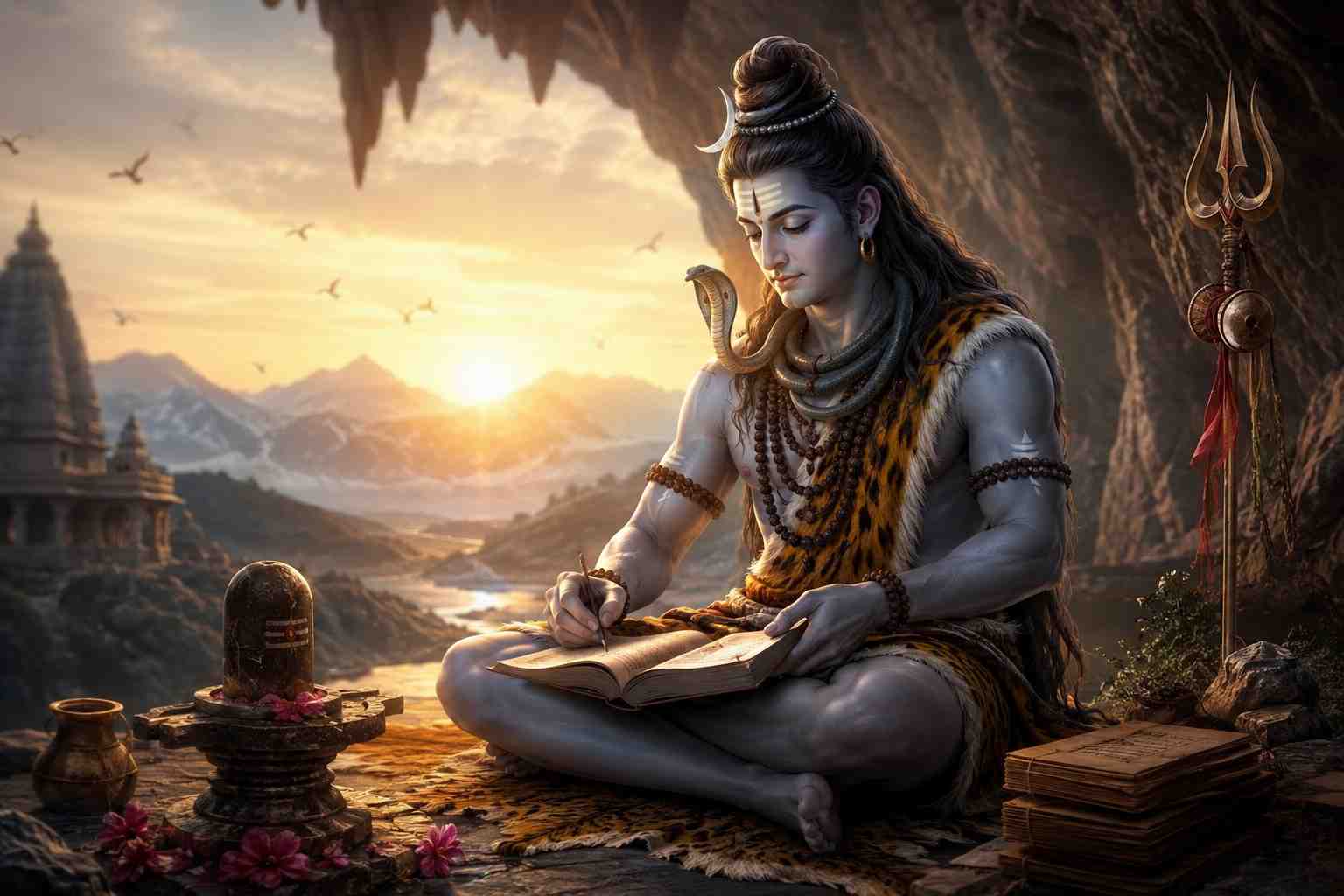
The Shiva Mahapurana is one of the supreme texts of Hindu literature, dedicated to Lord Shiva, the god of destruction, meditation, and spiritual regeneration. It contains the deepest secrets of the cosmos, the glory of the Jyotirlingas, and the ultimate path of devotion.
Episode 1
Discover the manifestation of Lord Shiva as an endless pillar of light to resolve the conflict between Brahma and Vishnu. The Shiv Mahapuran begins with a profound cosmic event. Long before the creation of the universe as we know it, a dispute arose between Lord Brahma (the creator) and Lord Vishnu (the preserver). Both claimed supremacy over the other. As their argument escalated into a fierce battle threatening cosmic balance, a colossal, blazing pillar of infinite light (the Jyotirlinga) suddenly manifested between them, piercing the heavens and the underworld. Astonished, Brahma and Vishnu agreed to find the ends of this glowing column. Brahma took the form of a swan and flew upwards to find the top, while Vishnu took the form of a boar (Varaha) and dug downwards to find the base. After eons of searching, both failed. Vishnu humbly admitted his failure, but Brahma falsely claimed he had found the top, presenting a Ketaki flower as a false witness. At that moment, the pillar split open, revealing Lord Shiva in His magnificent form. He praised Vishnu for his honesty and cursed Brahma that he would not be widely worshipped in temples, while the Ketaki flower was banned from Shiva's worship. This episode establishes Shiva as the absolute, beginningless, and endless Supreme Reality (Parabrahman). The worship of the Shiva Linga originates from this divine formless pillar of light.
55 min
Episode 2
Witness the divine union of Shiva and Sati, the arrogance of Daksha, and the fierce manifestation of Virabhadra. Goddess Adi Shakti incarnates as Sati, the daughter of Prajapati Daksha, to become the consort of Lord Shiva. Despite Daksha's intense dislike for Shiva—whom he views as a wild, ash-smeared ascetic who frequents cremation grounds—Sati undergoes severe penance to win Shiva's heart. Eventually, they are married, and Sati moves to Mount Kailash. Years later, Daksha organizes a grand Yajna (fire sacrifice) and intentionally invites all the gods except Shiva and Sati. Hearing of the event, Sati decides to attend uninvited, hoping to reconcile with her father. Shiva warns her against it, but she insists. At the Yajna, Daksha publicly humiliates Sati and insults Lord Shiva. Unable to bear her husband's dishonor and recognizing her father's irredeemable arrogance, Sati invokes her yogic powers and immolates herself in the sacrificial fire. When Shiva learns of her death, His grief transforms into apocalyptic rage. He plucks a lock of His matted hair and throws it to the ground, creating the terrifying and colossal warrior, Virabhadra. Virabhadra and Goddess Bhadrakali storm the Yajna, destroying everything and beheading Daksha. Later, Shiva restores Daksha's life with a goat's head, crushing his ego forever. Shiva then wanders the universe carrying Sati's burnt body, completely detached, until Vishnu uses His Sudarshana Chakra to sever her remains, creating the 51 Shakti Peethas across the Indian subcontinent.
The core message is that Lord Shiva is the formless, infinite supreme reality (Brahman). Surrendering to Him with a pure heart burns away all karmas and grants Moksha (liberation).
Listening to Shiv Mahapuran removes fear, anxieties, and negative energies. It fosters a deep state of inner peace and brings the divine blessings of Mahadev into everyday life.
65 min
Episode 3
Mata Parvati's severe penance to reunite with Shiva, the ashes of desire, and their grand cosmic marriage. Following Sati's death, Lord Shiva retreats into deep, impenetrable meditation. The universe is left vulnerable, and the demon Tarakasura wreaks havoc, having secured a boon that he can only be killed by the son of Shiva. To save the worlds, Adi Shakti reincarnates as Parvati, the daughter of Himavan (King of the Himalayas). The gods, desperate to awaken Shiva, send Kamadeva (the god of love and desire) to shoot his flower-arrows at Shiva while Parvati is nearby. Disturbed from His trance, an enraged Shiva opens His third eye, instantly reducing Kamadeva to ashes. This signifies that true realization of God is achieved not through physical desire, but through burning it away. Undeterred, Parvati embarks on a severe Tapasya (penance). She renounces food, water, and shelter, meditating on Shiva in the freezing Himalayas for thousands of years. Pleased by her unmatched devotion, Shiva finally accepts her. Their marriage is a cosmic celebration. The groom's procession (Baraat) includes not just gods, but ghosts, goblins, and ascetic saints, proving that Mahadev is the lord of all beings, regardless of their social standing or appearance.
70 min
Episode 4
The origin of the warrior god Kartikeya to slay Tarakasura, and the fascinating story of Lord Ganesha's elephant head. From the divine spark of Shiva and Parvati, Lord Kartikeya (Skanda/Murugan) is born. Raised by the Krittikas (Pleiades), Kartikeya grows into a fierce and brilliant warrior. Appointed as the commander-in-chief of the celestial army, he confronts the invincible demon Tarakasura and slays him, restoring peace to the heavens. The Purana then narrates the beloved story of Lord Ganesha. While Shiva is away, Goddess Parvati creates a boy from the turmeric paste of her body to guard her chambers. When Shiva returns and is denied entry by the unknown boy, a fierce battle ensues. In a fit of rage, Shiva beheads the boy with His Trishul (trident). When Parvati sees her dead son, she threatens to destroy the entire universe. Realizing the gravity of the situation, Shiva orders His Ganas to bring the head of the first living creature they find facing north. They return with the head of a strong, wise elephant. Shiva attaches it to the boy's body, breathes life into him, and names him Ganesha (Lord of the Ganas), declaring that he must be worshipped first in all auspicious endeavors.
65 min
Episode 5
The churning of the cosmic ocean, the emergence of the deadly Halahala poison, and Shiva's ultimate sacrifice to save the universe. To regain their lost glory, the Devas (gods) and Asuras (demons) decide to churn the cosmic ocean (Samudra Manthan) using Mount Mandara as a churning rod and the serpent king Vasuki as a rope. They seek the nectar of immortality (Amrita). However, before the nectar can emerge, the churning releases the most terrifying substance in the universe—the Halahala poison. The toxic fumes begin to choke the gods, demons, and the entire cosmos. Recognizing that only Lord Shiva has the power to contain this destruction, they rush to Mount Kailash for help. Out of pure compassion for all living beings, Mahadev scoops the lethal poison into His hands and drinks it. Fearing for His life, Goddess Parvati places her hands on His throat, stopping the poison from descending into His stomach. The intense toxicity turns Shiva's neck a deep, radiant blue. From that day forth, He is lovingly worshipped as Neelkanth (The Blue-Throated One), symbolizing that a true yogi absorbs the world's negativity and transforms it without letting it poison their inner being.
60 min
Episode 6
The rise of the three flying demonic cities and Lord Shiva's magnificent destruction of them with a single arrow. The three sons of Tarakasura—Tarakaksha, Kamalaksha, and Vidyunmali—perform severe penance and receive a boon from Lord Brahma. They are granted three impregnable flying cities (Tripura) made of gold, silver, and iron. The boon dictates that the cities can only be destroyed when they align in a single line, and only by a single arrow. Empowered by this near-invincibility, the demons terrorize the universe. The gods once again turn to Mahadev. Shiva prepares for the ultimate battle. The earth itself becomes His chariot, the sun and moon serve as its wheels, Mount Meru becomes His bow, and Lord Vishnu Himself becomes the arrow. The serpent Vasuki is used as the bowstring. Waiting for the exact astrological moment when the three cities align in the sky, Shiva draws the mighty bow. He releases the single, cosmic arrow that pierces through all three cities simultaneously, reducing them to ashes. For this unparalleled feat, Shiva is glorified as Tripurari (The Destroyer of Tripura), symbolizing the destruction of the three impurities of the soul: ego, karma, and illusion (Maya).
65 min
Episode 7
Explore the significance of the 12 sacred Jyotirlingas, the Maha Mrityunjaya Mantra, and the ultimate message of the Shiva Purana. The final episodes of the Shiv Mahapuran detail the locations and immense spiritual significance of the 12 Jyotirlingas—radiant manifestations of Lord Shiva spread across India. From Somnath in the west to Kashi Vishwanath in the north, Mahakaleshwar in Ujjain, and Mallikarjuna in the south, these sacred sites are pillars of cosmic energy. The Purana emphasizes that visiting or merely hearing the stories of these Jyotirlingas destroys lifetimes of accumulated sins. It also reveals the profound power of the Maha Mrityunjaya Mantra—the great death-conquering chant—which grants healing, longevity, and spiritual enlightenment. The ultimate message of the Shiv Mahapuran is the path of unconditional devotion (Bhakti) combined with knowledge (Jnana) and detachment (Vairagya). Lord Shiva is easily pleased (Bholenath); He does not require grand wealth or complex rituals. A simple offering of water, a Bilva leaf, and a pure heart uttering "Om Namah Shivaya" is enough to win His grace. By listening to this Katha daily, devotees burn their karmic impurities, overcome the fear of death, and eventually merge into the infinite bliss of Mahadev.
75 min
