Ramayan
The Epic Journey of Maryada Purushottam
A clear Indian narrator will read this katha in English or Hindi. Tap again to stop.
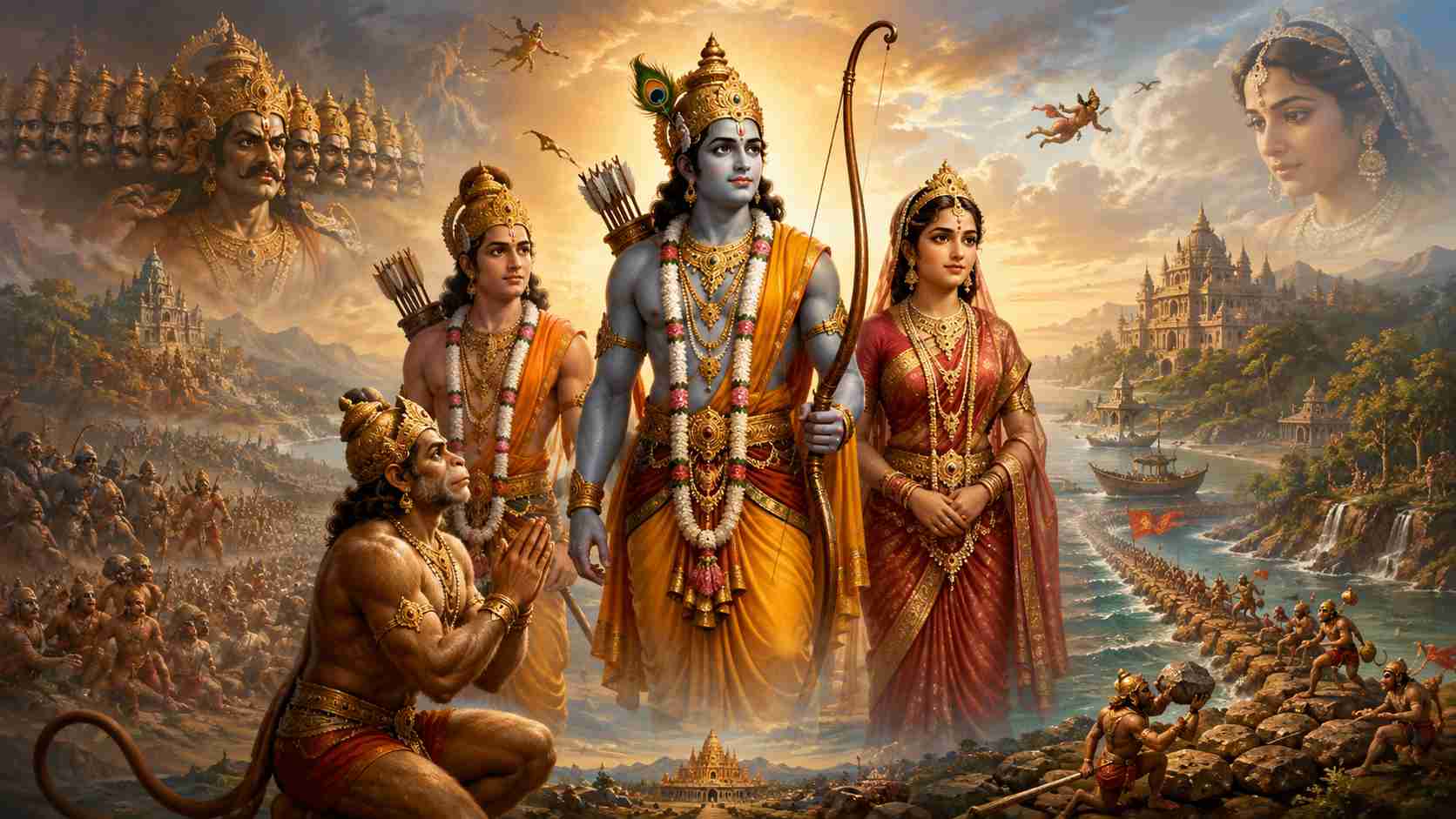
The Ramayana is a timeless manual for human life, righteousness, and spiritual evolution. Composed by Maharishi Valmiki and rendered as Ramcharitmanas by Goswami Tulsidas, it narrates the life of Lord Shri Ram—the embodiment of duty, compassion, and truth.
Episode 1
Discover the divine birth of Shri Ram, his youth, the protection of Sage Vishwamitra's yajna, and the sacred swayamvara of Mata Sita in Mithila. The Ramayan Katha is far more than an ancient mythological tale; it is the very soul of India’s spiritual and cultural heritage. For thousands of years, the Story of Ramayana has guided humanity through the darkest of times, offering a beacon of hope, righteousness, and unwavering moral clarity. Before we delve into the epic narrative, it is crucial to understand the textual history of the Ramayana. The Summary of Valmiki Ramayana begins with the great sage Valmiki, who is hailed as the Adi Kavi (the first poet). Legend has it that upon witnessing a hunter shoot down a mating bird, Valmiki’s immense grief transformed into the first-ever Sanskrit Shloka. Instructed by Lord Brahma and guided by Sage Narada, Valmiki composed the epic in 24,000 verses, chronicling the life of Shri Ram during his actual lifetime. Centuries later, in the 16th century, the revered saint and poet Goswami Tulsidas translated this divine essence into Awadhi, creating the Ramcharitmanas. Today, when devotees seek Shri Ram Katha in English or Hindi, they are often drawing from the emotional depth of the Ramcharitmanas, where every verse is dripping with love, surrender, and divine grace. The epic commences in the glorious city of Ayodhya, the capital of the Kosala Kingdom, ruled by the righteous King Dasharatha. Despite immense wealth and a peaceful reign, King Dasharatha is plagued by a deep sorrow—he has no heir. Advised by his royal priest, Sage Vashistha, Dasharatha performs the Putrakameshti Yajna. Pleased by the devotion, the fire god Agni emerges and presents a bowl of divine dessert (Payasam). Dasharatha distributes this among his three queens. Soon, Queen Kausalya gives birth to Shri Ram (the incarnation of Lord Vishnu), Queen Kaikeyi to Bharata, and Queen Sumitra to the twins Lakshmana and Shatrughna. The childhood of the four brothers is marked by immense love and the mastery of scriptures and martial arts. The turning point arrives when Sage Vishwamitra visits Ayodhya, requesting Dasharatha to send Ram to the forest to protect his sacred fire rituals from the demonic forces of Maricha, Subahu, and Tataka. In the forest, Ram slays Tataka and redeems Ahalya from a stone curse with the mere touch of his foot. Following this, Vishwamitra takes the brothers to Mithila for the Swayamvara of Mata Sita. The challenge is to lift, string, and bow the mighty Pinaka, the celestial bow of Lord Shiva. While mighty kings fail, Shri Ram effortlessly lifts and strings the bow, which snaps with a thunderous sound, uniting Ram and Sita in sacred matrimony.
55 min
The central message is the victory of Dharma (righteousness) over Adharma (unrighteousness), illustrating how to navigate life's trials with moral integrity.
Regular listening calms the mind, strengthens moral intuition, and fosters harmonious relationships by inspiring patience and sacrifice.
Episode 2
The true test of duty as Shri Ram accepts 14 years of exile to honor his father's vow. Witness Bharata's unparalleled devotion and renunciation. With the marriages concluded, Ayodhya basks in unprecedented joy. King Dasharatha, feeling the weight of his age, decides to crown Shri Ram as the Prince Regent (Yuvaraja). The citizens are ecstatic, for Ram is universally loved for his compassion, wisdom, and justice. However, destiny has other plans. The gods influence the mind of Manthara, a hunchbacked maidservant, who poisons Queen Kaikeyi’s mind, convincing her that Ram’s coronation will marginalize her son, Bharata. Overcome by insecurity, Kaikeyi retreats to the Chamber of Sorrow. When Dasharatha approaches her, she calls upon two boons he had promised her years ago: Fourteen years of exile (Vanvas) for Shri Ram, and the coronation of Bharata as King. King Dasharatha is devastated, begging and fainting from agony. When Shri Ram learns of these demands, he does not show a single trace of anger or sorrow. He smiles gently, viewing this as an opportunity to uphold his father’s honor and absolute truth (Satya). Mata Sita refuses to stay behind, declaring her place is by her husband's side. Lakshmana, fiercely devoted, also renounces his royal comforts. As the three depart, Ayodhya is plunged into grief. Unable to bear the sorrow of separation (Putra-shoka), King Dasharatha passes away. Bharata, upon returning and discovering his mother’s deceit and his father’s death, is utterly disgusted. He refuses the blood-stained throne and marches into the forest to Chitrakoot to bring his brother back. The meeting between Ram and Bharata is emotionally charged. Ram firmly refuses to return until the fourteen years are completed. Bharata returns to Ayodhya with Ram’s wooden sandals (Charan Paduka), places them on the throne, and rules as a humble ascetic from Nandigram.
60 min
Episode 3
Life in the Dandaka forest, the confrontation with Surpanakha, and the tragic abduction of Mata Sita by the demon king Ravana. The Aranya Kanda plunges the narrative into the dense, perilous Dandaka Forest. Ram, Sita, and Lakshmana spend years moving from one hermitage to another, protecting sages from demonic harassment. They eventually settle in Panchavati, on the banks of the Godavari river. It is here that the core conflict of the epic is ignited. The demoness Surpanakha, sister of the mighty demon King Ravana, becomes infatuated with Ram. When rejected, she attempts to attack Sita. In defense, Lakshmana cuts off her nose and ears. Humiliated, she flees to her brothers Khara and Dushana, who attack Panchavati with a 14,000-strong demonic army. Shri Ram single-handedly decimates them all. When news reaches Lanka, Ravana vows revenge. Inflamed by descriptions of Sita’s beauty, Ravana coerces the demon Maricha to disguise himself as a mesmerizing golden deer (Swarna Mriga). Mata Sita requests Ram to capture it. Ram pursues the deer, and upon shooting it, the dying Maricha perfectly mimics Ram's voice screaming for help. Sita, paralyzed with fear, forces a reluctant Lakshmana to go to his brother’s aid. Before leaving, Lakshmana draws a mystical protective line—the Lakshmana Rekha—and warns Sita not to cross it. The moment Sita is alone, Ravana arrives disguised as a pious ascetic seeking alms. He tricks Sita into stepping out of the Rekha, reveals his true form, and abducts her in his flying chariot. The noble vulture king Jatayu fights fiercely to stop Ravana but is mortally wounded. When Ram and Lakshmana return to find the hermitage empty, their grief is boundless. They find the dying Jatayu, who informs them of Ravana’s identity before passing away in Ram’s lap. During this search, Ram also meets Shabari, an old tribal woman, honoring her pure devotion by eating her half-bitten berries.
50 min
Episode 4
Shri Ram meets his greatest devotee, Hanuman, and forms a formidable alliance with the Vanara King Sugriva to search for Mata Sita. The search for Sita leads the brothers southward to the Rishyamukha mountains, the realm of the Vanaras. Here, they meet Hanuman, who approaches them disguised as a Brahmin. Upon realizing Ram's divine identity, Hanuman falls at his feet, beginning the most celebrated devotee-deity relationship in Hindu theology. Hanuman introduces Ram to Sugriva, the exiled Vanara prince hiding from his powerful, abusive brother Vali, who had usurped his wife and kingdom. Recognizing a shared plight, Ram and Sugriva forge an alliance around a sacred fire. Ram promises to restore Sugriva’s honor, and in return, Sugriva promises to use his vast Vanara army to find Sita. A fierce duel ensues between Sugriva and Vali. Shri Ram, hiding behind a tree, shoots a fatal arrow into Vali’s chest. As Vali lies dying, Ram explains the karmic justification for his actions. Sugriva is crowned the King of Kishkindha. After the monsoon, Sugriva mobilizes millions of Vanaras and sends search parties in all directions. The southern expedition reaches the edge of the ocean, where they meet Sampati, the elder brother of Jatayu. Sampati informs them that Sita is being held captive in the island kingdom of Lanka. The Vanaras are despondent, wondering who can leap across such a vast ocean. Jambavan realizes that only Hanuman is capable. Hanuman, cursed to forget his immense strength until reminded, is made aware of his divine powers. His body expands, glowing with the radiance of a mountain of gold, ready to undertake the impossible leap.
45 min
Episode 5
Hanuman's epic leap across the ocean to Lanka, his meeting with Mata Sita in Ashoka Vatika, and the burning of the golden city. The Sundara Kanda is widely considered the heart and soul of the Sampurna Ramayan, focusing entirely on the heroism, supreme intelligence, and unmatched devotion of Hanuman. Reading or chanting it is believed to remove all obstacles. With a thunderous roar, Hanuman leaps from the Mahendra mountain into the sky. He bypasses the mountain Mainaka, outwits the mother of serpents Surasa, and slays the shadow-catching demoness Simhika. Landing on the shores of Lanka at night, Hanuman reduces himself to the size of a cat and slips into the golden fortress. He searches every palace and finally arrives at the Ashoka Vatika. There, surrounded by terrifying demonesses, sits Mata Sita, emaciated and absorbed in the thought of Shri Ram. Hanuman witnesses Ravana threaten Sita, who rebukes him fiercely, warning him of Ram's impending wrath. Once Ravana leaves, Hanuman drops Shri Ram’s signet ring (Mudrika) from the branches above. Sita is overwhelmed with joy. Hanuman introduces himself as Ram's messenger (Doot). He offers to carry her back, but Sita refuses, stating it is Shri Ram’s duty to defeat Ravana. She gives Hanuman her hair ornament (Chudamani) as a token. Before leaving, Hanuman destroys the Ashoka grove, slays demonic commanders, and allows himself to be captured. Brought into Ravana’s court, Hanuman fearlessly preaches Dharma. Furious, Ravana orders Hanuman’s tail to be set on fire. The Vanara hero expands his tail, exhausts Lanka's oil, breaks free, and sets the entire golden city of Lanka ablaze, sparing only the house of Vibhishana and the Ashoka Vatika. Hanuman returns across the ocean, bringing the news to Shri Ram.
70 min
Episode 6
The construction of Ram Setu, the fierce battle against Ravana's forces, the bringing of Sanjeevani Booti, and the ultimate victory of Dharma. The Yuddha Kanda (also known as Lanka Kanda) is the longest chapter, detailing the epic struggle between the forces of light and darkness. The Vanara army marches to the southern shore. Meanwhile, in Lanka, Vibhishana pleads with Ravana to return Sita. Arrogant and blinded by ego, Ravana kicks Vibhishana out of the court. Vibhishana seeks refuge at the lotus feet of Shri Ram, who accepts him instantly and symbolically crowns him the future king of Lanka. Faced with the mighty ocean, Ram requests the sea god, Varuna, to give way. When Varuna ignores him, Ram raises his bow in anger. A terrified Varuna advises Ram to build a bridge with the help of the Vanara engineers, Nala and Nila. Thus, the legendary Ram Setu is constructed, with stones floating on the water by the sheer power of the name "RAM" inscribed on them. The cataclysmic war begins. The demons fight with dark magic, while the Vanaras fight with trees, boulders, and raw devotion. Key moments include the awakening and slaying of Kumbhakarna, Ravana’s colossal brother. Later, Indrajit strikes Lakshmana with a fatal weapon (Shakti). Hanuman flies thousands of miles to the Himalayas, lifts the entire Dronagiri mountain, and brings the Sanjeevani Booti to Lanka, saving Lakshmana's life. Revived, Lakshmana defeats Indrajit. Finally, the ultimate confrontation between Ram and Ravana takes place. Sage Agastya imparts the Aditya Hridaya Stotram to Shri Ram. Upon Vibhishana’s revelation that Ravana’s nectar of immortality lies in his navel, Shri Ram fires the lethal Brahmastra, piercing Ravana's chest and ending the reign of terror. Mata Sita is brought before Shri Ram and undergoes the Agnipariksha (trial by fire) to prove her absolute purity to the world. The fourteen years of exile end, and they fly back to Ayodhya on the Pushpaka Vimana, marking the joyous festival of Diwali.
85 min
Episode 7
The grand return of Shri Ram, the establishment of the ideal Ram Rajya, timeless moral lessons, and the enduring legacy of justice and peace. The final chapter, Uttara Kanda, describes the glorious coronation of Shri Ram as the Emperor of Ayodhya. His reign is hailed as Ram Rajya—a utopian era where truth, justice, and prosperity flow like a mighty river. In Ram Rajya, there is no disease, poverty, or premature death. However, the epic maintains its complex undertones. To uphold the absolute moral standard expected of a ruler after a citizen questions Sita's purity, a heartbroken Ram asks Lakshmana to leave a pregnant Sita in the forest near Sage Valmiki’s ashram. There, Sita gives birth to the brave twin boys, Lava and Kusha, who master the Ramayana. Years later, they sing the epic in Ram's royal court, leading to a tearful reunion. Having fulfilled her earthly purpose, Mata Sita calls upon the Earth Goddess and returns to the earth's womb. Eventually, Shri Ram walks into the Sarayu river, shedding his mortal coil and returning to Vaikuntha. The Ramayan Katha offers timeless life lessons for modern living: 1. Dharma over Convenience: Shri Ram gave up a mighty empire with a smile to honor his father's word, teaching us the value of integrity. 2. The Danger of Arrogance: Ravana had immense knowledge but was destroyed by his massive ego and unchecked lust. Intellect without humility leads to destruction. 3. Absolute Devotion: Hanuman teaches that completely surrendering one's ego to a higher divine purpose unlocks infinite potential. 4. Equality and Inclusivity: Shri Ram embraced tribal kings, monkeys, bears, and squirrels, judging people solely by the purity of their hearts. 5. Ideal Relationships: The epic is a masterclass in brotherhood, marriage, and friendship, exemplifying mutual respect and unwavering loyalty. Listening to the Ramayan Katha daily provides emotional resilience, purifies the home environment, installs strong moral compasses in children, and leads to spiritual liberation. It is an inexhaustible ocean of wisdom, proving that the path of righteousness ultimately leads to eternal glory and divine peace.
55 min
