Mahabharat
The Ultimate Saga of Duty, Destiny, and Dharma
A clear Indian narrator will read this katha in English or Hindi. Tap again to stop.
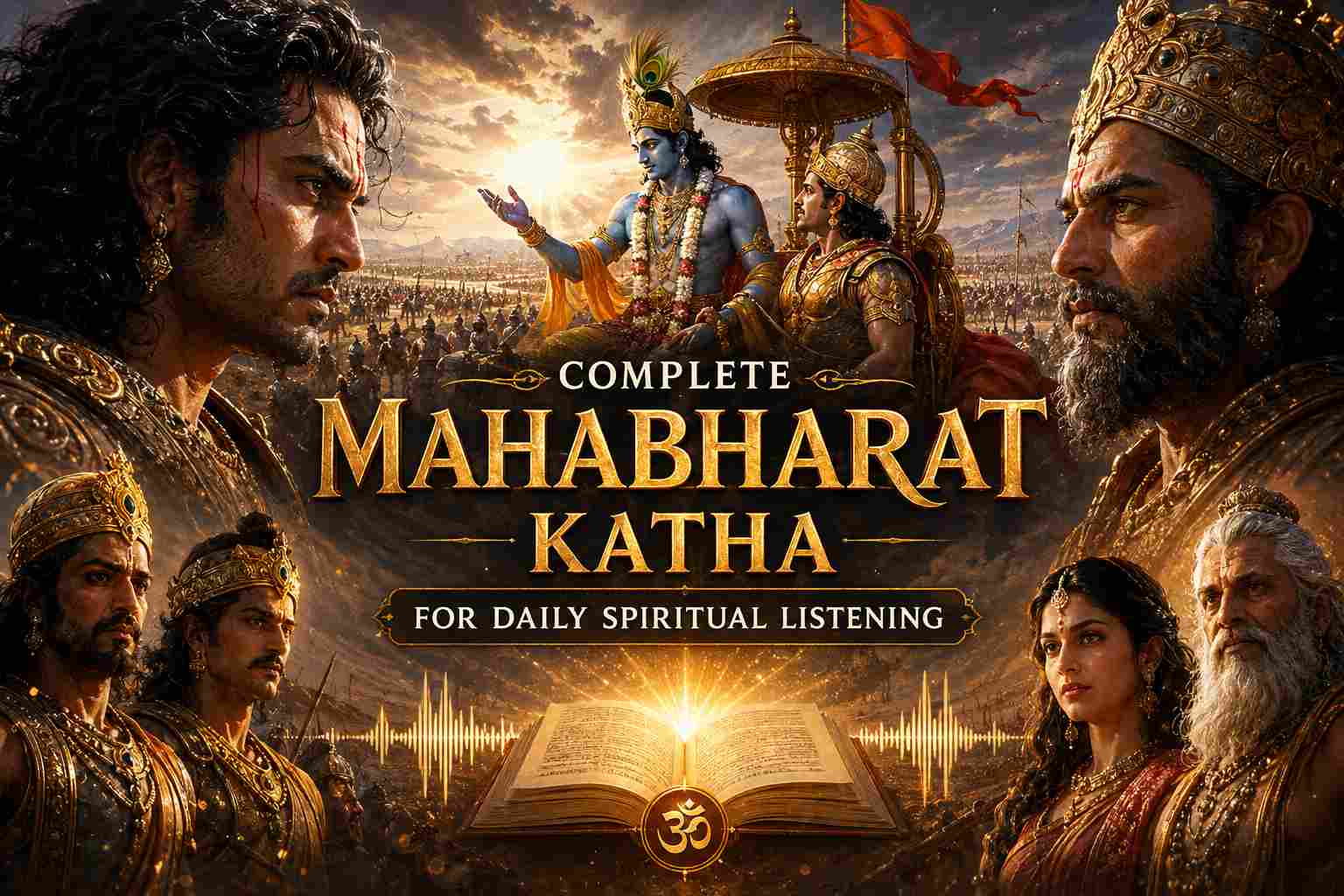
The Mahabharata, composed by Sage Ved Vyasa, is the longest epic in world literature. It is not just a historical account of a great war, but a profound philosophical exploration of Dharma, Karma, and human psychology, culminating in the divine teachings of the Bhagavad Gita.
Episode 1
Discover the origins of the Kuru dynasty, the terrible vow of Bhishma, and the birth of the Pandavas and Kauravas. The Mahabharata, dictated by Sage Ved Vyasa to Lord Ganesha, is the grandest epic of ancient India. It begins in the prosperous kingdom of Hastinapur, ruled by King Shantanu. The king falls in love with Satyavati, a fisherwoman. However, her father sets a condition: only Satyavati's son will inherit the throne, meaning Shantanu's noble eldest son, Devavrata, must step aside. To fulfill his father's desire, Devavrata takes a terrifying vow (Bhishma Pratigya) of lifelong celibacy and renounces the throne forever. The heavens rain flowers, and he is named 'Bhishma' (The Terrible). He promises to serve whoever sits on the throne of Hastinapur, a vow that eventually forces him to fight against righteousness. Generations pass. The blind Prince Dhritarashtra is denied the throne due to his disability, and it is given to his younger brother, Pandu. Dhritarashtra marries Gandhari, who voluntarily blindfolds herself to share her husband's darkness. They give birth to the hundred Kauravas, led by the ambitious Duryodhana. Pandu, cursed to die if he approaches his wives, retreats to the forest. His wives, Kunti and Madri, use a divine boon to bear five exceptional sons—Yudhishthira, Bhima, Arjuna, Nakula, and Sahadeva—collectively known as the Pandavas. Following Pandu's untimely death, the Pandavas return to Hastinapur. Under the tutelage of Dronacharya and Kripacharya, the cousins receive military training. While the Pandavas excel in virtue and skill, especially Arjuna in archery and Bhima in mace fighting, the seeds of jealousy take deep root in Duryodhana's heart, setting the stage for the greatest conflict of ancient times.
60 min
Episode 2
Witness the rising jealousy of Duryodhana, the deadly plot of Lakshagriha, and the Pandavas' escape into the forest. As the princes grow, the citizens of Hastinapur openly prefer the righteous Yudhishthira as their future king. Consumed by envy and guided by his cunning uncle, Shakuni, Duryodhana plots to assassinate the Pandavas. Duryodhana commissions an architect to build a beautiful palace in the town of Varnavata. However, this palace is constructed entirely of highly flammable materials like lac, resin, and ghee (Lakshagriha). Dhritarashtra innocently sends the Pandavas and Kunti to stay there. Warned by their wise uncle Vidura through a secret message, the Pandavas discover the plot. Under the cover of night, before Duryodhana's spy can ignite the palace, Bhima sets it ablaze. The Pandavas and Kunti escape through a pre-dug underground tunnel, vanishing into the dense forest, leaving the world to believe they perished in the fire. Living in disguise as Brahmins in the forest, they face numerous trials. Bhima slays the demons Hidimba and Baka, protecting the innocent forest dwellers. During this period of exile and hardship, their bond strengthens. They realize that destiny has stripped them of royal comforts to forge them into resilient warriors capable of upholding Dharma against overwhelming odds.
The core message is the complexity of Dharma (duty). It teaches that righteousness must be upheld even against one's own kin, and that all actions (Karma) bear inevitable consequences.
Listening to the Mahabharata helps resolve inner conflicts, teaches strategic and righteous living, and imparts the supreme wisdom of the Bhagavad Gita to attain spiritual peace.
75 min
Episode 3
Arjuna wins the hand of Princess Draupadi, forging powerful alliances, and the Pandavas establish the glorious city of Indraprastha. While wandering in disguise, the Pandavas arrive at the kingdom of Panchala to attend the Swayamvar of Princess Draupadi, born of holy fire. The challenge is nearly impossible: a suitor must look at a reflection in water and shoot an arrow into the eye of a rotating wooden fish suspended above. Great kings fail miserably. Finally, Arjuna, dressed as a humble Brahmin, steps forward. With absolute focus, he strings the mighty bow and pierces the target seamlessly. The assembly erupts in chaos as royalty feels insulted by a Brahmin's victory, but Bhima and Arjuna fend them off. Returning to their mother Kunti, Arjuna announces he has brought "alms." Without looking, Kunti says, "Share it equally among your brothers." Bound by their mother's sacred word, Draupadi becomes the common wife of the five Pandavas, symbolizing their unbreakable unity. The news of their survival reaches Hastinapur. To avoid a civil war, the elders divide the kingdom. The Kauravas keep the prosperous Hastinapur, while the Pandavas are given Khandavprastha, a barren, snake-infested wasteland. Undeterred, with the architectural genius of Mayasura and the divine guidance of Lord Krishna—their cousin, guide, and the supreme avatar of Lord Vishnu—they transform the wasteland into Indraprastha, the most magnificent city on earth. Yudhishthira performs the Rajasuya Yajna, establishing himself as an Emperor of unquestioned virtue.
80 min
Episode 4
The devastating game of dice orchestrated by Shakuni leads to the loss of Indraprastha, Draupadi's humiliation, and the Pandavas' 13-year exile. The splendor of Indraprastha burns Duryodhana's heart. Knowing the Pandavas cannot be defeated in battle, Shakuni devises a psychological trap. He invites Yudhishthira to Hastinapur for a "friendly" game of dice. Bound by the warrior code, Yudhishthira accepts. Shakuni, using loaded dice, plays on behalf of Duryodhana. Blinded by the addiction of the game, Yudhishthira loses his wealth, his kingdom, his brothers, and himself. In a final, desperate move, he stakes Draupadi and loses her too. Dushasana drags Draupadi into the royal court by her hair. In front of elders like Bhishma and Drona—who sit in silent shame—Duryodhana commands that she be stripped. As Dushasana pulls at her sari, Draupadi realizes no human can save her. She surrenders entirely, praying to Lord Krishna. A miracle occurs: the sari becomes infinitely long, exhausting Dushasana until he faints. Though Draupadi's honor is saved by divine grace, the insult is unforgettable. Bhima vows to drink Dushasana's blood and break Duryodhana's thigh. A horrified Dhritarashtra tries to reverse the damage, but another game forces the Pandavas into a 12-year forest exile, followed by one year of living incognito (Agyatavas). If discovered during the 13th year, the exile repeats.
90 min
Episode 5
Peace efforts fail, armies gather at Kurukshetra, and Lord Krishna delivers the supreme spiritual wisdom of the Bhagavad Gita to a despondent Arjuna. The Pandavas successfully complete their 13 years of exile, spending their final incognito year serving the King of Matsya. When they return to claim Indraprastha, Duryodhana flatly refuses, declaring he will not give them even "a needle's point of land." Lord Krishna goes to Hastinapur as a peace messenger. He asks for merely five villages to prevent war, but Duryodhana arrogantly orders Krishna's arrest. Krishna reveals his cosmic form (Vishwaroopam), blinding the courtiers, and declares that war is inevitable. The two colossal armies gather on the holy field of Kurukshetra. On one side are the righteous Pandavas; on the other, the massive Kaurava army, led by the invincible Bhishma and Drona, who are bound by loyalty to Hastinapur. As the conches sound, Arjuna asks Krishna (his charioteer) to drive into the middle of the battlefield. Seeing his beloved grandfather Bhishma, his guru Drona, and his cousins across the lines, Arjuna suffers a severe panic attack. He drops his bow, Gandiva, refusing to fight for a blood-stained throne. Here begins the Bhagavad Gita. Lord Krishna explains the eternal nature of the soul (Atman), which cannot be killed. He teaches Arjuna the path of Nishkama Karma—performing one's duty without attachment to the results. Krishna reveals that he is Time itself, the destroyer of worlds, and that the warriors are already slain by destiny; Arjuna is merely an instrument. Enlightened and liberated from his doubts, Arjuna picks up his bow, ready to uphold Dharma.
85 min
Episode 6
The catastrophic 18-day war unfolds. Witness the fall of legendary warriors, tragic sacrifices, and the ultimate triumph of Dharma. The Kurukshetra War is a bloodbath that shakes the foundations of the earth. For the first ten days, Bhishma decimates the Pandava army. To stop him, Arjuna places Shikhandi (a warrior born as a woman) on his chariot. Bound by his code, Bhishma drops his weapons, allowing Arjuna to pierce him with hundreds of arrows, creating a bed of arrows on which Bhishma waits for the auspicious time to die. Dronacharya takes command. The tragic death of Arjuna's young son, Abhimanyu—who is trapped and killed mercilessly by seven Kaurava generals in the Chakravyuh—enrages Arjuna, who wipes out an entire division to avenge him. Yudhishthira is forced to tell a half-truth to disarm Drona, leading to the guru's fall. Karna, the unrecognized elder brother of the Pandavas fighting for Duryodhana, clashes with Arjuna. Despite Karna's unmatched skill, a curse causes his chariot wheel to sink. As he tries to lift it, Krishna reminds Arjuna of how Karna participated in Draupadi's humiliation. Arjuna shoots Karna, securing a major victory. On the 18th day, the Kaurava army is destroyed. Duryodhana hides in a lake but is taunted out by the Pandavas. He engages Bhima in a brutal mace fight. Following Krishna's signal, Bhima strikes Duryodhana below the waist—breaking the rules of mace fighting but fulfilling his sacred vow. The war ends, but millions lie dead. Dharma has won, but the cost is unimaginable.
95 min
Episode 7
Yudhishthira rules a broken world, Lord Krishna departs the mortal realm, and the Pandavas undertake their final journey to heaven. The victory is hollow. The Pandavas visit the battlefield, where mothers and widows mourn. Gandhari, devastated by the loss of her hundred sons, curses Lord Krishna, saying his Yadu dynasty will perish in exactly the same way—through civil war—in 36 years. Krishna accepts the curse with a smile, knowing it is destiny. Yudhishthira is crowned Emperor of Hastinapur. He performs the Ashwamedha Yajna to purify the land and rules righteously for 36 years. Eventually, Gandhari's curse comes true. The Yadavas destroy themselves in a drunken brawl, and Lord Krishna is accidentally shot by a hunter, returning to his divine abode in Vaikuntha. This marks the beginning of the Kali Yuga (the dark age). Hearing of Krishna's departure, the Pandavas lose the will to live. They hand the kingdom to Parikshit (Abhimanyu's son) and embark on the Mahaprasthanika Parva—a final pilgrimage into the Himalayas, accompanied by a loyal dog. One by one, they fall along the snowy peaks, punished for minor flaws in their character: Draupadi for favoring Arjuna, Sahadeva for pride in wisdom, Nakula for vanity, Arjuna for boastfulness, and Bhima for gluttony. Only Yudhishthira, steadfast in absolute truth, reaches the summit. Lord Indra arrives in a chariot to take him to heaven, but asks him to leave the dog behind. Yudhishthira refuses to abandon a loyal companion, even for heaven. The dog reveals itself as Yama, the God of Dharma, testing him one last time. Yudhishthira enters heaven, learning that in the cosmic balance, true Dharma goes beyond physical victory—it is the eternal purity of the soul.
60 min
