
Mythology
The Mystical Story of Kedarnath: Why Lord Shiva Took the Form of a Bull to Avoid the Pandavas
Bhakti Voice Editorial · 12 min · Updated 2026-08-23
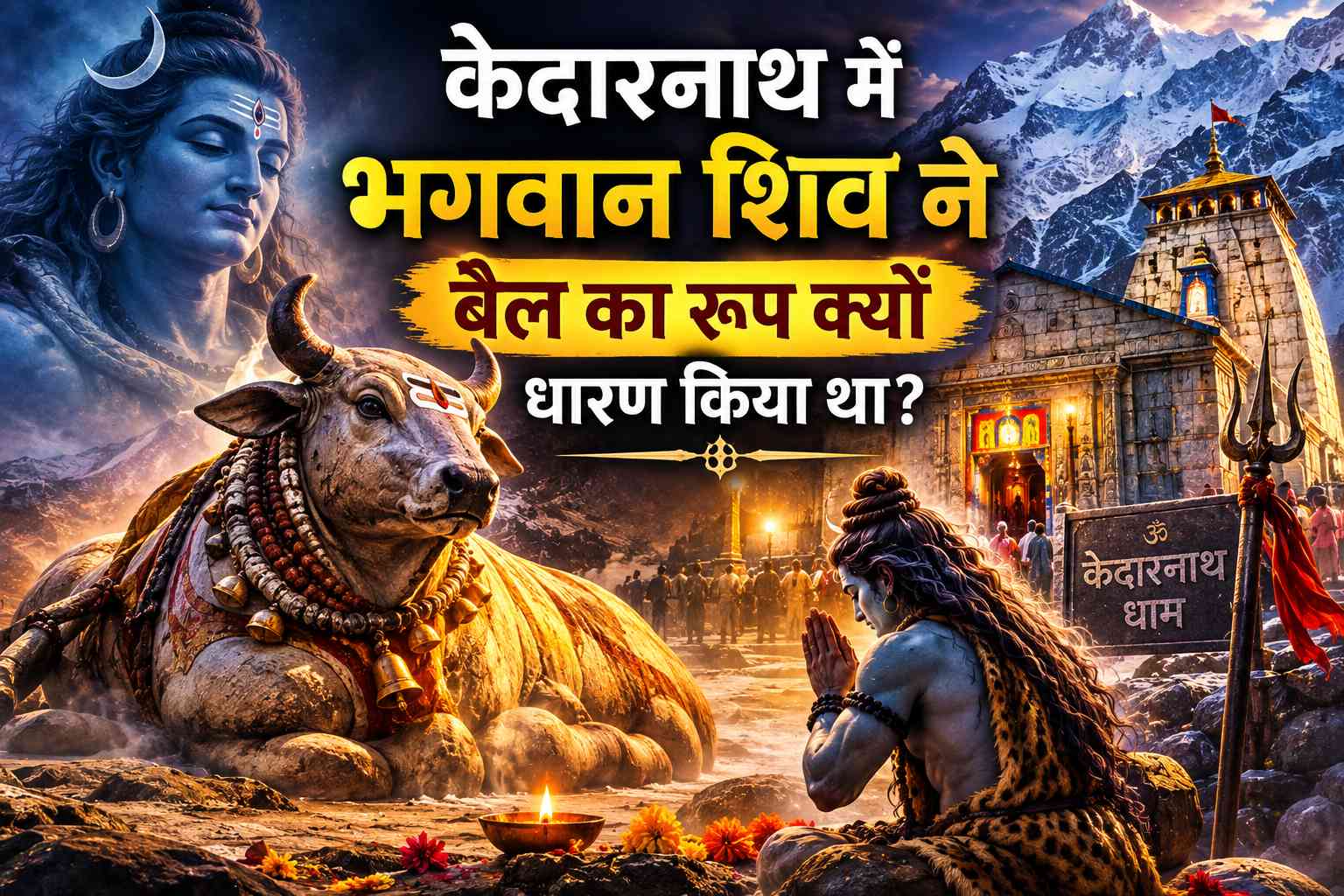
Nestled high in the snow-capped peaks of the Garhwal Himalayas lies Kedarnath, one of the most revered Jyotirlingas of Lord Shiva. Unlike traditional Shivlings, the main deity worshipped inside the ancient Kedarnath temple is a triangular, conical rock resembling the hump of a bull. For centuries, devotees have trekked through treacherous terrains to touch this sacred rock, but a profound question remains: Why did the Lord of the Universe, Mahadev, take the form of a bull (Vrishabha/Nandi) in this icy wilderness? The answer lies in the tragic aftermath of the Mahabharata war, a cosmic game of hide-and-seek, and the desperate quest of the Pandavas for redemption. Let us delve deep into the epic mythology that birthed the Kedarnath shrine and the legendary Panch Kedar.
1. The Guilt of Kurukshetra: The Burden of Bloodshed
The epic war of Mahabharata ended with the triumph of Dharma, but the victory tasted like ashes for the Pandavas. The battlefield of Kurukshetra was soaked in the blood of millions. Yudhishthira, the righteous king, was consumed by severe guilt for having committed 'Gotra Hatya' (the slaughter of one's own kin, the Kauravas) and 'Brahma Hatya' (the killing of venerable Brahmins like Guru Dronacharya).
Desperate for peace and redemption, the Pandavas approached the great Sage Ved Vyasa. The sage told them that their sins were so monumental that ordinary penance would not suffice. Only Mahadev, the supreme Lord Shiva, had the power to absolve them of such grave karmic debts. Following his advice, the Pandavas handed over their kingdom to Parikshit and set out on a journey to find Shiva.
2. The Cosmic Hide and Seek: The Journey to Guptkashi
The Pandavas first traveled to Kashi (Varanasi), the eternal city of Lord Shiva. However, Shiva was deeply angered by the unprecedented deceit and violence of the Kurukshetra war. He did not want to forgive the Pandavas so easily. To avoid them, He made Himself invisible and left Kashi for the serene, icy terrains of the Garhwal Himalayas.
When the Pandavas realized Shiva had left Kashi, they followed His cosmic trail into the mountains. Sensing their approach, Lord Shiva hid Himself in a secret location in the Mandakini valley. This place, where the Lord of the Universe temporarily concealed His identity, became known as 'Guptkashi' (The Hidden Kashi). But the Pandavas were determined; led by the powerful Bhima, they continued their relentless search.
3. The Divine Disguise: Mahadev as the Mystical Bull
As the Pandavas reached the breathtakingly beautiful but rugged valley of Kedarnath, Lord Shiva decided to test their resolve one final time. He transformed Himself into a magnificent, radiant bull (Vrishabha). Why a bull? In Hindu philosophy, the bull represents 'Dharma' (righteousness). By taking this form, Shiva was testing if the Pandavas, who fought for Dharma, could truly recognize it.
Shiva, in His bovine disguise, mixed with a grazing herd of cattle in the Kedarnath valley. The valley was covered in mist, and finding the Lord seemed impossible. But Bhima, possessing immense physical and mental strength, devised a clever plan. He stood with his massive legs spread across two adjacent mountains, forcing the herd to pass beneath him.
4. Bhima’s Catch and the Sinking of the Bull
As the cattle passed under Bhima's legs, ordinary cows and bulls went through easily. But the divine bull, being the Lord of the Universe, refused to pass beneath a mortal's legs. Realizing this extraordinary behavior and noting the divine glow of the animal, Bhima instantly recognized it was Mahadev.
Bhima lunged to catch the bull. Seeing that He was recognized, Lord Shiva began to sink into the earth. With all his mighty strength, Bhima grabbed the hind part (the hump and the tail) of the sinking bull. Bhima's sheer devotion and sheer persistence pleased Lord Shiva. He allowed His hump to remain above the ground as a triangular rock, forgiving the Pandavas and declaring that He would forever reside in Kedarnath in this conical form to bless His devotees.
5. The Genesis of Panch Kedar and Pashupatinath
The mythological phenomenon did not end at Kedarnath. When the divine bull dissolved into the earth, its fragmented cosmic body rematerialized at different locations across the Himalayas, forming the sacred 'Panch Kedar' (Five Kedars).
The hump emerged at **Kedarnath**, becoming the supreme Jyotirlinga. The arms (Bahu) appeared at **Tungnath** (the highest Shiva temple in the world). The face (Mukh) manifested at **Rudranath**. The navel and stomach (Nabhi) surfaced at **Madhyamaheshwar**, and the divine matted hair (Jata) appeared at **Kalpeshwar**.
Interestingly, ancient legends also state that the head of the divine bull traveled across the mountains and manifested in the Kathmandu valley of Nepal, which is today worshipped as the world-renowned **Pashupatinath Temple**. Together, these shrines form a massive, interlinked cosmic geography representing Shiva's grace, born from a legendary game of hide-and-seek with the Pandavas.
Frequently asked questions
Why did the Pandavas want to meet Lord Shiva after the Mahabharata?
After winning the Kurukshetra war, the Pandavas were drowning in guilt for committing 'Gotra Hatya' (killing their own cousins, the Kauravas) and 'Brahma Hatya' (killing their Guru Dronacharya). Sage Vyasa advised them that only Lord Shiva could forgive these grave sins.
Why was Shiva hiding from the Pandavas?
Lord Shiva was deeply angered by the massive bloodshed, deceit, and destruction caused during the Mahabharata war. He felt the Pandavas were responsible for this horrific violence and initially refused to grant them Darshan (forgiveness), choosing to hide instead.