
Mythology & Philosophy
The Secret Why Lord Brahma Has Very Few Temples
Vedic Wisdom · 6 min · Updated 2026-08-17
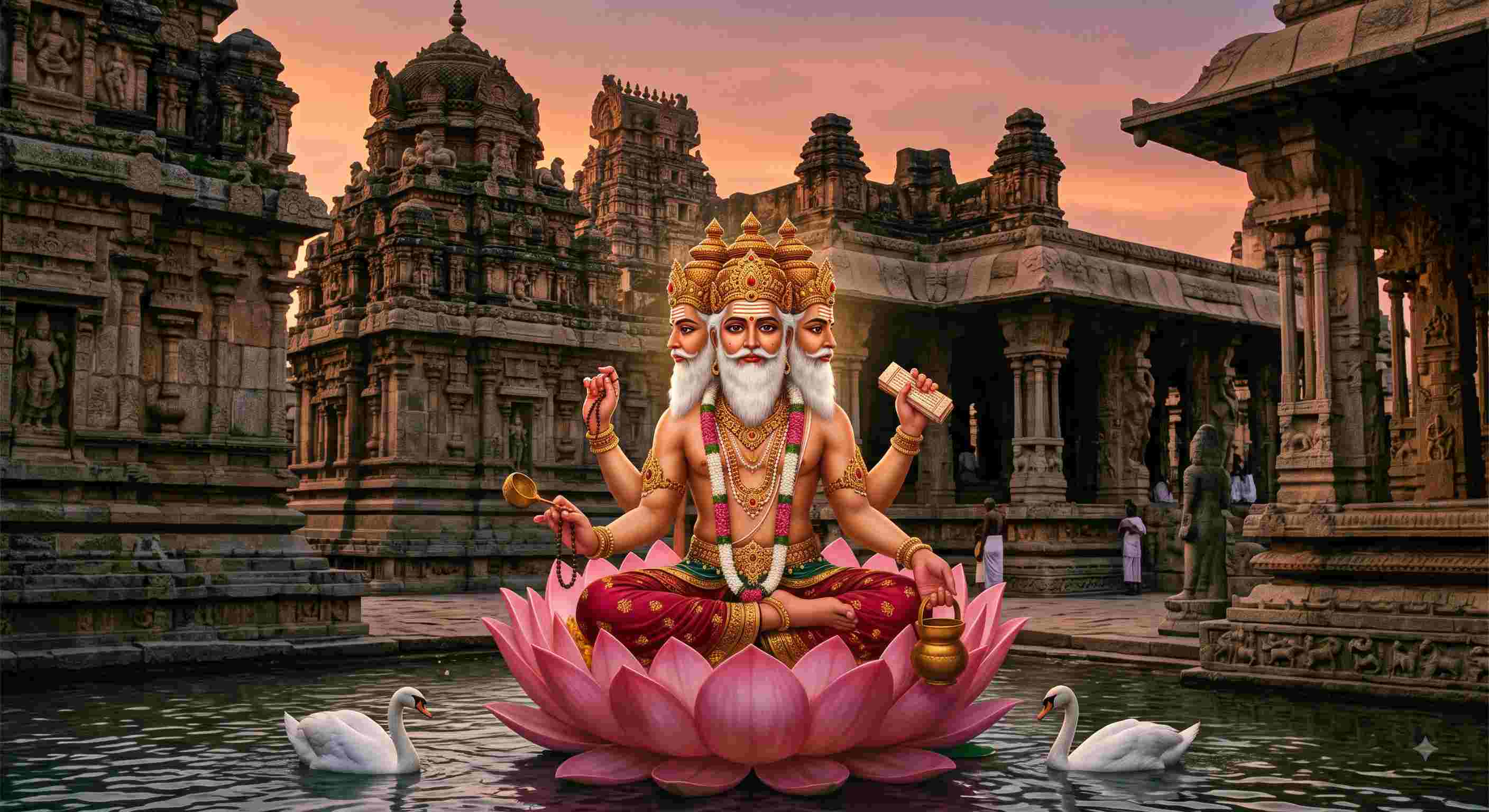
In Sanatan Dharma, the Supreme Divine functions through the Holy Trinity (Trimurti): Brahma the Creator, Vishnu the Preserver, and Shiva the Destroyer. While millions of temples are dedicated to Lord Shiva and Lord Vishnu across the globe, Lord Brahma, the one who supposedly created the entire universe, is largely ignored. Apart from the famous temple in Pushkar, Rajasthan, he has almost no dedicated shrines. How can the architect of existence be sidelined in everyday worship? The answer is a fascinating blend of ancient curses, cosmic ego, and a highly logical philosophical view of time.
The Curse of Lord Shiva (The Pillar of Light)
According to the Shiva Purana, an argument once broke out between Lord Brahma and Lord Vishnu over who was the greatest. To settle the dispute, Lord Shiva appeared as an infinite, blazing pillar of light (the Jyotirlinga). He challenged them to find the end of the pillar. Vishnu went downwards as a boar but honestly admitted he couldn't find the base. Brahma flew upwards as a swan, failed to find the top, but decided to lie. He convinced a Ketaki flower falling from the top to bear false witness that he had reached the summit.
Infuriated by this deceit, Lord Shiva appeared from the light. He cursed Brahma, stating that because he lied to establish his supremacy, he would never be worshipped by humanity. He also cursed the Ketaki flower, banning it forever from being offered in Shiva Pujas.
The Curse of Goddess Saraswati
Another popular legend from the Padma Purana involves a grand Yajna (fire sacrifice) Lord Brahma was performing in Pushkar. The presence of his wife, Goddess Saraswati, was mandatory for the rituals. When she was delayed, an impatient Brahma married a local milkmaid, Gayatri, to complete the ceremony on time. When Saraswati arrived and saw another woman in her place, she was utterly devastated and furious. She cursed Brahma that he would never be worshipped anywhere on Earth, except in that very spot of Pushkar.
The Deep Philosophical Reason (The Concept of Time)
Beyond mythology, there is a brilliant philosophical logic. Brahma represents the 'Creation' (the Past). Vishnu represents 'Maintenance' (the Present). Shiva represents 'Transformation/Destruction' (the Future). Human psychology naturally ignores what is already done. The creation is complete; the past cannot be changed. Therefore, humans naturally pray to the forces that maintain their present life (Vishnu/Lakshmi for wealth and health) and the forces that govern their ultimate future and transformation (Shiva). Since the act of creation is over, Brahma’s active role in our daily lives is finished, hence the lack of daily worship.
Frequently asked questions
Where is the most famous Brahma temple located?
The most prominent and widely visited temple dedicated to Lord Brahma is located in Pushkar, Rajasthan, near the sacred Pushkar Lake.
Can we keep an idol of Lord Brahma at home?
Usually, individual idols of Lord Brahma are not kept in home temples for daily worship. He is mostly worshipped along with the Trimurti or as part of specific architectural and foundational rituals (Vastu).