
Mythology & Devotion
Why Is Tulsi Considered Sacred in Hinduism?
Bhakti Voice · 9 min · Updated 2026-08-18
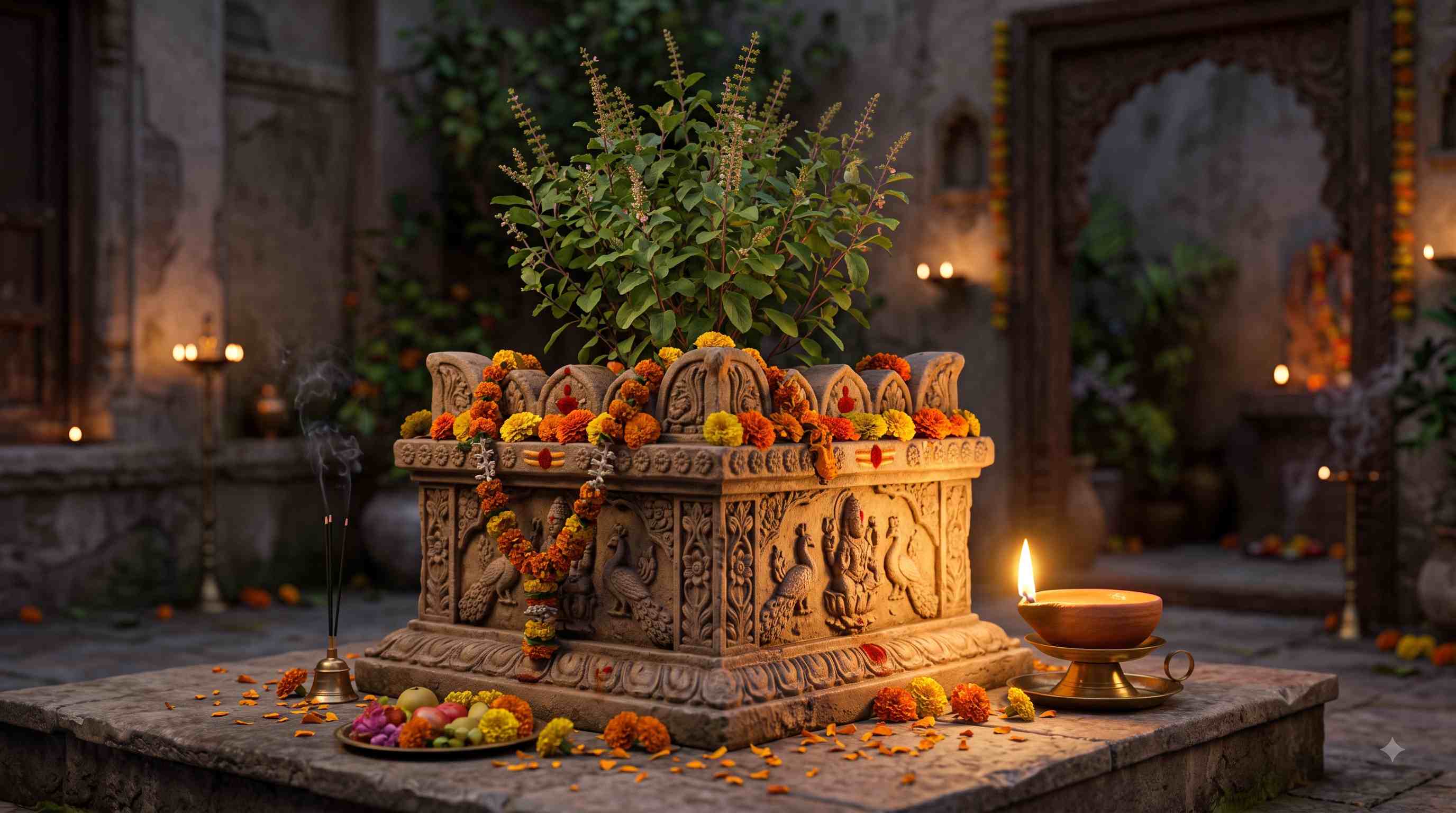
Walk into the courtyard of any traditional Indian home, and you will almost certainly find a vibrant green plant placed reverently on a pedestal. This is the Tulsi, or Holy Basil. While modern science and Ayurveda praise it for its incredible medicinal, antiviral, and stress-relieving properties, its significance in Hinduism goes infinitely deeper. To millions of devotees, Tulsi is not just a plant; she is Maa Tulsi, a goddess of devotion, purity, and unparalleled spiritual power. But why is this specific plant held in such extraordinarily high esteem? Why is it said that Lord Vishnu refuses any food offering that lacks a Tulsi leaf? The answer lies in an ancient, heart-wrenching, and beautiful mythological saga from the Puranas—the epic story of Devi Vrinda, the mighty demon king Jalandhar, and the supreme preserver of the universe, Lord Vishnu.
The Spiritual and Ayurvedic Marvel of Holy Basil
Before delving into the mythology, it is vital to acknowledge the physical wonders of the Tulsi plant (Ocimum tenuiflorum). Ayurveda honors Tulsi as 'The Incomparable One' and the 'Queen of Herbs'. It purifies the air, acts as a powerful adaptogen, boosts immunity, and wards off negative energies.
However, in the realm of Bhakti (devotion), Tulsi transcends her botanical properties. She is considered a manifestation of Goddess Lakshmi on Earth. Scriptures state that the root of the Tulsi plant encompasses all the holy pilgrimage sites, its stem is the abode of all the deities, and its leaves contain the essence of the sacred Vedas.
The Origin Story: The Devotion of Princess Vrinda
The legend begins with a powerful and beautiful princess named Vrinda (who was an ardent devotee of Lord Vishnu) and her marriage to Jalandhar, a fierce demon king born from the cosmic anger of Lord Shiva. Though Jalandhar was a demon, Vrinda’s character was absolutely pure. She strictly followed her 'Pativrata Dharma' (the sacred vows of absolute loyalty to her husband).
Her unwavering devotion and chastity created an impenetrable mystical shield around Jalandhar. No weapon, no matter how divine, could pierce this shield. Empowered by his wife's virtue, Jalandhar became arrogant and went on a rampage, conquering the three worlds and eventually challenging Lord Shiva himself.
The Cosmic Crisis and Lord Vishnu's Illusion
A catastrophic war broke out between Lord Shiva and Jalandhar. However, to the shock of the cosmos, even Lord Shiva's deadly trident could not harm the demon king because of Vrinda’s spiritual shield. The universe was on the brink of destruction. The deities rushed to Lord Vishnu, the preserver, begging for a solution.
Vishnu knew that Jalandhar could only be killed if Vrinda’s vow of chastity was broken. Bound by cosmic duty to save the universe, Lord Vishnu took the form of Jalandhar and appeared before Vrinda while the real Jalandhar was fighting Shiva. Believing him to be her husband returning victorious, Vrinda embraced him. At that exact moment, her shield shattered, and Lord Shiva instantly struck down Jalandhar.
The Curse of the Stone and the Birth of Tulsi
Realizing she had been tricked, a devastated and furious Vrinda demanded the impostor reveal himself. Lord Vishnu returned to his true divine form. Heartbroken that her beloved deity had betrayed her, she cursed Lord Vishnu: 'You, who are completely devoid of emotion and acted like a stone, shall turn into a stone!'
Accepting the curse from his supreme devotee out of deep guilt and love, Lord Vishnu transformed into the black, ammonite stone known as the Shaligram. Vrinda then chose to immolate herself in the funeral pyre of her husband. From her holy ashes, a remarkably fragrant plant sprouted. Lord Vishnu, moved to tears, named the plant 'Tulsi' (meaning the incomparable one).
The Eternal Blessing and Tulsi Vivah
To honor her supreme sacrifice and eternal devotion, Lord Vishnu declared a divine boon: 'O Vrinda! You will forever remain by my side. You are dearer to me than my own life. From this day forth, no offering, whether it be food or flowers, will be accepted by me unless it is accompanied by a Tulsi leaf.'
This is why, every year on Prabodhini Ekadashi (the 11th day of the bright half of the Kartik month), devotees celebrate 'Tulsi Vivah'. It is the glorious cosmic wedding of the Tulsi plant to the Shaligram stone, symbolizing the eternal union of Lord Vishnu and his greatest devotee, restoring cosmic balance and divine love.
Why Lord Vishnu's Worship is Incomplete Without Tulsi
The impact of this story echoes in daily Hindu rituals to this day. It is an unbroken law of Bhakti that 'Naivedhya' (food offered to the deity) for Lord Vishnu, Lord Krishna, or Lord Rama is considered impure and incomplete without the presence of a Tulsi leaf. Placing a single leaf purifies the entire offering.
Furthermore, Vaishnavas (devotees of Vishnu) wear neck beads and chant their mantras on a 'Tulsi Mala' (rosary made of Tulsi wood). Chanting on a Tulsi mala multiplies the spiritual merit of the mantra immensely. Ultimately, Maa Tulsi stands as the ultimate symbol of surrender, showing that true devotion can bind even the Supreme Lord of the Universe.
Frequently asked questions
Why is Tulsi dear to Lord Vishnu?
Tulsi is the reincarnated form of Devi Vrinda, a supreme devotee of Lord Vishnu. Touched by her unwavering devotion and a subsequent curse, Vishnu blessed her saying she would forever remain closest to his heart, and his worship would be incomplete without her.
What is the relationship between Shaligram and Tulsi?
Shaligram is the sacred, non-anthropomorphic stone representation of Lord Vishnu. Devi Vrinda cursed Vishnu to turn into a stone (Shaligram), and in return, he blessed her to become the Tulsi plant. They are eternally worshipped together.