
Mythology & Devotion
Why Is Tuesday Considered Auspicious for Hanuman Ji?
Bhakti Voice · 8 min · Updated 2026-08-18
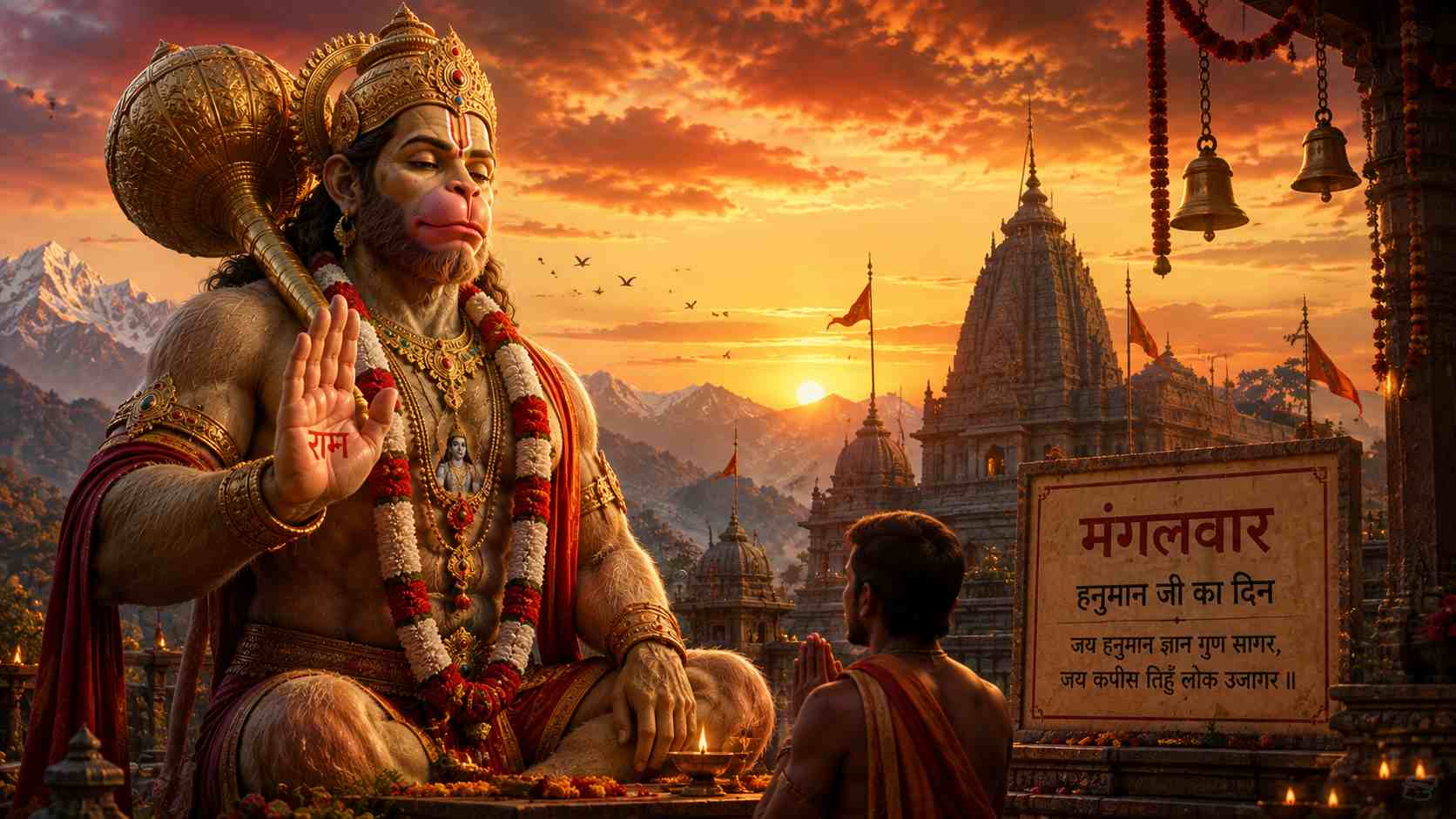
Every week, as Tuesday dawns, a profound spiritual shift occurs across India and in the hearts of millions of devotees worldwide. Hanuman temples witness massive crowds, the air resonates with the rhythmic chanting of the Hanuman Chalisa, and the fragrance of jasmine oil and sweet boondi fills the streets. Devotees observe strict fasts and offer red flowers and sindoor to Bajrangbali. But have you ever paused to ask: Why Tuesday? Out of the seven days of the week, why is 'Mangalvar' exclusively dedicated to the supreme devotee of Lord Rama? The answer is a fascinating blend of ancient mythology, Vedic astrology, and divine boons that explain why worshipping Hanuman Ji on a Tuesday brings instantaneous relief from life's deepest crises.
The Day of the Divine Birth
The most direct reason Tuesday is considered highly auspicious for Lord Hanuman is linked to his cosmic descent. According to the Skanda Purana and several other revered ancient texts, Hanuman Ji was born on the full moon day (Purnima) of the Chaitra month on a Tuesday. He was born to the Vanara King Kesari and Mata Anjana through the blessings of Lord Shiva and the Wind God (Vayu).
Because Tuesday marks the day he graced the earth with his presence to assist Lord Rama in eradicating evil, it became eternally associated with his worship. Devotees believe that invoking his name on his birth day makes him incredibly pleased and highly responsive to their prayers.
Bringing the 'Mangal Samachar' (Auspicious News)
The word 'Mangal' in Sanskrit and Hindi translates to auspicious, well-being, or good fortune. The epic Ramayana associates Hanuman Ji with bringing the ultimate 'Mangal Samachar' (good news) during the darkest times of Lord Rama's life.
When Mata Sita was abducted by Ravana, Lord Rama was drowning in sorrow and uncertainty. It was Hanuman who leaped across the ocean, braved demonic obstacles, found Sita in the Ashok Vatika, and returned to Rama with her crest jewel (Chudamani). Legend holds that the day Hanuman returned and delivered this immensely auspicious news—restoring hope to Lord Rama—was a Tuesday. Thus, worshipping him on Tuesday is said to bring 'Mangal' (good news) into the life of the devotee.
The Astrological Connection: Pacifying Planet Mars
In Vedic Astrology (Jyotish Shastra), Tuesday is 'Mangalvar', the day ruled by the planet Mars (Mangala). Mars is characterized as a fierce, red, masculine planet representing raw physical energy, courage, aggression, fire, and warfare. When Mars is negatively placed in a person's horoscope (Mangal Dosha), it can cause anger issues, accidents, crippling debts, and severe marital discord.
Hanuman Ji is the perfect embodiment of positive Martian energy. He possesses infinite strength and courage (Bala and Parakrama) but directs it entirely toward selfless service and devotion (Bhakti). Because Hanuman has absolute authority over the Navagrahas (nine planets), worshipping him on Tuesday pacifies the fierce energy of Mars. He absorbs the malefic effects of the planet and converts them into fearlessness and success for his devotees.
The Fiery Red Form: The Significance of the Color
Have you noticed that everything associated with Tuesday and Hanuman Ji is deeply connected to the color red or orange? Mars is the red planet. Hanuman is often offered a Chola of bright orange/red sindoor.
This color represents the fire of life, vitality, and unyielding strength. By offering red flowers, red sandalwood (Raktachandan), or sindoor to Bajrangbali on Mangalvar, devotees symbolically offer their own fiery passions, anger, and ego to him, asking him to purify their energy and grant them inner peace and discipline.
Burning Down Lanka: A Triumph of Good over Evil
Another powerful folklore suggests that Hanuman burned down the golden city of Lanka on a Tuesday. When Ravana arrogantly set Hanuman's tail on fire, he underestimated the Vanara warrior. Hanuman used that very fire to reduce Ravana's ego and his glorious city to ashes.
This act was the first major blow to Ravana's terrifying empire. Therefore, observing a fast and worshipping Hanuman on Tuesday is believed to burn down the negative energies, enemies, and obstacles in a devotee's life, just as Hanuman burned down Lanka.
How to Best Observe Tuesday for Hanuman Ji
To harness the powerful, protective energy of Tuesday, devotees follow several simple yet profound practices. Taking a vow (Sankalpa) to fast for 21 consecutive Tuesdays is considered a highly effective remedy for overcoming severe illnesses, financial blockages, or fear.
On these days, reciting the Hanuman Chalisa, the Bajrang Baan, or the Sundarkand is highly recommended. Offering sweet treats like Besan Ladoos, Boondi, or jaggery and gram (Gud-Chana) pleases his childlike innocence. Ultimately, Tuesday is not just a day of ritual; it is a weekly reminder to awaken the 'Hanuman' within—to face life's battles with unshakeable courage and absolute devotion to the Divine.
Frequently asked questions
Was Lord Hanuman born on a Tuesday?
Yes, according to several Puranic texts including the Skanda Purana, Lord Hanuman was born to Mata Anjana and Kesari on a Tuesday, which is a primary reason the day is dedicated to him.
How does worshipping Hanuman on Tuesday help astrologically?
Tuesday is ruled by Mars (Mangal), an aggressive and fiery planet. Worshipping Hanuman Ji, who controls Mars, neutralizes Mangal Dosha and protects the devotee from accidents, debts, and anger issues.