
Hindu Gods & Science
Decoding the Blue Color of Lord Krishna
Vedic Wisdom · 5 min · Updated 2026-08-17
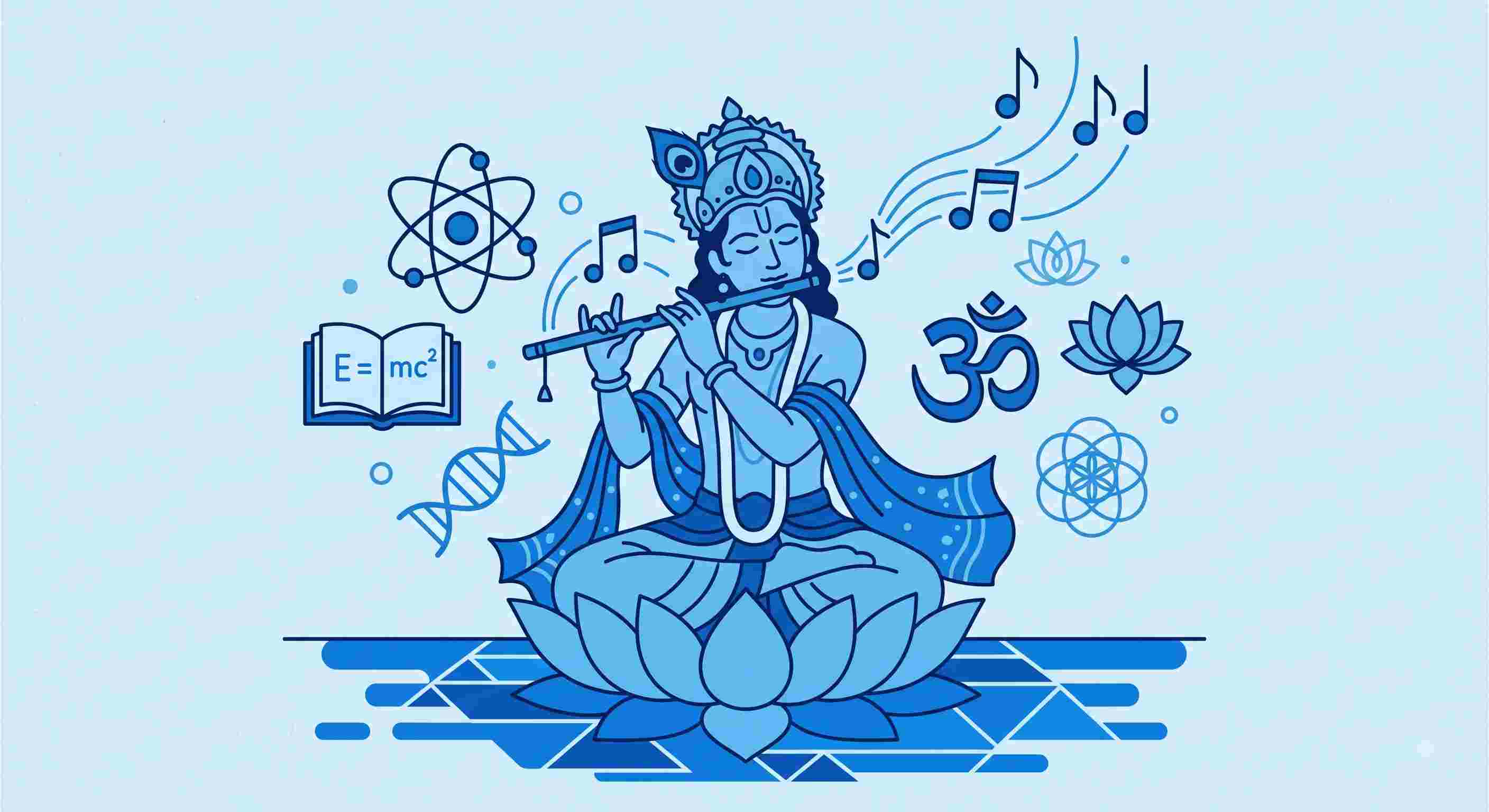
In almost all ancient paintings, modern art, and television shows, Lord Krishna is distinctively painted in shades of blue. He is often lovingly referred to as 'Meghashyam', meaning 'dark like a raincloud'. Have you ever wondered why the supreme avatar of Lord Vishnu has blue skin? Is it a literal skin color based on genetics, a reaction to demon poison, or a highly sophisticated symbol crafted by ancient sages to represent the infinite nature of the cosmos? Let's dive into the fascinating mythological, scientific, and spiritual reasons behind the blue hue of the divine flute player.
The Symbol of the Infinite (The Science of Light)
In nature, anything that is vastly immense, boundless, and deep appears blue to the human eye. Look up at the sky; it is completely transparent, yet the scattering of light makes it appear a brilliant blue. Look at the oceans; water is colorless, but in massive, unfathomable depths, it takes on a dark blue hue. Ancient Hindu sages were profound observers of nature. By coloring Lord Krishna blue, they were communicating a highly advanced philosophical concept: Krishna is not just a person; he is infinite, immeasurable, and all-encompassing, exactly like the boundless sky and the deep ocean.
The Legend of Putana's Poison
From a mythological perspective, the Puranas tell the story of Krishna as an infant. The demoness Putana disguised herself as a beautiful woman and attempted to kill baby Krishna by feeding him breast milk laced with highly toxic poison. Krishna, being the Supreme Lord, drank not only the milk but sucked the very life force out of the demoness. It is believed that the absorption of this lethal poison didn't kill him, but permanently turned his skin a shade of dark blue, representing his capability to absorb the toxicity and suffering of the world.
The Color of the Spiritual Aura
According to Yogic science, every living being emits an energy field known as an 'Aura'. The color of an aura changes based on a person's spiritual evolution. A purely blue aura indicates the highest level of spiritual consciousness, supreme peace, deep magnetism, and unconditional love. Krishna’s blue color in art is actually the depiction of his vibrant, magnetic aura rather than his physical skin. His dark, bluish hue ('Shyam') absorbed all colors (all types of people and energies) around him, reflecting back only pure divine love.
Frequently asked questions
Was Lord Krishna actually blue in real life?
Historically, Krishna was described as having a very dark, lustrous complexion, like a dark monsoon cloud (Meghashyam). Over centuries, artists began using blue pigment to represent this dark, infinite quality to distinguish his divine nature.
Why is Lord Rama also depicted as blue?
Like Krishna, Lord Rama is an avatar of Lord Vishnu. The blue color represents their shared divine essence, their all-encompassing nature, and their cosmic connection to the infinite, just like the sky.