
Mythology & Devotion
Why Does Lord Shiva Wear a Snake Around His Neck?
Bhakti Voice · 8 min · Updated 2026-08-18
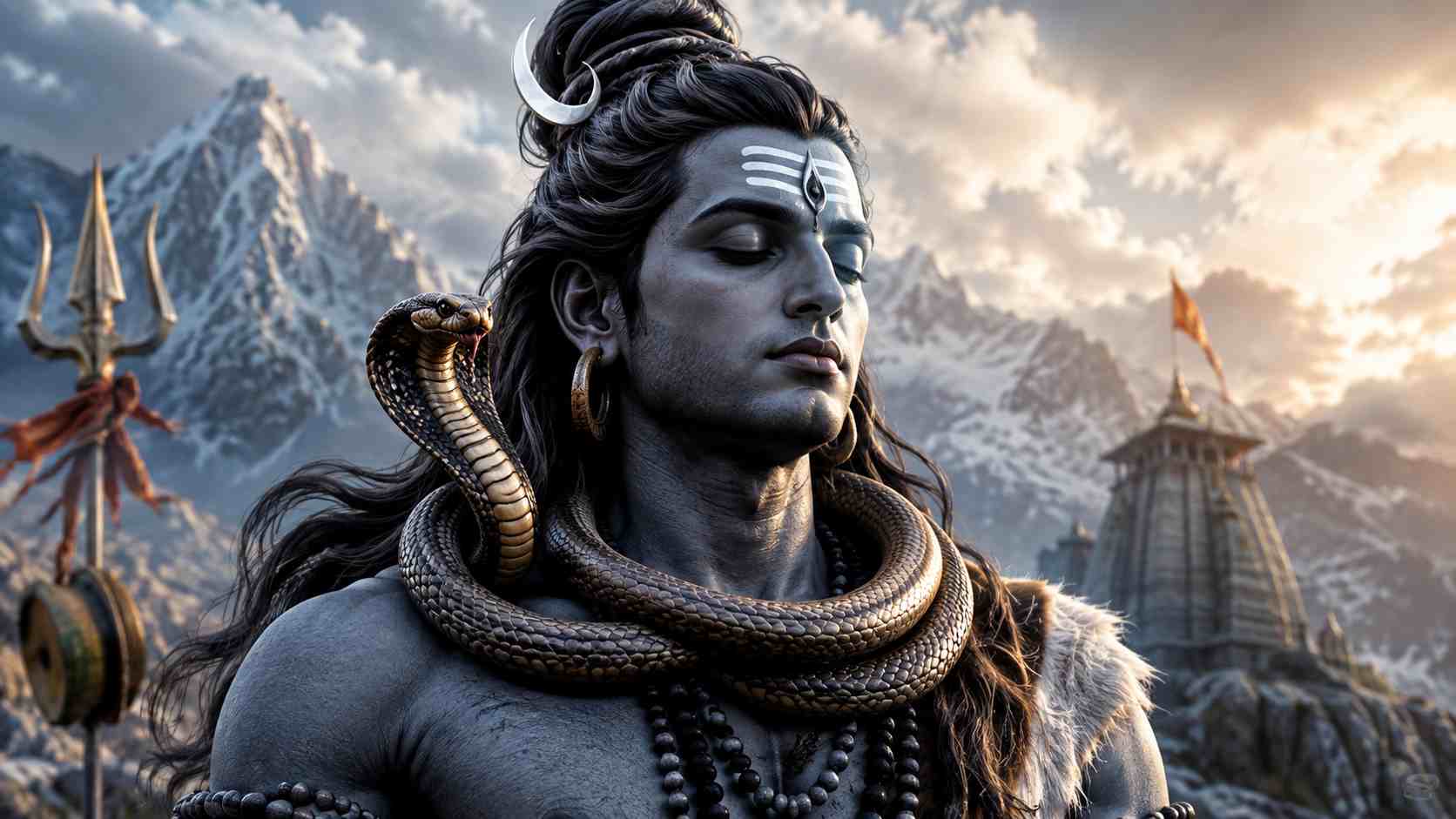
When you picture Lord Shiva, the image is instantly recognizable and breathtakingly unique. He sits in deep meditation on Mount Kailash, his body smeared with holy ash, the crescent moon resting in his matted hair, and the holy Ganga flowing from his locks. But perhaps the most striking and intimidating feature of Mahadev is the venomous cobra coiled three times around his blue neck, its hood raised in a protective stance. To the uninitiated, a snake represents fear, danger, and death. So why does the Supreme Lord of the Universe, the destroyer of evil, wear a deadly serpent as an ornament? The answer weaves together an epic tale from the Samudra Manthan (The Churning of the Ocean), deep yogic symbolism, and Mahadev’s boundless compassion as Pashupatinath—the Lord of all creatures.
The Compassion of Pashupatinath
To understand why Lord Shiva wears a snake, we must first understand his nature. Shiva is known as Pashupatinath—the Lord of all animals and living beings. Unlike the materialistic world that seeks only the beautiful, wealthy, and powerful, Mahadev is the refuge for the rejected, the fierce, and the terrifying.
While society fears snakes for their lethal venom, Shiva embraces them. He accepts all that the world discards. By placing a venomous creature so close to his divine throat, Shiva sends a profound message: in the eyes of the Divine, all creatures are equal, and even the most feared beings deserve love and shelter.
The Epic Origin: The Churning of the Ocean
The mythological reason behind the snake dates back to one of the most magnificent events in Hindu cosmology: the Samudra Manthan, or the Churning of the Cosmic Ocean. The Devas (gods) and Asuras (demons) decided to churn the ocean of milk to extract Amrita, the nectar of immortality.
To accomplish this impossible task, they used Mount Mandara as the churning rod. But they needed a rope strong enough to turn a mountain. They requested Vasuki, the mighty King of Serpents, to act as the churning rope. Vasuki, a great devotee of Lord Shiva, agreed to endure this immense suffering for the greater good of the cosmos.
Vasuki's Sacrifice and Shiva's Blessing
As the demons pulled Vasuki from the head and the gods from the tail, the friction caused immense agony to the serpent king. His body was bruised, and he began emitting deadly venom, adding to the lethal Halahala poison that emerged from the ocean, which threatened to destroy the universe.
Lord Shiva stepped in, consuming the Halahala poison to save creation, holding it in his throat (earning him the name Neelkanth). Witnessing Vasuki’s battered state and deep devotion, Shiva was moved by compassion. He blessed Vasuki, healing his wounds, and offered him the highest place of honor—resting eternally around the Lord's own neck as a divine ornament.
Symbolism: Mastery Over Fear and Death
Beyond mythology, the snake carries deep spiritual symbolism. A venomous cobra represents primal fear, danger, and sudden death. Most humans are paralyzed by the fear of their mortality.
By wearing the ultimate symbol of death around his neck, Lord Shiva demonstrates his absolute mastery over it. He is Mrityunjaya, the conqueror of death. The snake acts as a reminder that death is not something to be feared, but a natural, inevitable phase of the cosmic cycle that Shiva controls.
The Three Coils: The Concept of Time
Look closely at the iconography of Mahadev, and you will notice that Vasuki is coiled exactly three times around his neck. These three coils are not a random artistic choice; they represent the three dimensions of time: the past, the present, and the future.
The snake looking forward with its raised hood signifies that time is always moving forward. Shiva, by wearing time itself as an ornament, shows that he is Mahakala—the absolute reality that exists beyond the limitations of time and space. He controls time, but time does not control him.
Kundalini Energy: The Yogic Perspective
From an esoteric and yogic perspective, Lord Shiva is the Adiyogi (the first yogi). In the yogic tradition, spiritual energy, known as Kundalini, is visualized as a dormant serpent coiled at the base of the human spine (the Muladhara chakra).
When a yogi achieves self-realization through intense meditation, this Kundalini energy awakens, uncoils, and travels up the spine to the crown chakra (Sahasrara). The snake around Shiva's neck represents this fully awakened Kundalini energy. It shows that Mahadev is in the highest state of consciousness and ultimate spiritual enlightenment.
Frequently asked questions
What is the name of the snake around Lord Shiva's neck?
The snake coiled around Lord Shiva's neck is Vasuki, the King of Serpents (Nagaraja) in Hindu mythology.
Why did Shiva accept Vasuki as his ornament?
During the Samudra Manthan, Vasuki was used as a churning rope and suffered immense pain. Touched by his devotion and sacrifice, Shiva blessed him to forever rest comfortably around his neck as his closest ornament.
What do the three coils of the snake signify?
The three coils of the snake represent the three dimensions of time: past, present, and future. By wearing it, Shiva shows that he is Mahakala—the one who is absolutely beyond the limitations of time.