
Hindu Epics & Mythology
Why Does Lord Krishna Hold the Sudarshan Chakra? The Divine Origin, Power, and Meaning
Vedic Scholar · 15 min · Updated 2026-08-23
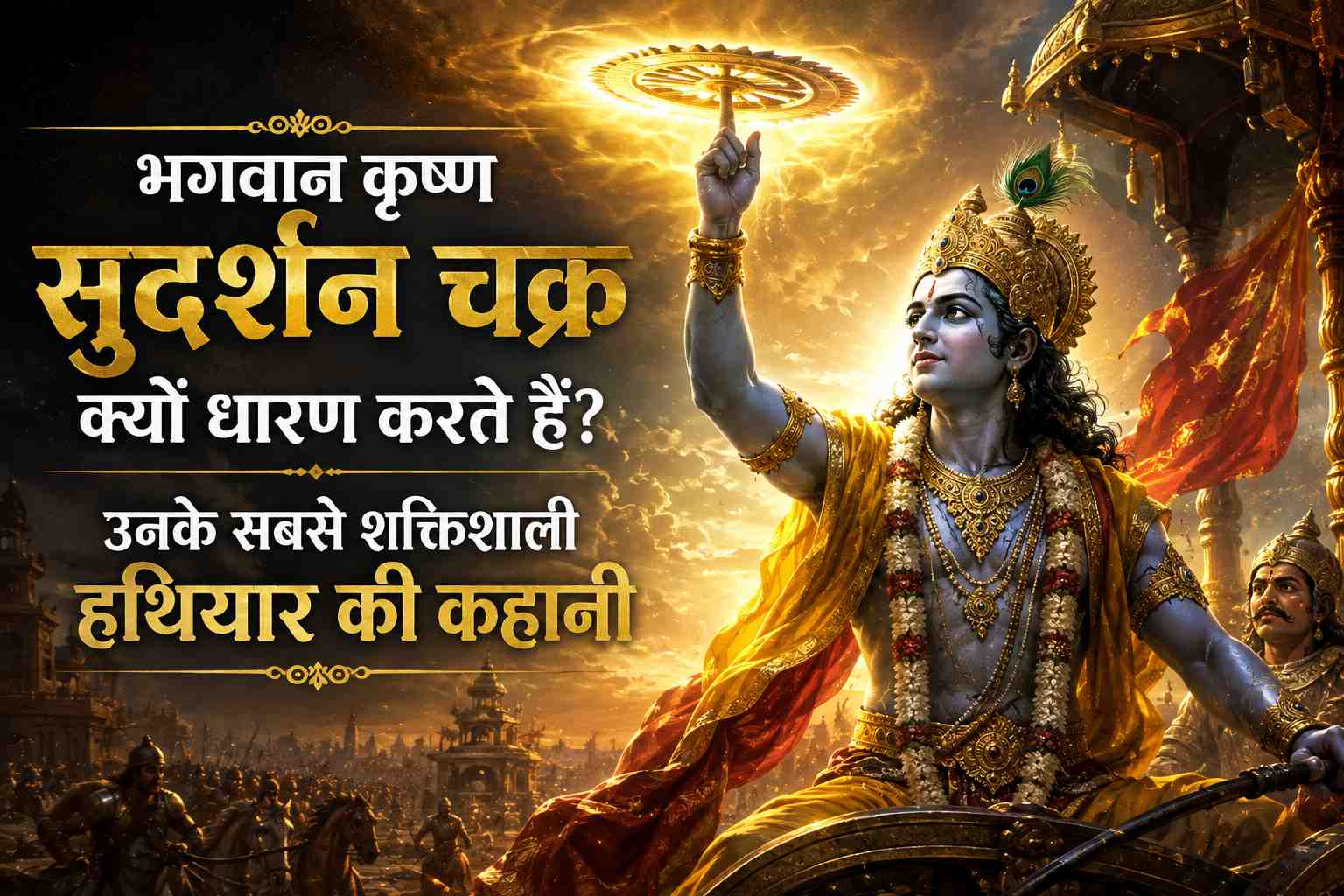
In the grand tapestry of Sanatan Dharma, few symbols command as much reverence, awe, and absolute authority as the Sudarshan Chakra of Lord Vishnu and his complete avatar, Lord Krishna. Usually depicted spinning gracefully on the index finger of the Supreme Lord, this blazing discus is far more than a mere weapon; it is the ultimate embodiment of cosmic time, moral order (Dharma), and the ruthless destruction of ignorance. But a profound question arises: why does Lord Krishna, widely celebrated as the playful cowherd of Vrindavan, the ultimate lover, and the compassionate messenger of peace, wield such a terrifying and invincible weapon? How did he acquire it during his earthly incarnation, and what hidden philosophical truths does it carry? This deeply researched guide explores the ancient Puranic scriptures and epic narratives to reveal the fascinating origins of Lord Krishna's Sudarshan Chakra, its incredible powers, and why it remains his ultimate instrument for maintaining balance in the universe.
The Duality of Lord Krishna: Compassion and Destruction
When we close our eyes and visualize Lord Krishna, our minds are naturally flooded with scenes of profound peace and love. We see the enchanting peacock feather, the mesmerizing melody of the Bansuri (flute), and a divine smile that captivated the entirety of Vrindavan. He is the very embodiment of Prema (divine love) and Karuna (compassion). Yet, alongside this gentle demeanor, rests the most destructive force known to cosmic creation: the Sudarshan Chakra, silently spinning on his right index finger.
This striking duality is the essence of Lord Krishna's earthly descent. In the Bhagavad Gita, Krishna explicitly declares his mission: 'Paritranaya sadhunam, vinashaya cha dushkritam'—to protect the righteous and annihilate the wicked. The flute represents his call of love to pure souls, while the Sudarshan Chakra represents his uncompromising commitment to cosmic justice. When diplomacy fails and Adharma (unrighteousness) threatens to consume the world, the flute is set aside, and the Chakra is unleashed. Understanding the Chakra is essential to understanding the complete nature of God in Sanatan Dharma.
The Fiery Forge: The Origin of the Sudarshan Chakra
The genesis of this supreme weapon is recorded in ancient texts like the Shiva Purana and the Markandeya Purana, showcasing a beautiful synergy between the principal deities of Hinduism.
Long before the events of the Mahabharata or Ramayana, the universe was besieged by invincible Asuras (demons) who tormented the Devas. Overwhelmed, the gods approached Lord Vishnu, who directed them to Lord Shiva, the master of destruction and transformation. Acknowledging the need for a weapon of absolute power, Lord Shiva commanded Vishwakarma, the celestial architect, to craft an unparalleled instrument.
Vishwakarma utilized a magnificent source of energy. He captured the searing, intense heat and dust from Surya (the Sun God) and placed it into his cosmic forge. Combining this raw solar energy with divine incantations, he forged a blazing disc. It possessed 108 serrated edges, radiating the blinding light of a million suns. Lord Shiva initially used this Chakra to slay the demon Jalandhara. Eventually, knowing that Lord Vishnu was the preserver responsible for maintaining universal equilibrium, Shiva gifted the Sudarshan Chakra to Vishnu, cementing it as his signature weapon.
The Earthly Descent: How Krishna Acquired the Chakra
While the Sudarshan Chakra eternally belongs to Lord Vishnu, how did his human avatar, Krishna, formally receive it on Earth? The Mahabharata provides a riveting account in the Adi Parva during the 'Khandava Dahana' (The Burning of the Khandava Forest) episode.
Lord Krishna and his dear friend Arjuna were resting by the Yamuna River when they were approached by a glowing brahmana, who was none other than Agni, the Fire God. Agni was suffering from an ailment caused by consuming too much clarified butter during a 12-year-long yagna. The only cure was to consume the massive Khandava forest and its inhabitants. However, Indra (the King of Heavens and Arjuna's father) fiercely protected the forest because his friend, the Naga king Takshaka, lived there. Every time Agni tried to burn the forest, Indra sent torrential rains to douse the fire.
Agni sought the help of Krishna and Arjuna to hold off Indra's forces. Recognizing that mortal weapons would be insufficient against celestial onslaughts, Agni invoked Varuna, the Lord of the Oceans. Upon his arrival, Varuna presented Arjuna with the mighty Gandiva bow and inexhaustible quivers. To Lord Krishna, Varuna offered the Sudarshan Chakra and the thunderous Kaumodaki mace. Armed with the supreme Chakra, Krishna easily repelled the heavenly deities, solidifying the power dynamic of the Dwapara Yuga and officially introducing the ultimate weapon into the Mahabharata.
The Anatomy and Mind-Bending Powers of the Chakra
The Sudarshan Chakra defies the conventions of normal weaponry. It is not an inert piece of metal; it is a conscious, sentient entity (Chetana) that acts upon the will of the Supreme Lord.
Firstly, its speed is described as 'Mano-java', meaning it travels at the speed of thought. The moment Lord Krishna wills a target to be destroyed, the Chakra reaches it instantaneously, unhindered by physical distance, dimensions, or mystical barriers. Secondly, it operates on a 'seek and destroy' autonomous mode. Once launched, it cannot be stopped, deflected, or countered by any other weapon in the universe, including the mighty Brahmastra. After severing its target, it automatically returns to Krishna's finger.
Beyond its offensive capabilities, it serves as the ultimate shield. When deployed defensively, it creates an impenetrable dome of kinetic divine energy. Furthermore, the Chakra emits extreme, purifying heat. Unlike earthly weapons that merely cause physical death, the Sudarshan Chakra purifies the soul of the one it strikes, instantly absolving them of their sins and frequently granting them Moksha (liberation), as seen in the deaths of various demons.
Decisive Interventions in the Mahabharata
Though possessing ultimate power, Lord Krishna used the Sudarshan Chakra exceedingly sparingly, reflecting his nature as a patient diplomat. However, when he did use it, it decisively altered the course of history.
The most famous instance is the beheading of King Shishupala of Chedi. Shishupala had an intense, lifelong hatred for Krishna. Krishna had given a boon to Shishupala's mother that he would pardon exactly 100 grave insults from her son. During the grand Rajasuya Yagna organized by Emperor Yudhishthira, Shishupala began a vitriolic rant against Krishna. Krishna patiently counted the insults. The moment Shishupala uttered the 101st insult, crossing the boundary of forgiveness, Krishna calmly released the Sudarshan Chakra. In a flash of blinding light, Shishupala's head was severed, and his soul merged into the Lord.
Another profound moment occurred during the Kurukshetra War involving Bhishma Pitamah. Arjuna, overwhelmed by familial love, was fighting weakly against Bhishma, who was decimating the Pandava army. Enraged by Arjuna's hesitation and determined to protect his devotee, Lord Krishna broke his vow of not taking up arms. He jumped off the chariot, summoned the roaring Sudarshan Chakra, and rushed toward Bhishma. Seeing the Lord rushing at him with the supreme weapon, Bhishma dropped his bow and folded his hands in sheer joy, ready to die at the hands of the divine. This act forced Arjuna to realize his duty, begging Krishna to stop and promising to fight with his full might.
The Deep Spiritual and Philosophical Symbolism
The word 'Sudarshan' translates beautifully to 'auspicious vision' (Su = auspicious, Darshan = vision). This indicates that the ultimate truth, though sometimes destructive, is always beautiful and pure. In Vedic philosophy, the Chakra represents the Kaal-Chakra, the eternal, unstoppable Wheel of Time.
The circular shape of the Chakra symbolizes perfection, continuity, and the cyclical nature of the cosmos (birth, life, death, and rebirth). The spinning motion indicates that time spares no one; kings, empires, and eras are all eventually consumed by the rolling wheel of time. By holding the Chakra on his finger, Lord Krishna signifies that he is the Master of Time, the supreme consciousness that governs the past, present, and future.
For the spiritual seeker, the Sudarshan Chakra is a metaphor for supreme spiritual knowledge (Jnana). Just as the Chakra cuts through physical enemies, true divine knowledge cuts through the inner enemies of humanity: Kama (lust), Krodha (anger), Lobha (greed), Moha (attachment), and Ahankara (ego). Meditating on the Chakra is believed to sever the bonds of Maya (illusion), granting the soul the 'auspicious vision' of ultimate reality.
Conclusion: The Eternal Guardian of Dharma
The Sudarshan Chakra on Lord Krishna’s finger is a powerful reminder that true divinity is a perfect balance of infinite love and uncompromising justice. While he will infinitely forgive, protect, and play with his devotees, he will not hesitate to unleash absolute destruction upon forces that threaten the moral fabric of the universe.
Through the searing heat of the Chakra and the soothing music of the flute, Lord Krishna maintains the delicate equilibrium of creation. It stands as an eternal beacon of hope for the righteous—an assurance that when the darkness of Adharma reaches its peak, the blinding light of the Sudarshan Chakra will always emerge to restore balance and guide humanity back to the path of truth.
Frequently asked questions
How did Lord Krishna get the Sudarshan Chakra?
According to the Mahabharata, Lord Krishna formally acquired the Sudarshan Chakra during the Khandava Forest burning episode. Agni, the Fire God, needed to consume the forest but faced fierce resistance from Lord Indra. To assist Agni, the ocean god Varuna manifested and presented the celestial Sudarshan Chakra to Krishna, ensuring his absolute victory against heavenly forces.