
Spiritual Philosophy
Why Does Lord Krishna Play the Flute?
Bhakti Voice · 8 min · Updated 2026-08-18
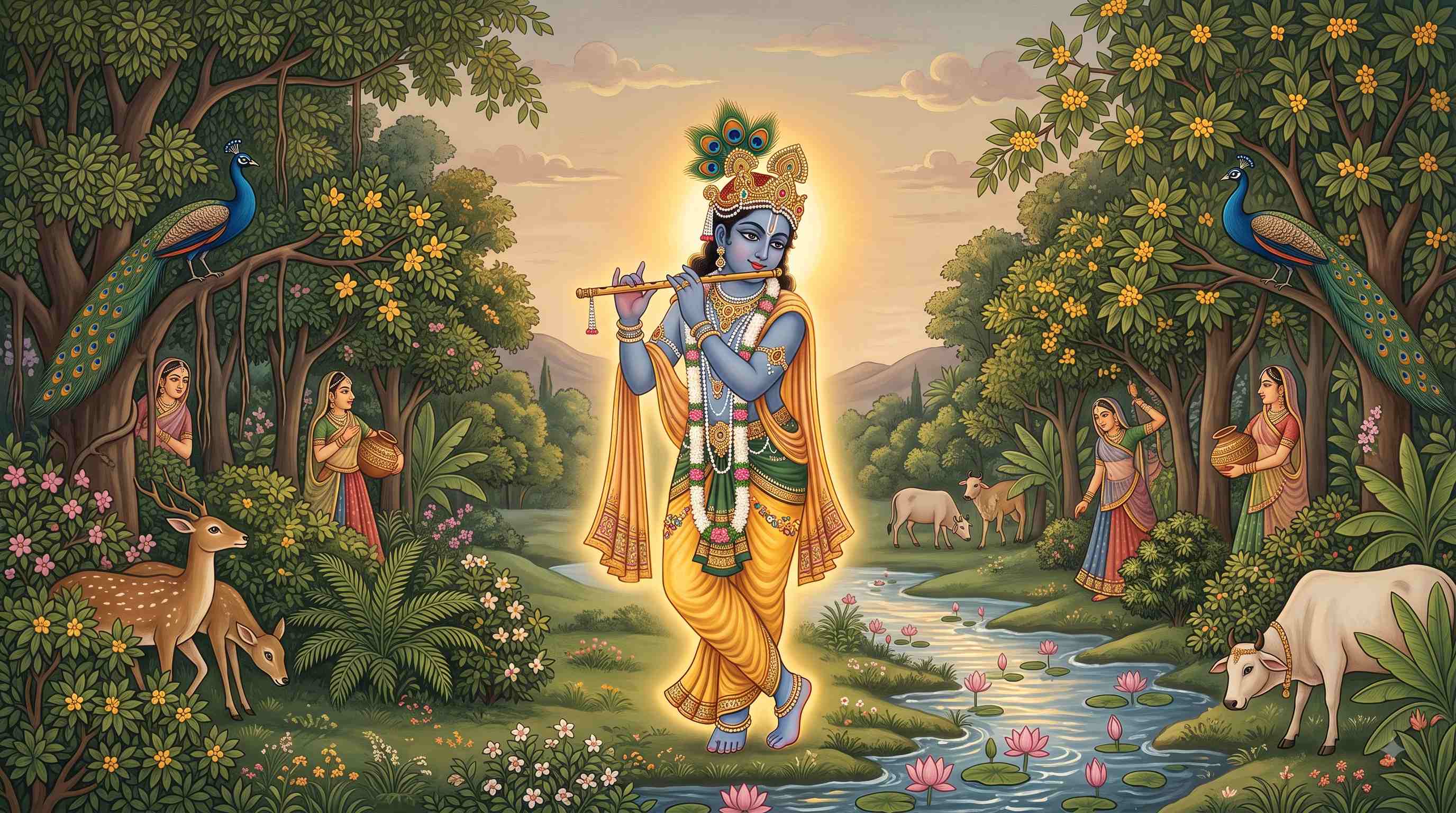
When we picture Lord Krishna, the most enchanting and enduring image is that of a dark-skinned, lotus-eyed youth standing cross-legged, adorned with a peacock feather, and playing a simple wooden flute (the Bansuri). The mesmerizing sound of his flute enchanted the Gopis, calmed the cows, and brought the entire universe to a standstill. But in Hindu philosophy, the deities do not hold objects merely for aesthetic appeal; every attribute is a profound cosmic metaphor. So, why does the Supreme Lord of the Universe choose a simple, hollow piece of bamboo as his constant companion? Why not a grand weapon or a jeweled instrument? The answer lies in the deeply mystical teachings of surrender, the dissolution of the ego, and the eternal romance between the human soul and the Divine. Let us decode the hidden spiritual secrets behind Lord Krishna's divine flute.
The Story of the Bamboo's Sacrifice
A beautiful mythological tale perfectly encapsulates the essence of the flute. It is said that in the gardens of Vrindavan, all the plants and trees deeply loved Krishna. Among them was the Bamboo plant, which was sturdy and tall. One day, Krishna approached the Bamboo and said, 'I need something from you, but to give it, you must undergo immense pain.' The Bamboo, out of pure love, agreed.
Krishna cut the bamboo down, chopped off its branches, stripped away its leaves, hollowed out its insides, and then pierced holes into its body. The Bamboo endured the agonizing pain silently. Because it surrendered completely and allowed itself to be hollowed out, Krishna pressed it to his divine lips and breathed life into it, turning the simple grass into the celestial Bansuri that would forever rest on His lips.
The Emptiness of Ego: Becoming Hollow
The greatest spiritual lesson of the flute lies in its hollowness. The bamboo is completely empty inside; it has no knot, no obstruction, and no substance of its own. In spiritual terms, this emptiness represents a human mind that is completely devoid of the ego (Ahamkara)—the 'I' and 'Mine'.
Most humans are filled with their own desires, pride, anxieties, and preconceived notions. We are 'full' of ourselves. Because we are so full, the Divine cannot flow through us. Krishna teaches that when a devotee becomes entirely hollow—meaning they surrender their ego and personal desires to the Lord—they become a perfect instrument. Only then can the Supreme Lord pick them up and play the beautiful, flawless music of existence through their life.
The Call of the Divine (Nada Brahma)
The music that flows from Krishna's flute is not ordinary sound; it is 'Nada Brahma'—the primordial, cosmic sound of the universe, often associated with the sacred syllable 'Om'. When Krishna played his flute in the forests of Vrindavan, the Gopis (milkmaids) would drop whatever they were doing, forget their worldly duties, and run blindly toward the forest, mesmerized by the melody.
This is a profound allegory for Bhakti Yoga. The Gopis represent the Jivatmas (individual human souls), and Krishna is the Paramatma (the Supreme Soul). The sound of the flute is the silent call of the Divine that rings within the heart of every living being. When the soul truly hears this call, it forgets all worldly attachments and material pursuits, rushing back to merge with its eternal source.
The Symbolism of the Seven Holes
A traditional Indian bamboo flute has seven holes. In Yogic philosophy, the human body has seven major energy centers, known as Chakras, starting from the base of the spine (Muladhara) to the crown of the head (Sahasrara). The seven holes also represent the senses and the mind through which we interact with the material world.
When the flute is played, Krishna's fingers dance over these seven holes, opening and closing them at his will to create perfect harmony. This symbolizes that when we surrender to the Divine, God takes control of our senses, our thoughts, and our energy centers. Our actions are no longer driven by chaotic desires but are orchestrated by the Supreme, leading to a perfectly balanced, harmonious life.
The Tribhanga Posture: Conquering the Three Gunas
Notice the posture of Lord Krishna when he plays the flute. He rarely stands straight; he stands in the 'Tribhanga' posture, meaning his body is gracefully bent in three places—at the neck, the waist, and the knee.
These three bends hold a deep philosophical meaning. They represent the three Gunas (modes of material nature): Sattva (goodness/purity), Rajas (passion/activity), and Tamas (ignorance/lethargy). They also represent the three bodies: the physical, the subtle (mind/intellect), and the causal (ego). By standing atop these bends while playing the flute, Krishna demonstrates that He is the supreme master who transcends all three modes of material nature, and true divine music can only be heard when one rises above these earthly dualities.
Becoming God's Flute in Daily Life
The imagery of Krishna and his flute is an open invitation for all of us to change how we live. We often complain about the hardships and cuts life inflicts upon us, much like the bamboo being pierced. However, if we view these challenges as the Divine hollowing us out—removing our arrogance, our selfishness, and our false attachments—we begin to see the grace behind the pain.
To become God's flute in your daily life means to practice absolute surrender. Do your duties with sincerity, but leave the anxiety of the results to Him. Empty your mind of stress, hatred, and the constant need to control. When you become empty, still, and receptive, you will realize that Lord Krishna is ready to breathe His divine melody into your life, making it a masterpiece.
Frequently asked questions
What is the spiritual meaning of Krishna's flute?
The flute represents the human heart and mind. Being entirely hollow, it symbolizes a mind devoid of ego and worldly desires. When a devotee empties themselves of 'I' and 'Mine', God breathes His divine music through them.
What do the holes in Krishna's flute represent?
The seven holes in the Bansuri traditionally represent the seven main Chakras (energy centers) in the human body, or the senses. When governed by the Divine breath, they produce perfect cosmic harmony.