
Spiritual Practice & Mantras
Why Do We Use 108 Beads in a Mala?
Bhakti Voice · 9 min · Updated 2026-08-18
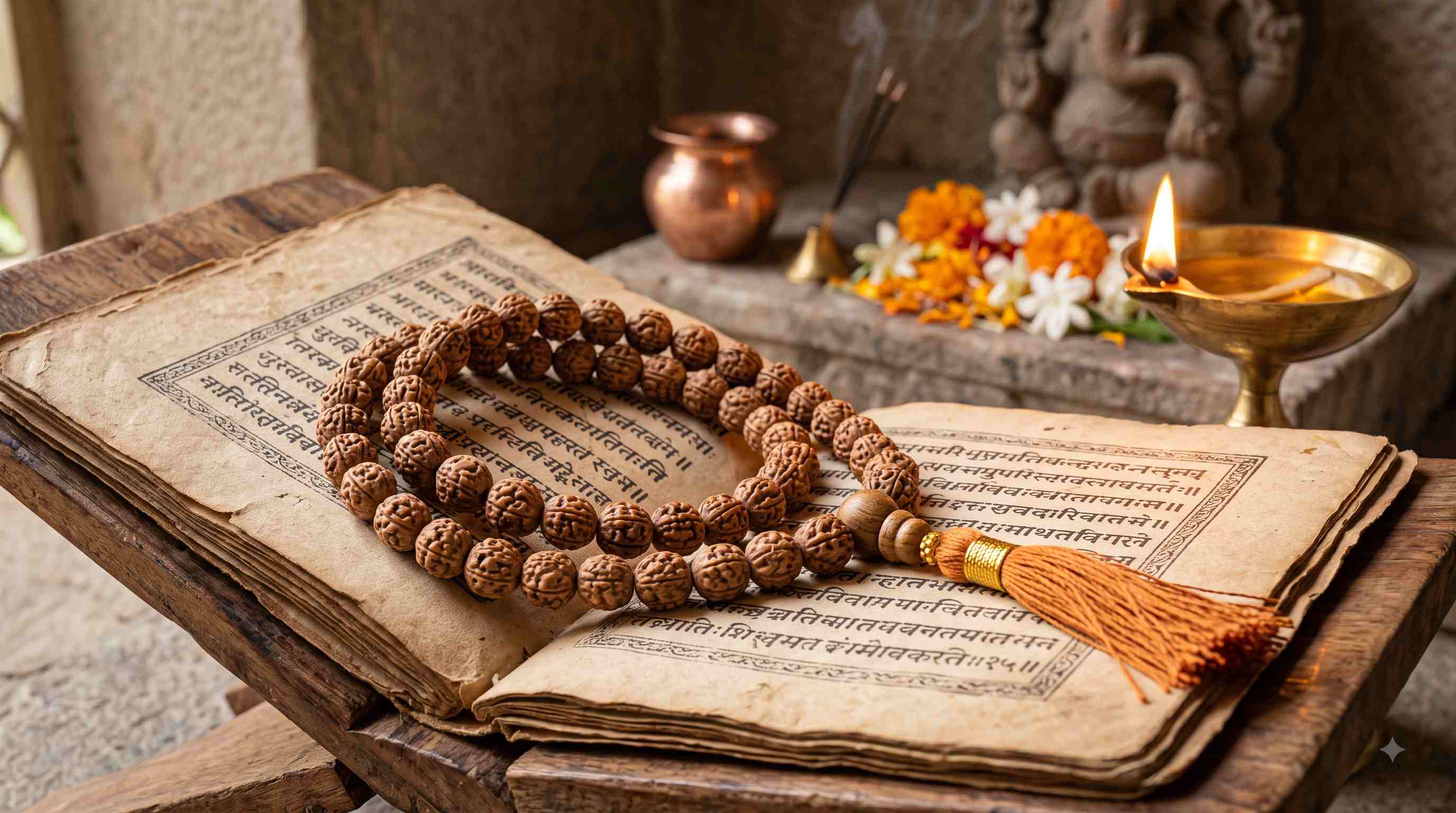
For thousands of years, spiritual seekers, sages, and practitioners across Hinduism, Buddhism, and Yogic traditions have used a string of beads to count their mantras during meditation. Whether it is made of Rudraksha, Tulsi, lotus seed, or sandalwood, a traditional 'Jaap Mala' almost always consists of exactly 108 beads. But have you ever wondered why? Why not 100, which seems like a perfect, round number? The number 108 is not a random choice. It is deeply embedded in the very fabric of the universe. From the astronomical distances between the earth, sun, and moon, to the subtle energy channels within the human body, the number 108 represents the ultimate code of spiritual completion and cosmic harmony. Let us dive deep into the ancient sciences—astronomy, Ayurveda, astrology, and mathematics—to unveil the sacred secret behind the 108 beads of a mala.
The Astronomical Perfection of 108
Long before modern telescopes were invented, the ancient Vedic sages of India possessed an astonishing understanding of the cosmos. They recognized that the number 108 is a sacred geometric code that binds the Earth to the heavens.
Consider these mathematical marvels: The distance between the Earth and the Sun is approximately 108 times the Sun's diameter. Similarly, the distance between the Earth and the Moon is roughly 108 times the Moon's diameter. Furthermore, the diameter of the Sun is about 108 times the diameter of the Earth. By chanting a mantra 108 times, we are symbolically aligning ourselves with the cosmic scale of our solar system, expressing harmony with the universe.
The Yogic and Anatomical Connection
In the traditions of Ayurveda, Yoga, and Tantra, the human body is not merely physical; it is a complex web of spiritual energy. The subtle body contains thousands of energy channels known as 'Nadis'. According to ancient yogic texts, there are exactly 108 primary Nadis that converge at the Anahata Chakra, the heart center.
When you chant a mantra 108 times, the sound vibration travels through each of these 108 energy lines. A complete cycle of a 108-bead mala ensures that your entire energetic heart center is bathed in the purifying frequency of the divine name, removing emotional blockages and awakening unconditional love and spiritual realization.
Astrology: The Mathematics of Destiny
Vedic Astrology (Jyotish Shastra) heavily relies on the number 108 to understand human karma and destiny. The universe is divided into 12 zodiac signs (Rashis), and there are 9 primary celestial bodies or planets (Navagrahas) that influence our lives.
When you multiply the 9 planets by the 12 zodiac signs, the result is exactly 108 (9 x 12 = 108). Therefore, chanting a mantra 108 times is believed to cover all possible combinations of planetary placements in your astrological chart. It acts as an energetic shield, pacifying the malefic effects of all planets across the entire zodiac, bringing balance to your destiny.
Sanskrit: The Language of the Gods
Sanskrit, often called Devabhasha (the language of the gods), is the language of Hindu scriptures and mantras. The Sanskrit alphabet consists of 54 primary letters. Each of these 54 letters possesses two distinct energies: a masculine aspect (Shiva) and a feminine aspect (Shakti).
When you multiply the 54 letters by their 2 dual energies, you get exactly 108 (54 x 2 = 108). Thus, chanting a mala of 108 beads signifies the recitation and integration of the entire spectrum of divine sound and creation, balancing the masculine and feminine energies within the practitioner.
The Significance of the 109th Bead (The Guru/Meru)
If you look closely at any authentic Jaap Mala, you will notice there are actually 109 beads. The 109th bead stands slightly apart from the main loop, often adorned with a tassel. This bead is known as the 'Meru' (mountain) or the 'Guru' bead.
The Guru bead is never counted during chanting, nor is it ever crossed. Once a practitioner chants 108 times and reaches the Guru bead, they must pause, bow their head in gratitude to their spiritual teacher or the Divine, flip the mala, and begin the next cycle in the reverse direction. The Guru bead grounds the energy of the mantra and ensures that the ego does not turn the sacred practice into a mindless race.
Spiritual Completion and the Human Experience
The number 108 permeates every aspect of Hindu and Buddhist theology. There are 108 sacred Upanishads (philosophical texts). In Bhakti traditions, deities like Lord Krishna and Lord Shiva are praised with 108 sacred names (Ashtottara Shatanamavali). In Buddhism, it is believed there are 108 earthly desires or defilements that a mortal must overcome to reach enlightenment.
Ultimately, a mala of 108 beads is a spiritual tool of transformation. It turns the wandering, restless mind into a focused laser of devotion. Whether you are seeking peace, healing, or self-realization, the repetitive, rhythmic counting of 108 beads acts as a ladder, slowly leading your soul out of the chaos of the material world and into the profound silence of the Divine.
Frequently asked questions
Why does a mala have 108 beads?
A mala has 108 beads because the number 108 represents spiritual completion. It reflects the cosmic ratio of the Earth, Sun, and Moon, the 108 energy lines converging at the heart chakra, and the 108 primary Upanishads.
What is the 109th bead on a mala?
The 109th bead is called the 'Guru bead' or 'Meru'. It is not counted during recitation. It signifies the Guru or the Divine, reminding the practitioner to pause, express gratitude, and turn the mala around rather than crossing over it.