
Pilgrimage Guides
Top 10 Most Famous Temples in India (2026 Edition): History, Architectural Wonder & Darshan Guide
Bhakti Guide Editorial · 16 min · Updated 2026-02-01
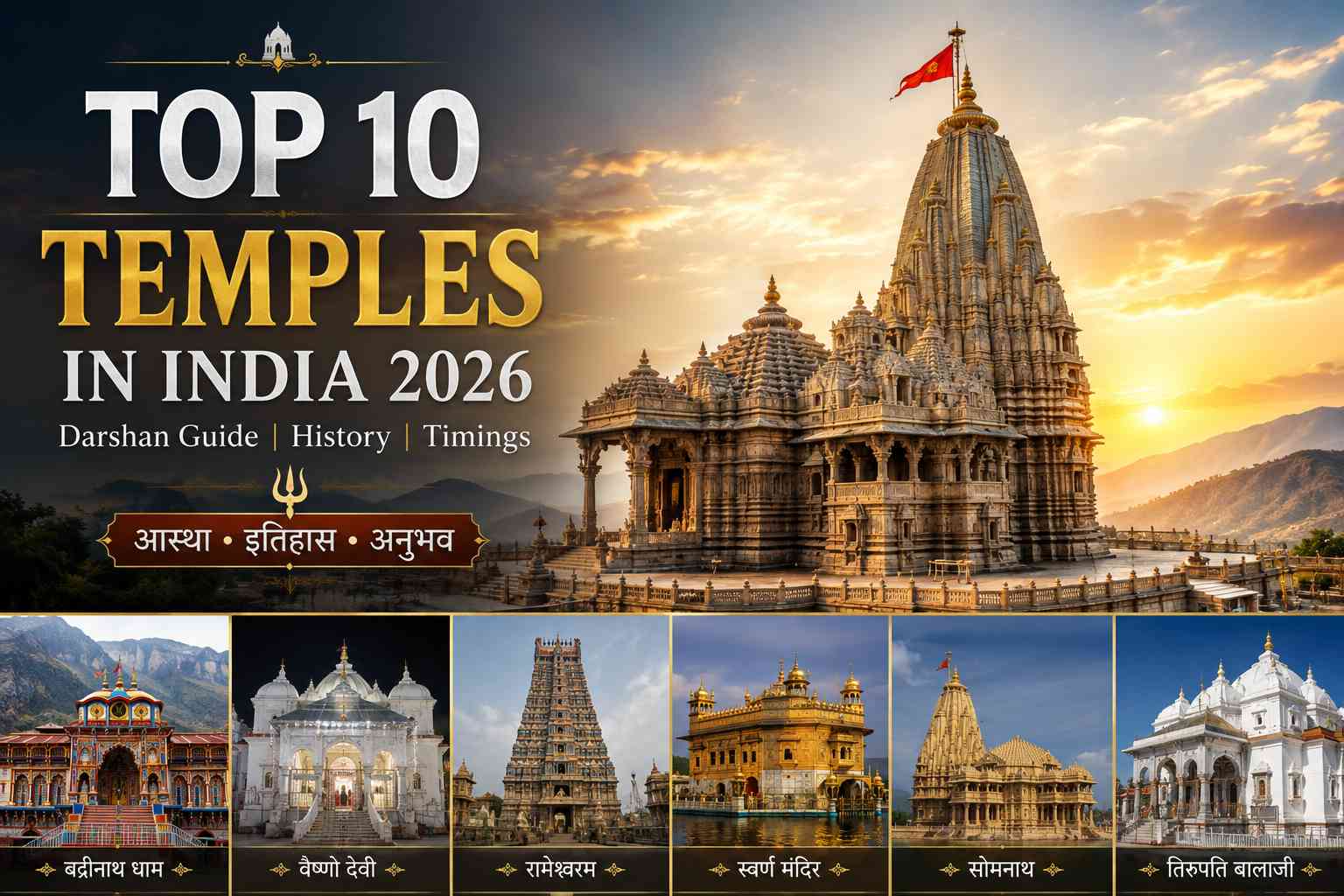
India, revered across millennia as the sacred land of Sanatana Dharma (Devbhoomi), is adorned with thousands of ancient sanctuaries that weave together deep mysticism, monumental stone architecture, and profound spiritual energy. From the snow-clad peaks of the Himalayas to the sun-kissed coastlines of the southern peninsula, these temples are not merely stone monuments; they are living portals of cosmic consciousness and devotion. As pilgrim infrastructure, digitized darshan booking, and high-speed transit networks expand rapidly across India in 2026, planning a sacred yatra has become smoother than ever. This definitive guide curates the Top 10 most famous, historically revered, and spiritually transformative temples in India, detailing their sacred histories, unique architectural styles, spiritual significance, and practical darshan tips.
1. Sri Venkateswara Swamy Temple (Tirupati Balaji), Andhra Pradesh
Perched upon the sacred Seshachalam range across the seven holy peaks of Tirumala in Andhra Pradesh, Sri Venkateswara Swamy Temple is universally venerated as Kaliyuga Vaikuntham—the earthly abode of Lord Vishnu incarnated as Srinivasa or Balaji. It is one of the most visited and revered religious powerhouses in the world, receiving tens of millions of pilgrims annually.
According to ancient Sthala Purana, Lord Vishnu manifested on Venkatadri to redeem mankind from the tribulations of the current age. The sanctum sanctorum (Garbha Griha) is crowned by the glittering gold-plated Ananda Nilayam Vimanam, enshrining a nine-foot-tall self-manifested (Swayambhu) idol of Lord Venkateswara wielding the Sudarshana Chakra and Panchajanya Conch.
Pilgrims traditionally tonsure their hair at the Kalyanakatta as an offering of ego and surrender, before partaking in the world-renowned Tirupati Laddu Prasadam, prepared under the strict centuries-old culinary standard known as 'Dittam' and protected by a Geographical Indication (GI) tag.
Pilgrim Tip for 2026: Book your Special Entry Darshan (SED ₹300) tickets 60 to 90 days in advance via the official TTD portal (tirupatibalaji.ap.gov.in). If walking on foot, opt for the scenic Alipiri Mettu (9 km, 3,550 steps) or the quicker Srivari Mettu (2.1 km, 2,388 steps) trekking paths.
2. Kashi Vishwanath Temple, Varanasi, Uttar Pradesh
Standing on the sacred western banks of the Holy River Ganga in Varanasi (Kashi)—the oldest continuously inhabited city on Earth—the Kashi Vishwanath Temple is the spiritual crown of Shaivism. Lord Shiva is worshipped here as Vishwanath or Vishveshwara, the 'Ruler of the Universe', residing as one of the twelve sacred Jyotirlingas.
Hindu scriptures hold that a single darshan of the Kashi Vishwanath Jyotirlinga, accompanied by a holy dip in the sacred waters of the Ganga, bestows Moksha (liberation from the cycle of rebirth). The temple's two magnificent spires and dome are plated with pure gold, originally donated in 1835 by Maharaja Ranjit Singh of Punjab.
With the inauguration of the sprawling Kashi Vishwanath Dham Corridor, the shrine is seamlessly connected directly to the Manikarnika, Jalasen, and Lalita Ghats. The corridor offers state-of-the-art pilgrim facilitation centers, wide paved pathways, museums, and wheelchair accessibility, eliminating congestion while preserving its sacred heritage.
Pilgrim Tip for 2026: Attend the mesmerizing Mangala Aarti at 3:00 AM or the evening Sapta Rishi Aarti. Tickets can be reserved well in advance on the Shri Kashi Vishwanath Temple Trust portal (shrikashivishwanath.org).
3. Shri Ram Janmabhoomi Mandir, Ayodhya, Uttar Pradesh
Rising majestically in the ancient holy city of Ayodhya on the banks of the sacred Saryu River, the newly consecrated Shri Ram Janmabhoomi Mandir represents one of the most monumental cultural and spiritual milestones in modern Indian history. The temple marks the sacred birthplace of Lord Rama, the seventh avatar of Bhagwan Vishnu.
Built purely in the traditional Nagara architectural style without the use of any iron or structural steel, the colossal temple spans three storeys, supported by 392 intricately carved stone pillars and 44 teakwood doors. Crafted from pink sandstone quarried in Bansi Paharpur (Rajasthan) and resting on a deep granite foundation, the sanctum enshrines the captivating 51-inch black stone idol of 'Ram Lalla' (the child form of Lord Rama) sculpted by Arun Yogiraj.
Ayodhya is now connected through the state-of-the-art Maharishi Valmiki International Airport and the modernized Ayodhya Dham Junction railway station, welcoming hundreds of thousands of daily pilgrims into a world-class spiritual atmosphere.
Pilgrim Tip for 2026: While general darshan is free and smoothly managed through digital queue holding complexes, devotees wishing to witness the morning Shringar Aarti or night Shayan Aarti must obtain passes online via the Shri Ram Janmbhoomi Teerth Kshetra portal.
4. Shri Mata Vaishno Devi Temple, Katra, Jammu & Kashmir
Perched inside a holy cave in the Trikuta Mountains at an altitude of 5,200 feet, the shrine of Shri Mata Vaishno Devi in Katra, Jammu & Kashmir, is one of the most sacred Shakti Peethas in the world. Millions of devotees chant 'Jai Mata Di' as they undertake the arduous 13-kilometer trek to seek the blessings of the Divine Mother.
Inside the sanctified sanctum cave, there are no statues or man-made idols; instead, the Mother Goddess manifests in the form of three natural rock formations known as the 'Holy Pindies', representing Maha Kali (destructive power over evil), Maha Lakshmi (wealth and prosperity), and Maha Saraswati (wisdom and intellect).
The Shri Mata Vaishno Devi Shrine Board (SMVDSB) provides world-class facilities along the route, including the scenic Tarakote Marg trekking path, battery-operated electric vehicle shuttles between Himkoti and Bhawan, passenger ropeway systems connecting Bhawan to the Bhairon Ghati temple, and direct helicopter services from Katra to Sanjichhat.
Pilgrim Tip for 2026: Mandatory online Yatra Parchi (registration card with RFID band) must be obtained from the official portal (maavaishnodevi.org) or Katra counters before commencing the uphill trek.
5. Kedarnath Temple, Rudraprayag, Uttarakhand
Standing against the dramatic backdrop of the snow-capped Kedarnath peak (6,940 meters) in the Garhwal Himalayas near the headwaters of the Mandakini River, Kedarnath Temple is the highest and most remote of the twelve Jyotirlingas. It is also the paramount shrine of the Himalayan Char Dham circuit and the leader of the sacred Panch Kedar.
Believed to have been founded originally by the Pandavas seeking absolution from Lord Shiva after the Kurukshetra War, the present stone structure of colossal granite slabs was revived in the 8th century CE by Adi Shankaracharya. Inside the sanctum, Lord Shiva is worshipped in the form of an irregular triangular stone lingam (the hump of the celestial bull Nandi).
Due to extreme Himalayan winter snowfall, the shrine remains accessible only for six months each year, opening on Akshaya Tritiya (April/May) and closing on Bhai Dooj (October/November), during which the deity's puja moves down to Ukhimath.
Pilgrim Tip for 2026: The 16-kilometer uphill trek begins at Gaurikund. Devotees can trek, hire ponies/palkis, or book authorized government helicopter shuttles via the IRCTC HeliYatra portal (heliyatra.irctc.co.in). Biometric Char Dham yatra registration is mandatory.
6. Jagannath Temple, Puri, Odisha
Situated along the Bay of Bengal in Puri, Odisha, the Shree Jagannath Temple is one of the foundational Char Dham pilgrimage destinations established by Adi Shankaracharya. Built in the 12th century by King Anantavarman Chodaganga Deva in the classical Kalinga architectural style, the towering 214-foot Shikhara overlooks a vibrant spiritual township.
Unlike standard stone deities, Lord Jagannath (Lord of the Universe), along with His elder brother Balabhadra and sister Subhadra, is carved out of sacred Neem logs (Daru Brahma) and ritually renewed during the rare celestial cycle known as Nabakalebara. The temple is globally celebrated for its annual Ratha Yatra (Chariot Festival), where millions gather to pull the colossal wooden chariots of the divine siblings.
The temple kitchen (Rosaghara) is the largest traditional kitchen on Earth, where hundreds of cooks prepare the sacred 'Mahaprasad' across 752 earthen hearths using only layered clay pots over firewood, offering it first to Lord Jagannath and then to Goddess Vimala before distributing it at the Anandabazar.
Pilgrim Tip for 2026: Non-Hindus are traditionally not permitted inside the inner sanctum. Ensure you taste the Mahaprasad inside Anandabazar, and adhere to conservative attire when entering through the iconic Singhadwara (Lion Gate).
7. Ramanathaswamy Temple, Rameswaram, Tamil Nadu
Located on the serene island of Rameswaram in Tamil Nadu, the Ramanathaswamy Temple is a unique confluence of divinity—being simultaneously one of the twelve holy Jyotirlingas and one of the revered four cardinal Char Dham shrines of India. According to the Ramayana, Lord Rama Himself sculpted and consecrated the Shiva Lingam here to seek forgiveness and offer thanksgiving after defeating Ravana in Lanka.
The temple is an architectural masterpiece of Dravidian engineering, boasting the longest and most spectacular temple corridor in the world, flanked by over 1,200 intricately carved granite pillars spanning a total length of approximately 3,850 feet. The sheer symmetry and acoustic precision of these majestic halls leave visitors spellbound.
A fundamental ritual of the Rameswaram pilgrimage is the sacred bath in the sea at Agni Theertham, followed by sequentially bathing in the waters of the 22 holy wells (Theerthams) located inside the inner temple complex, each possessing distinctive mineral properties and spiritual purification powers.
Pilgrim Tip for 2026: Arrive early in the morning (around 5:00 AM) to complete the 22 Theertham baths in wet clothes, change into dry traditional dhotis/sarees, and witness the sacred Spatika Linga Darshan.
8. Meenakshi Amman Temple, Madurai, Tamil Nadu
Dominating the historic skyline of Madurai—the ancient cultural capital of Tamil Nadu on the banks of the Vaigai River—the Meenakshi Sundareswarar Temple is a breathtaking zenith of Dravidian temple architecture. The complex is dedicated to Goddess Meenakshi (an incarnation of Goddess Parvati) and Her consort Lord Sundareswarar (Lord Shiva).
The temple complex is enclosed within high stone masonry walls and crowned by 14 monumental multi-tiered gateway towers (Gopurams), the tallest of which soars over 170 feet into the sky, adorned with thousands of vibrant, hand-sculpted polychrome mythological figures, deities, and celestial beings. Inside lies the mesmerizing Hall of Thousand Pillars (Aayiram Kaal Mandapam), famed for its flawless perspective and musical granite pillars that emit distinct acoustic notes when tapped.
In Madurai tradition, Goddess Meenakshi is worshipped first before Her consort, underscoring the supreme primacy of feminine divine cosmic energy (Shakti) in Tamil spiritual heritage.
Pilgrim Tip for 2026: Do not miss the evening 'Palliyarai Pooja' ceremony (around 9:00 PM), during which the icon of Lord Sundareswarar is carried in a grand musical palanquin procession to Goddess Meenakshi's chamber for the night.
9. Sri Harmandir Sahib (The Golden Temple), Amritsar, Punjab
Gleaming with ethereal beauty in the heart of Amritsar, Punjab, Sri Harmandir Sahib—popularly known worldwide as the Golden Temple—is the central spiritual seat and holiest Gurdwara of Sikhism. Founded in 1577 by the fourth Sikh Guru, Guru Ram Das Ji, and completed by Guru Arjan Dev Ji, the shrine embodies the eternal principles of universal brotherhood, humility, and equality.
Surrounded by the vast, purifying sacred nectar tank (Amrit Sarovar), the sanctum is accessed via a single marble causeway known as the Guru's Bridge. The upper floors of the Gurdwara were gilded with over 500 kilograms of pure gold leaf during the reign of Maharaja Ranjit Singh in the early 19th century. Inside, the continuous melodious recitation (Akhand Path) of the Guru Granth Sahib resonates day and night.
Harmandir Sahib operates the largest free community kitchen in human history—the Guru Ka Langar—serving nourishing hot meals to over 100,000 people daily, regardless of religion, caste, nationality, or social status, with selfless volunteer service (Seva).
Pilgrim Tip for 2026: The shrine is open 24/7. All visitors must remove their footwear, wash their hands and feet, and cover their heads completely with a scarf/rumal before entering the complex. Smoking, alcohol, and non-vegetarian items are strictly prohibited.
10. Somnath Jyotirlinga Temple, Prabhas Patan, Gujarat
Standing gracefully on the rugged coastline of the Arabian Sea at Prabhas Patan in Saurashtra, Gujarat, the Somnath Temple is venerated as the 'Prathama Jyotirlinga'—the very first among the twelve self-manifested shrines of Lord Shiva. According to Hindu mythology, the original temple was constructed out of pure gold by Chandra Dev (the Moon God) after Lord Shiva cured him of a waning curse.
Revered as the 'Shrine Eternal', Somnath has a heroic history of enduring and overcoming repeated invasions and destruction across centuries. The present majestic structure, built in the grand Chalukyan (Kailash Mahameru Prasad) architectural style, was reconstructed after Indian Independence under the visionary leadership of Sardar Vallabhbhai Patel and inaugurated in 1951 by President Dr. Rajendra Prasad.
A fascinating feature on the temple sea-wall is the ancient 'Baan Stambh' (Arrow Pillar), which points directly south toward Antarctica, bearing an ancient Sanskrit inscription proving that there is no piece of land between Somnath's shore and the South Pole along that exact line of longitude.
Pilgrim Tip for 2026: Attend the captivating 3D Sound & Light Show (Jay Somnath) held on the temple lawns every evening after sunset against the backdrop of the illuminated temple and roaring ocean waves.
11. Essential Pilgrim Checklist & Travel Tips for 2026
To ensure a fulfilling and obstacle-free pilgrimage across India's top spiritual destinations in 2026, keep these fundamental guidelines in mind:
Digital Documentation: Always carry original physical government-issued identity cards (Aadhaar Card, Voter ID, or Passport for international pilgrims). Most major shrine trusts require QR-coded digital slot slips and identity cross-verification at entry gates.
Advance Bookings: High-volume shrines like Tirupati Balaji, Vaishno Devi, Kashi Vishwanath, and Kedarnath release darshan slots, special poojas, and trust guesthouse quotas 60-90 days in advance. Always book strictly via official government and shrine board web domains (.org, .gov.in, .nic.in) to avoid fraudulent third-party agents.
Respect Local Traditions: Strictly adhere to regional dress codes, avoid using mobile phones or photography inside sanctums where prohibited, and maintain deep reverence for ancient temple customs and environmental hygiene.
Frequently asked questions
Which is the richest and most visited temple in India?
Sri Venkateswara Swamy Temple (Tirupati Balaji) in Andhra Pradesh is widely recognized as the most visited and wealthiest operational religious institution in India, welcoming 60,000 to over 100,000 devotees daily, alongside the Padmanabhaswamy Temple in Kerala, which holds the world's largest treasure vault.