
Temple Guides
Sri Venkateswara Swamy Temple (Tirupati Balaji): The Ultimate Devotee Guide
Bhakti Guide Editorial · 14 min · Updated 2026-01-15
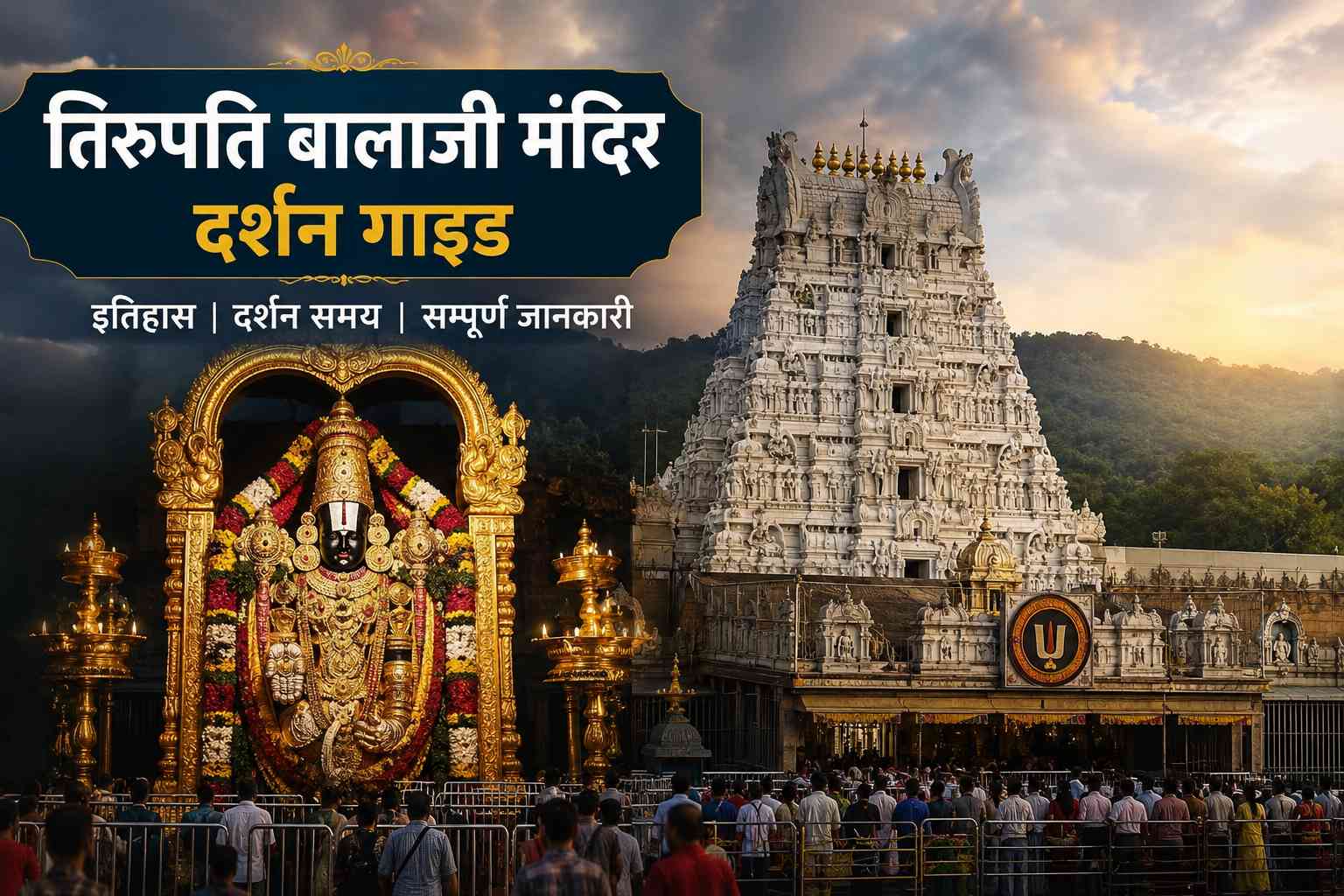
Perched amidst the sacred Seshachalam hills in the Eastern Ghats of Andhra Pradesh, Sri Venkateswara Swamy Temple at Tirumala stands as the holiest Kaliyuga Vaikuntham on Earth. Revered by millions as Tirupati Balaji or Govinda, Lord Venkateswara is believed to have manifested in self-manifested (Swayambhu) form to redeem humanity from the trials of Kali Yuga. As one of the world's most visited and spiritually vibrant pilgrimage destinations, navigating Tirumala requires careful planning. This comprehensive guide covers everything from the sacred legends (Sthala Purana) and architectural magnificence to practical advice on TTD online darshan booking (Special Entry Darshan ₹300), Slotted Sarva Darshan (SSD), VIP Break passes, daily sevas, tonsuring rituals, Tirupati Laddu Prasadam, and travel logistics.
1. Introduction to Sri Venkateswara Swamy Temple: The Abode of Kaliyuga Varada
Nestled on the seventh peak—Venkatadri—of the sacred Seshachalam range in Tirupati, Andhra Pradesh, Sri Venkateswara Swamy Temple is universally acclaimed as the spiritual epicenter of Vaishnavism and one of the most venerated sanctuaries on planet Earth. Known affectionately as Balaji, Srinivasa, Govinda, and Lord of the Seven Hills (Ezhumalayan), Lord Venkateswara is celebrated in the Puranas as 'Kaliyuga Prathyaksha Daivam'—the divinity directly manifest to protect and uplift humanity in this present age of darkness.
Every day, between 60,000 to over 100,000 devotees converge at Tirumala from every corner of the globe, chanting 'Govinda! Govinda!' as they ascend the sacred hills. Managed with meticulous precision by the Tirumala Tirupati Devasthanams (TTD), the temple is not only an architectural marvel of Dravidian heritage but also a vibrant epicenter of charitable activities, Vedic education, free food distribution (Annaprasadam), and spiritual solace.
Understanding the deep spiritual symbolism, historical lineage, and administrative systems of Tirumala transforms an ordinary trip into a profound, life-affirming spiritual pilgrimage. Whether you are a first-time visitor navigating the online booking portal or a lifelong devotee seeking a deeper connection with Srinivasa, this complete guide provides every detail required for a seamless and blissful pilgrimage.
2. Sacred Sthala Purana: The Divine Legend of Lord Srinivasa and Goddess Padmavathi
The legend of Tirupati Balaji is narrated across several sacred texts, predominantly the Varaha Purana, Bhavishyottara Purana, and Padma Purana. At the commencement of Kali Yuga, sages led by Maharishi Bhrigu convened on the banks of the river Ganga to perform a supreme Yajna. To decide which of the Holy Trinity (Trimurti) deserved the primary offering of the sacrifice, Maharishi Bhrigu set out to test Brahma, Shiva, and Vishnu.
When Bhrigu visited Vaikuntha, Lord Vishnu was resting on Adisesha while Goddess Lakshmi massaged His feet. To test Vishnu's equanimity, Bhrigu Maharishi kicked the Lord's chest—the sacred seat of Goddess Lakshmi (Vakshasthala). Instead of displaying wrath, Lord Vishnu gently held the sage's foot, asking if he was hurt, while subtly subduing the sage's pride by removing the eye of ego located on his sole. Overwhelmed by the Lord's divine composure, Bhrigu declared Vishnu supreme.
However, Goddess Lakshmi, deeply grieved that her abode on the Lord's chest was violated without instantaneous retribution, left Vaikuntha and descended to Earth to perform intense penance at Kolhapur. Stricken with separation, Lord Vishnu descended to Earth, taking abode on the Sheshadri hills inside an anthill beneath a tamarind tree. Hearing of His penance, Lord Brahma and Lord Shiva assumed the forms of a cow and a calf. King Chola's cowherd noticed the cow emptying its milk into the anthill. When the cowherd attempted to strike the cow with an axe, Lord Vishnu emerged and took the blow on His head, leaving a wound.
Later, the Lord resided with His foster mother Vakula Devi (the reincarnation of Yashoda) and was known as Srinivasa. He fell in love with Princess Padmavathi, daughter of King Akasa Raja (an incarnation of Vedavati). To solemnize their grand celestial wedding, Srinivasa took a massive loan of wealth from Kubera, the treasurer of the Devas, pledging that He would remain on the Seshachalam hills and repay the interest until the very end of Kali Yuga. Devotees offer coins and gold into the Srivari Hundi to assist the Lord in servicing this cosmic debt, receiving boundless blessings and worldly prosperity in return.
3. Architectural Splendor: Ananda Nilayam and the Dravidian Marvel
The Tirumala temple stands as an exquisite testament to classical Dravidian temple architecture, enriched across centuries by the Pallavas, Cholas, Pandyas, and most prominently, the Vijayanagara Emperors like Sri Krishnadevaraya, who made frequent pilgrimages and covered the sanctuary in gold.
The epicenter of divine vibration is the Garbha Griha (Sanctum Sanctorum), crowned by the resplendent 'Ananda Nilayam Vimanam'—a three-tiered tower enveloped entirely in gilded gold sheet copper. The idol of Lord Venkateswara is a Swayambhu (self-manifested) stone deity standing over nine feet tall. The Lord holds the celestial discus (Sudarshana Chakra) in His upper right hand and the holy conch (Panchajanya Shankha) in His upper left hand. His lower right hand points downward in the 'Varada Hasta' posture, granting boons, while His lower left hand rests on His thigh in 'Kati Hasta', reassuring devotees that the ocean of worldly suffering (Samsara) is only knee-deep for those who seek His lotus feet.
The temple complex is encircled by monumental granite corridors (Prakarams), majestic entry Gopurams, the sacred Pushkarini tank (Swami Pushkarini), the Dhwajasthambham (golden flagstaff), and the Ranga Mandapam. Every stone pillar and sculpted relief resonates with ancient sacred geometry intended to channel and amplify cosmic energy.
4. Complete Guide to Darshan Types: Booking, Slots & Timelines
Navigating the darshan systems at Tirupati requires familiarity with TTD's digitized queue management protocols. TTD provides several categories of darshan to accommodate every pilgrim profile:
Special Entry Darshan (SED ₹300): This is the most popular and convenient online ticket category. TTD releases SED slots approximately 60 to 90 days in advance on the official portal (tirupatibalaji.ap.gov.in). Pilgrims choose a specific date and hourly reporting slot (e.g., 9:00 AM, 2:00 PM). It allows entry through the dedicated SED queue line at ATC Car Parking, typically concluding darshan within 2 to 4 hours.
Slotted Sarva Darshan (SSD - Free Offline Tokens): For pilgrims visiting without advance online reservations, TTD issues free SSD biometric tokens at designated offline counters in Tirupati city. Each pilgrim must present their physical Aadhaar card. Once the token is scanned, it displays a designated reporting time at the Vaikuntam Queue Complex in Tirumala, eliminating the need to stand in physical queues for 15-20 hours.
VIP Break Darshan: Reserved for constitutional dignitaries, high-ranking officials, and devotees with official recommendation letters approved by the Joint Executive Officer (JEO) office, or through substantial donations to TTD's Sri Venkateswara Aalayala Nirmanam / Prana Daana Trusts (under the Srivani Trust Scheme, where a ₹10,000 donation yields one VIP Break Darshan ticket priced at ₹500).
Divya Darshan (Pedestrian Pilgrims): Traditionally allocated to devotees who ascend Tirumala on foot via the Alipiri Mettu or Srivari Mettu pathways. Pedestrian tokens with guaranteed time slots are issued directly along the trekking steps after verifying biometric identity.
Senior Citizens, Physically Challenged, and Parents with Infants: TTD offers dedicated priority darshan slots twice daily for senior citizens (aged 65+) and differently-abled devotees, as well as separate entry provisions for parents with infants below one year of age at the Supadham entrance.
5. Daily Sevas and Arjitha Seva Offerings
The daily worship schedule at Tirumala adheres strictly to the ancient Vaikhanasa Agama traditions. Witnessing an Arjitha Seva is considered one of the highest spiritual honors for a Vaishnava devotee:
Suprabhatam: Performed at the dawn of the day (around 3:00 AM), where the sacred verses of the Venkateswara Suprabhatam are chanted by hereditary Vedic scholars to gently awaken the Lord from His divine slumber.
Thomala Seva: The decorative floral worship where the Lord is adorned with fragrant garlands of jasmine, tulsi, lotus, and roses woven by hereditary flower workers.
Archana (Sahasranama Archana): Chanting the 1,008 divine names of Lord Srinivasa while offering sacred Tulsi leaves at His lotus feet.
Kalyanotsavam: The celestial wedding ceremony of Lord Malayappa Swamy (the Utsava Murti) with Goddess Sridevi and Goddess Bhudevi, conducted daily with Vedic mantras and auspicious bridal ceremonies.
Unjal Seva and Ekanta Seva: The evening swing ceremony (Unjal Seva) where the deities are rocked gently to celestial music, concluding with Ekanta Seva (around 1:00 AM), where the Lord is put to rest for the night amidst sweet lullabies written by Saint Annamacharya.
6. Sacred Rituals: Tonsuring (Mottai/Kalyanakatta) and Angapradakshinam
Tirumala is globally renowned for two intense acts of devotion and ego-surrender: hair tonsuring and circumambulation:
Kalyanakatta (Hair Offering): Millions of pilgrims shave their heads completely at the massive multi-story Kalyanakatta buildings or decentralized mini-centers. According to legend, when Srinivasa was struck on the head, a portion of His divine hair was lost; the Gandharva princess Neela Devi immediately sheared a lock of her own hair and placed it upon the Lord's scalp. Moved by her selfless devotion, the Lord promised that anyone who surrenders their hair—the ultimate symbol of worldly vanity and ego—at Tirumala will have their heartfelt prayers fulfilled. All tonsuring services at TTD Kalyanakattas are completely free of charge.
Angapradakshinam: Devotees perform this rigorous penance by rolling their entire bodies along the sanctified flagstone floor of the inner Vimana Pradakshinam corridor at dawn, after bathing in the Swami Pushkarini tank in wet clothes, expressing total submission to the divine will.
7. The World-Famous Tirupati Laddu Prasadam: History, Potu & GI Tag
No pilgrimage to Tirumala is complete without the receipt of Srivari Laddu Prasadam. Introduced officially in the year 1715, the Tirupati Laddu has been nurtured over three centuries under a rigorous culinary standard known as the 'Dittam'—the precise formula governing the ratio of ingredients.
Prepared inside the sanctified kitchen known as 'Srivari Potu' under the strict supervision of hereditary temple cooks (Potu Mirasidars), thousands of laddus are produced daily using mammoth cauldrons. The ingredients include premium chickpea flour (besan), pure cow ghee, sugar crystals, cardamom, golden raisins, whole cashew nuts, and a subtle touch of edible camphor (Pachcha Karpooram).
In 2009, the Tirupati Laddu was granted Geographical Indication (GI) status under the Geographical Indications of Goods Act, protecting its name, distinct taste, and heritage from commercial imitation. Every ₹300 SED ticket holder receives one complimentary laddu, with additional laddus purchasable at subsidized rates at the laddu disbursement complex.
8. The Sacred Hill Trek: Alipiri Mettu vs. Srivari Mettu Routes
Ascending the sacred hills on foot is considered an act of profound spiritual purification, burning away accumulated karmic impurities with every physical step. Devotees have two primary trekking paths:
Alipiri Mettu (The Traditional Highway): Starting at the foot of Alipiri in Tirupati town, this path spans approximately 9 kilometers and comprises 3,550 steps. It passes historical landmarks such as Galigopuram, the Deer Park, and Mokalla Mitta (where pilgrims climb on their knees in deep devotion). The path is completely roofed, well-lit, monitored by CCTV, and lined with drinking water, medical kiosks, and continuous chanting stations. It takes an average of 3.5 to 5 hours to complete.
Srivari Mettu (The Ancient Shortcut): Located near Srinivasa Mangapuram (around 15 km from Tirupati station), this is the historic route taken by Sri Krishnadevaraya. Spanning just 2.1 kilometers with 2,388 steeper steps, it is surrounded by lush forest and can be completed in 1.5 to 2.5 hours. It is ideal for devotees seeking a faster, scenic ascent.
Pilgrim Convenience: TTD provides free luggage transportation services at the base of both routes. Devotees deposit their baggage at the foothill counter, and it is safely transported via road to Tirumala, waiting for pickup near the hilltop bus terminal upon arrival.
9. Crucial Rules, Dress Code, and Pilgrim Guidelines
To preserve the sanctity and security of the holy Tirumala hills, TTD strictly enforces several foundational rules:
Dress Code Enforcement: Western garments (jeans, t-shirts, cargo pants, shorts, mini-skirts, nightwear) are strictly banned inside all queue complexes and sanctum corridors. Men must wear white or traditional colored Dhotis/Veshtis with an Angavastram, or formal Kurta-Pyjama. Women must wear traditional Sarees, Half-sarees, or Salwar Kameez with a securely pinned Dupatta.
Banned Items & Security Checks: Electronic gadgets, mobile phones, cameras, smartwatches, recording devices, tobacco, alcohol, non-vegetarian food, leather footwear, and inflammable items are strictly prohibited beyond the Vaikuntam Queue Complex checkposts. Free electronic locker counters are available at reporting points.
Eco-Friendly Cleanliness: Tirumala is a single-use plastic-free zone. Pilgrims are requested to carry reusable glass or copper water bottles, which can be refilled at the numerous 'Jala Prasadam' filtered water kiosks installed across the hill.
10. How to Plan Your Trip: Accommodation, Transport, and Nearby Shrines
Planning an end-to-end trip to Tirupati requires syncing transport, lodging, and secondary temple visits:
How to Reach Tirupati: Tirupati is connected seamlessly across India. Tirupati International Airport (TIR) at Renigunta operates regular domestic flights from major metros like Hyderabad, Bangalore, Chennai, Mumbai, and Delhi. Tirupati Main Railway Station (TPTY) and Renigunta Junction (RU) connect with long-distance express trains. Frequent luxury electric and semi-sleeper buses operate continuously from Chennai, Bengaluru, and Hyderabad to the Central Bus Stand.
Ascending to Tirumala: A dedicated fleet of APSRTC 'Saptagiri' buses runs every 2 minutes between Tirupati bus stand/railway station and the Tirumala hill shrine via the well-maintained ghat roads.
Accommodation: TTD operates extensive guesthouses, choultries, and rest houses (such as Srinivasam, Madhavam, and Vishnu Nivasam in Tirupati, and Padmavathi, Varahaswamy, and Shankhumitta rest houses in Tirumala). Online rooms can be booked on the TTD portal 30-60 days in advance. Numerous premium private hotels are also available in Tirupati city.
Essential Nearby Shrines: A complete Tirupati pilgrimage traditionally includes visits to Sri Padmavathi Ammavari Temple at Tiruchanur (consort of Lord Venkateswara), Sri Govindaraja Swamy Temple in Tirupati city, Sri Kapileswara Swamy Temple at the base of Kapila Theertham waterfall, Sri Kalyana Venkateswara Temple at Srinivasa Mangapuram, and the ancient Vayu Lingam temple at Srikalahasti (located 38 km away).