
Hindu Gods & Science
Nataraja: The Cosmic Dance of Creation and Subatomic Physics
Vedic Wisdom · 7 min · Updated 2026-08-17
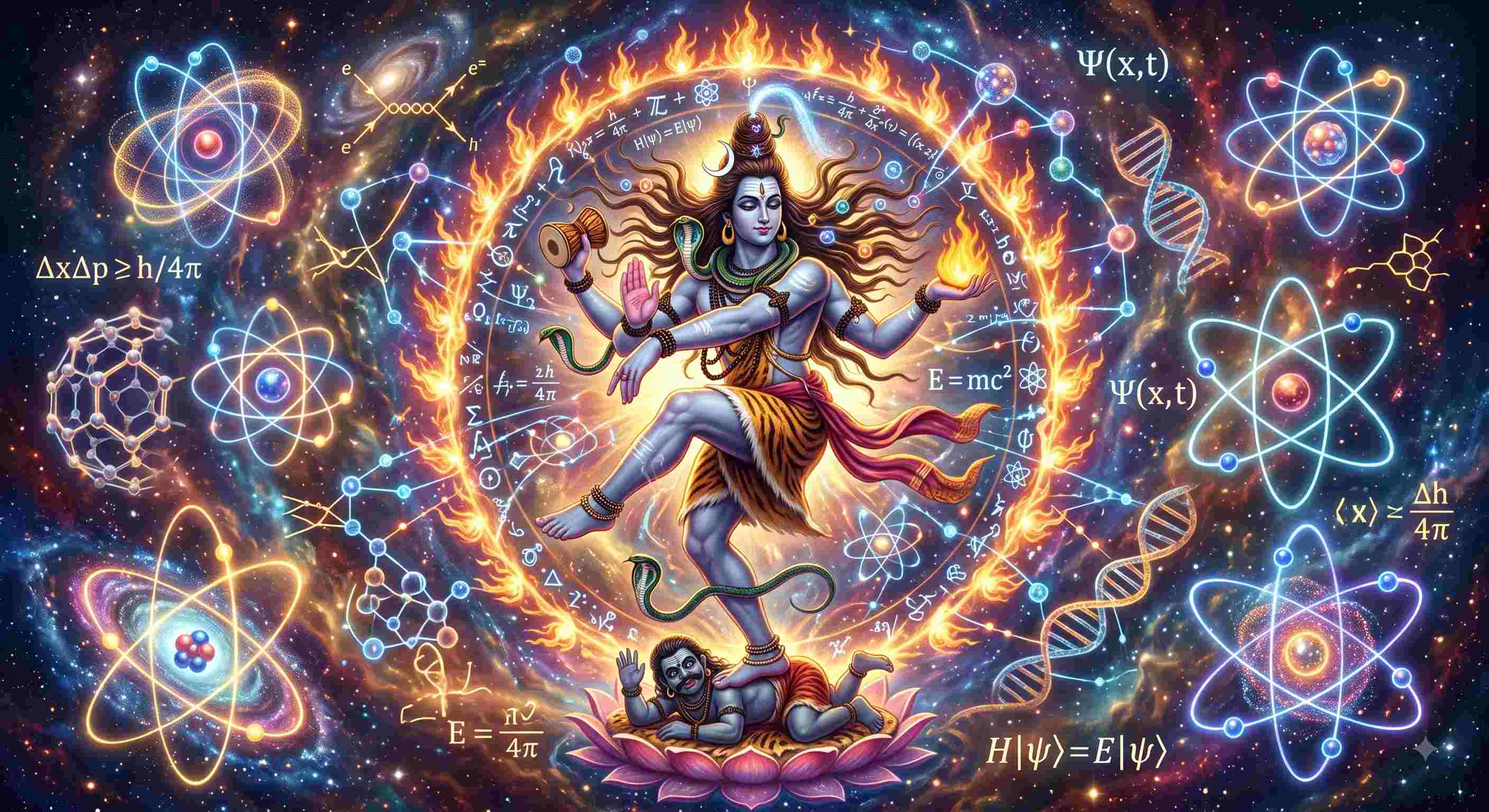
Geneva, Switzerland, is home to CERN—the European Organization for Nuclear Research. It houses the Large Hadron Collider, the most sophisticated scientific instrument ever built, designed to discover the 'God Particle' and the origins of the universe. Yet, right in the plaza of this pinnacle of modern science stands a 2-meter tall statue of a Hindu God: Lord Shiva in his dancing avatar, Nataraja. Why would the world’s top quantum physicists proudly display an ancient religious icon? The answer lies in a mind-bending parallel: the 'Ananda Tandava' (Dance of Bliss) performed by Shiva is the exact visual metaphor for the behavior of subatomic particles in quantum mechanics.
The Dance of Subatomic Particles
In quantum physics, matter is not static. At the subatomic level, particles are constantly appearing and disappearing in an eternal, pulsating dance of energy. Famous physicist Fritjof Capra brilliantly observed this in his book *The Tao of Physics*. He wrote, 'Modern physics has shown that the rhythm of creation and destruction is not only manifest in the turn of the seasons and in the birth and death of all living creatures but is also the very essence of inorganic matter. For the modern physicists, then, Shiva's dance is the dance of subatomic matter.' The continuous rhythm of the Nataraja's 'Tandava' mirrors the exact continuous cycle of particles being born and dying in the cosmic void.
Decoding the Symbolism of Nataraja
Every element of the Nataraja statue is a profound scientific metaphor. In his upper right hand, Shiva holds the 'Damaru' (drum), generating the primal sound (OM), representing the Big Bang and the ongoing creation of the universe. In his upper left hand, he holds 'Agni' (fire), representing destruction and the inevitable thermodynamic law of entropy. Thus, creation and destruction are perfectly balanced. The ring of fire surrounding him represents the observable universe and the cyclical nature of time (Yugas). His flying dreadlocks represent the kinetic energy and the vastness of space.
Trampling the Demon of Ignorance
Look closely at Shiva's feet in the Nataraja form. He is dancing upon a small dwarf-like demon named Apasmara. This demon represents 'Ignorance' or the illusion (Maya) that the material world is the only reality. By trampling it, Shiva signifies that true liberation and understanding of the universe come only when we overcome our intellectual arrogance and ignorance. The message is clear: whether you are an ancient yogi meditating in the Himalayas or a modern physicist peering into a particle accelerator, you are ultimately witnessing the same cosmic dance of the divine.
Frequently asked questions
Who gifted the Nataraja statue to CERN?
The Nataraja statue was gifted to CERN by the Government of India in 2004 to celebrate the long-standing collaboration between India and the research center.
What is the meaning of the fire in Nataraja's hand?
The fire (Agni) in his upper left hand represents the force of destruction and entropy. It balances the drum (Damaru) in his right hand, which represents creation and the heartbeat of the universe.