
Mythology
The Divine Legend of Manikarnika Ghat: Unveiling the Mystery of Lord Shiva and Goddess Parvati
Bhakti Voice Editorial · 8 min · Updated 2026-08-23
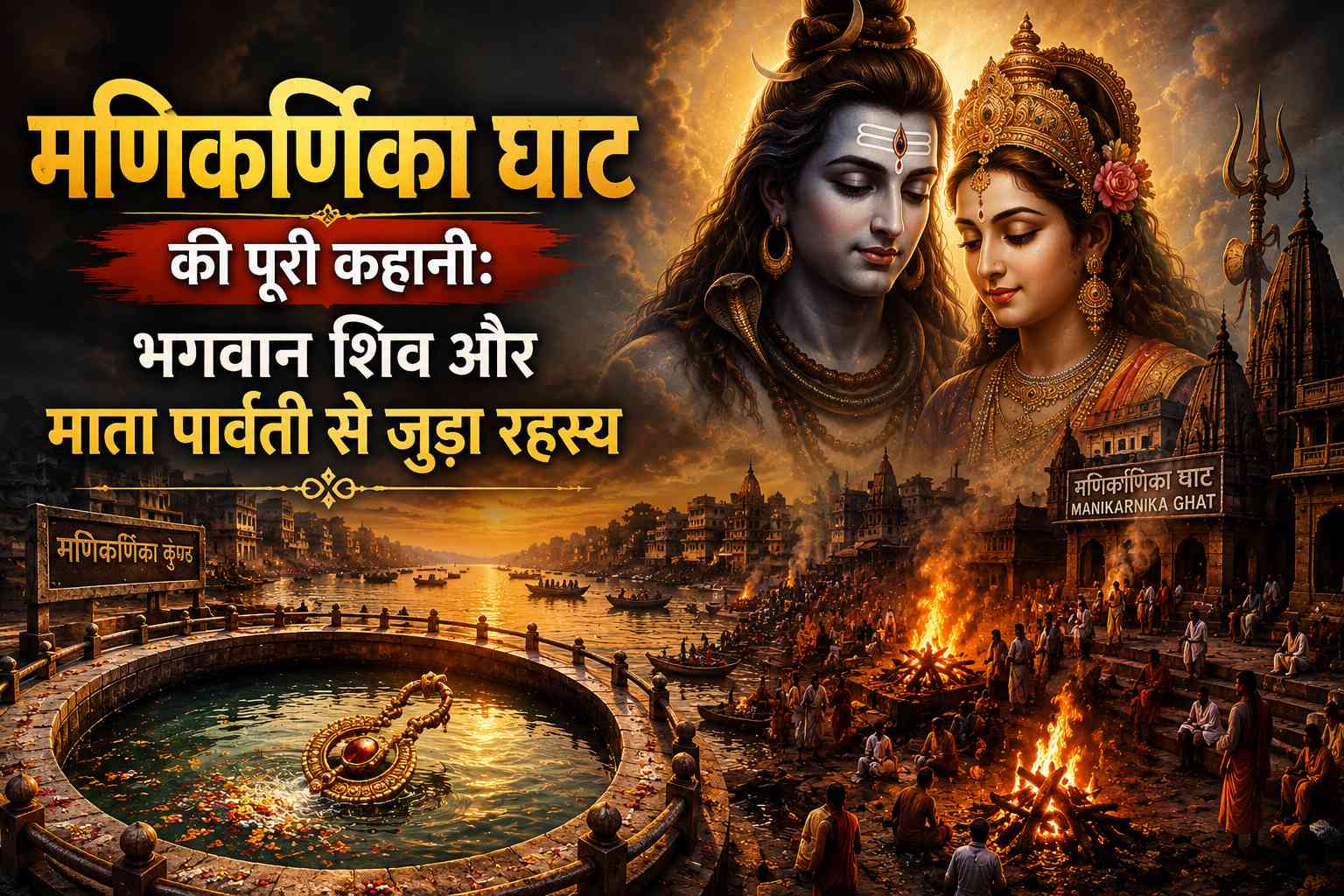
While Manikarnika Ghat is globally renowned as the eternal cremation ground where the fires of salvation never extinguish, its origin story is a beautiful tapestry of devotion, cosmic play (Leela), and divine love. Beyond the ashes and the pyres lies a profound mystery involving Lord Vishnu, Lord Shiva, and Goddess Parvati. Why is this specific stretch of the Ganges considered the holiest? How did a beautiful jeweled earring transform this spot into the ultimate gateway to Moksha? Let us dive deep into the Puranic legends to uncover the true story of Manikarnika Ghat.
1. The Devotion of Lord Vishnu: The Creation of Chakra Pushkarini
Long before the river Ganges flowed on Earth, the holy city of Kashi existed as 'Anandavan'—the forest of bliss. According to the Kashi Khanda of the Skanda Purana, Lord Vishnu came to Anandavan to perform intense penance to please Lord Shiva.
With His divine weapon, the Sudarshana Chakra, Lord Vishnu dug a large well. He engaged in such rigorous austerities for tens of thousands of years that His divine sweat filled the well entirely. This sacred water body came to be known as 'Chakra Pushkarini Kund,' which still exists today at Manikarnika Ghat.
2. The Arrival of Lord Shiva and Goddess Parvati
Pleased by Lord Vishnu's unparalleled devotion, Lord Shiva appeared before Him along with Goddess Parvati. Looking at the sheer dedication of Vishnu, Shiva’s heart filled with immense joy and cosmic ecstasy. He offered Vishnu a boon of His choosing.
Lord Vishnu respectfully folded His hands and asked for only one boon: 'O Mahadev, may You and Goddess Parvati always reside in this holy place, and may it become the greatest center for salvation in the universe.' Lord Shiva happily granted this wish.
3. The Fall of the Divine Jewel: How 'Manikarnika' Got Its Name
As Lord Shiva nodded His head in ecstatic joy while blessing Vishnu, a magnificent jeweled earring—comprising a radiant gem (Mani) and the ear ornament (Karnika)—slipped from His ear (in some versions, it was Goddess Parvati's earring) and fell directly into the Chakra Pushkarini Kund.
Because the 'Mani' and 'Karnika' fell into the waters of the kund, the surrounding area instantly absorbed a powerful divine energy. Lord Shiva declared that henceforth, this sacred spot would be known as 'Manikarnika', a place holier than any other pilgrimage site on Earth.
4. Goddess Parvati’s Playful Mystery (Leela)
Another fascinating oral tradition and localized Puranic variation adds a beautiful layer of romance to the story. Lord Shiva loved wandering across the cosmos as an ascetic. Goddess Parvati, wishing to keep Her beloved husband permanently in the beautiful city of Kashi, devised a playful plan.
She deliberately hid Her precious earring on the banks of the Ganges near the ghat and told Lord Shiva that She had lost it. She requested Him to find it. Bound by love, Shiva began a relentless search for the earring in the sands and ashes of Kashi. It is believed that Shiva is still searching for it, which is why He never leaves Kashi, and the souls cremated here are questioned by Shiva in the hope of finding the lost jewel.
5. The Ultimate Boon: A Journey from Ash to Liberation
Because of these profound divine interventions, Lord Shiva proclaimed Manikarnika as the holiest of all Tirthas (pilgrimage sites). He declared that the waters here would wash away the darkest of sins, and the fire here would not just burn the physical body, but the bonds of Karma itself.
Today, when a funeral pyre burns at Manikarnika Ghat, it is not merely a ritual of disposal. It is a soul's passage through the very spot where Shiva and Parvati showered their grace. The eternal fire of Manikarnika is a testament to Shiva's promise to Vishnu and His eternal love for Parvati—turning the grief of death into the ultimate celebration of Moksha.
Frequently asked questions
What is the meaning of the word 'Manikarnika'?
The word 'Manikarnika' is derived from two Sanskrit words: 'Mani' meaning jewel or pearl, and 'Karnika' meaning an ear ornament (earring). It is named after the divine earring of Lord Shiva or Goddess Parvati that fell at this location.
What is the Chakra Pushkarini Kund?
Before the Ganges descended to Earth, Lord Vishnu dug a sacred well at this spot in Kashi using His Sudarshana Chakra and filled it with the sweat of His immense penance. This sacred well is known as Chakra Pushkarini Kund.