
Sacred Places
The Sacred Mystery of Manikarnika Ghat: Varanasi's Gateway to Salvation
Bhakti Voice Editorial · 7 min · Updated 2026-08-23
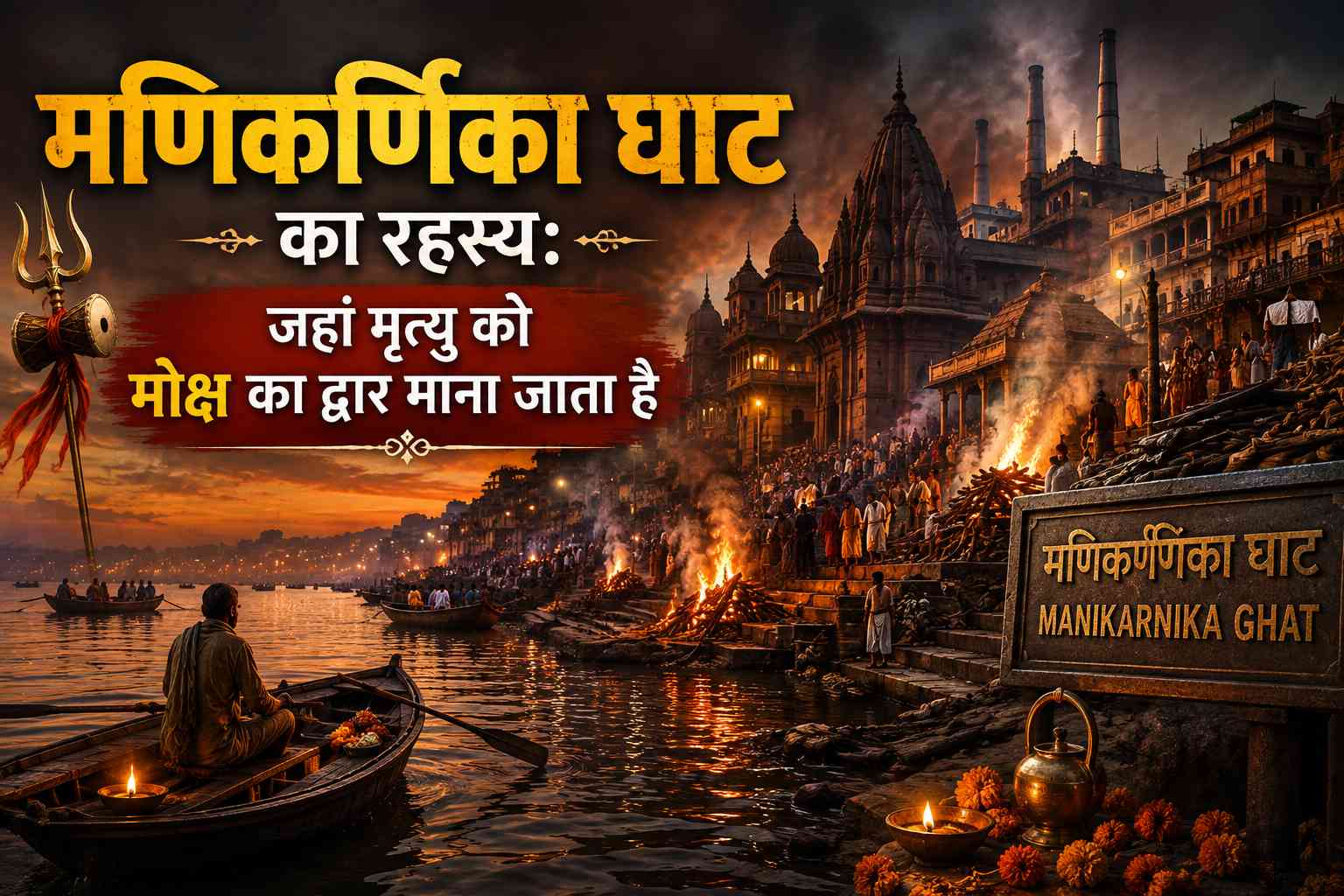
In most parts of the world, death is mourned in silence and shadows. But in Varanasi, on the sacred banks of the Ganges, death is brought into the light and celebrated as the ultimate liberation. Manikarnika Ghat, known as the Mahashmashan (the great cremation ground), is the beating heart of this profound philosophy. Here, the funeral fires have burned continuously for thousands of years. To understand the mystery of Manikarnika Ghat is to understand the core of Hindu philosophy: that death is not the end, but the glorious doorway to Moksha (salvation) orchestrated by Lord Shiva Himself.
1. The Origin of Manikarnika: The Dropped Jewel
The etymology of Manikarnika is rooted in deep mythology. 'Mani' translates to a jewel, and 'Karnika' refers to an ear ornament. According to the most prominent Puranic legend, when Goddess Sati immolated herself, a grief-stricken Lord Shiva carried her burning body across the cosmos. It is said that her ear ornament fell at this specific spot in Kashi, establishing it as a Shakti Peetha.
Another variation of the lore suggests that Lord Vishnu excavated a well (the Chakra Pushkarini) with his Sudarshana Chakra here, filling it with his sweat from intense penance. When Lord Shiva visited the site, he was so pleased with Vishnu's devotion that his own earring fell into the well. Since that day, the spot became exceptionally holy, drawing millions seeking purification.
2. Mahashmashan: The Great Cremation Ground
Varanasi is unique because its cremation ground is not relegated to the outskirts of the city, hidden from public view. Instead, Manikarnika Ghat sits proudly in the center of the bustling riverfront. It is called the 'Mahashmashan', the great cremation ground, a physical embodiment of the impermanence of the material world.
Here, death is not a taboo. Life and death coexist side by side. Monks meditate, children play, and pilgrims take holy dips in the Ganges, mere meters away from burning pyres. This proximity forces a spiritual realization (Vairagya) that all worldly attachments eventually turn to ash, urging the soul to seek higher truths.
3. The Fire That Has Never Extinguished
The most awe-inspiring visual and spiritual reality of Manikarnika Ghat is the eternal flame. Historical accounts and oral traditions maintain that the cremation fires here have not cooled for thousands of years. Day and night, through monsoons and scorching summers, the pyres burn relentlessly.
It is a staggering logistical and spiritual phenomenon. Up to 300 cremations happen daily. The continuous smoke rising from the ghat is seen as the literal ascent of souls towards the heavens, constantly reminding humanity of the relentless wheel of time (Kala) and inevitable mortality.
4. Lord Shiva and the Taraka Mantra
Why is Manikarnika so coveted for one's final rites? The answer lies in the promise of Moksha (liberation). In Hinduism, being trapped in the cycle of Samsara (birth, death, and rebirth) is the ultimate suffering. Manikarnika is the cosmic off-ramp from this cycle.
Scriptures decree that at the moment a body is consigned to the flames at Manikarnika, Lord Shiva personally arrives at the pyre. He tilts the departed soul's head and whispers the 'Taraka Mantra' (the ferryboat mantra) into their ear. This divine whisper instantly burns away lifetimes of Karma, granting the soul direct passage to eternal liberation.
5. The Keepers of the Flame: The Dom Raja
The sacred ecosystem of Manikarnika is maintained by the 'Dom' community, led by the Dom Raja. Despite the historical complexities of the caste system, at the Mahashmashan, the Dom Raja holds absolute authority over the rites of death. No cremation can commence without the holy fire (mughagni) purchased from them.
This dynamic serves as a profound social equalizer. Kings, billionaires, scholars, and paupers—all must ultimately lay bare at the ghat, their families negotiating with the Dom Raja for the fire of liberation. At Manikarnika, the grand illusions of ego and status are burned away, proving that in the eyes of Mahadev, every soul is equal in death.
Frequently asked questions
How did Manikarnika Ghat get its name?
The name combines 'Mani' (jewel) and 'Karnika' (earring). According to mythology, Goddess Sati's (or in some versions, Lord Shiva's) ear ornament fell at this exact spot, transforming the well into a sacred pilgrimage site.
Is it true that the fire at Manikarnika Ghat never stops?
Yes. It is believed that the cremation fires at Manikarnika Ghat have been burning continuously 24/7 for thousands of years. Not a single hour passes without a final rite being performed here.