
History
The Fascinating History of Ekashm Kailash Mandir
Heritage Explorer · 16 min · Updated 2026-08-26
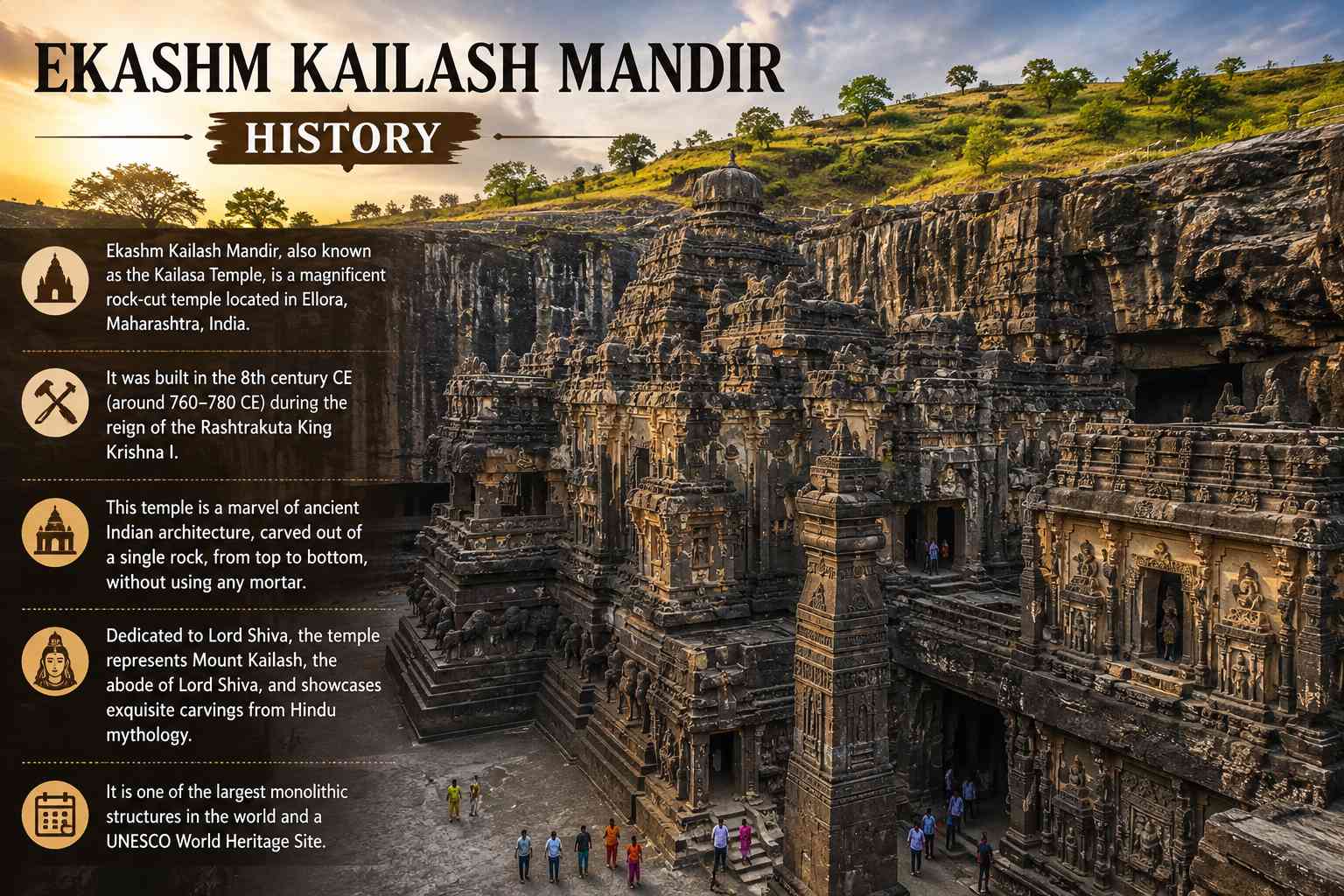
Imagine being handed a chisel and a hammer, and being told to carve a life-sized, multi-story chariot temple out of a single massive mountain—not by building it from the ground up, but by cutting it from the sky downwards. This is the mind-bending reality of the Ekashm Kailash Mandir (Ellora Cave 16). This monument continues to baffle modern engineers, historians, and archaeologists, serving as a testament to an era when human devotion and architectural brilliance knew no bounds. Delve into the epic history of this monolithic marvel that defied time, logic, and imperial invasions.
The Monolithic Miracle: A Top-Down Masterpiece
The term 'Ekashm' literally translates to 'one stone' or 'monolith'. The Kailash Temple (Cave 16) at Ellora is not an assembled structure. Unlike the Taj Mahal in Agra, the Great Pyramids of Giza, or the Colosseum in Rome, no architectural blocks or bricks were brought in to build this temple. Instead, the architects initiated three massive trenches into the face of the Charanandri hills. Over 400,000 tons of solid basalt rock were meticulously scooped out and removed to reveal the magnificent temple hidden within the mountain.
Historical records, backed by copper plate inscriptions, suggest the temple was primarily commissioned by the Rashtrakuta king Krishna I, who reigned from approximately 756 to 773 CE. The architectural technique employed is known as 'cut-out' or monolithic excavation. The structural design shows a clear influence of Pallava and Chalukya styles, suggesting that master sculptors from southern India were brought in for this mega-project.
What baffles structural engineers and architects today is the absolute zero margin of error required for this project. Since the temple was carved vertically downwards from the apex of the mountain to the base, a single erroneous strike by a heavy hammer could not be undone or replaced with a new block of stone. The master architect had to hold a 3D blueprint in his mind, envisioning the entire complex—three-story high pillars, intricate multi-level galleries, full-sized stone elephants, and complex drainage systems—before the very first chisel even struck the bedrock.
The Legend of the Queen and the Architect Kokasa
Local Marathi legends and ancient texts add a beautiful, emotional human layer to this stone colossus. According to folklore, King Krishna I fell severely ill, and none of the royal physicians could cure him. His queen, in desperation, prayed to Lord Shiva at Elapura (modern-day Ellora), taking a solemn vow to construct a magnificent temple dedicated to Shiva if her husband's life was spared. Furthermore, she vowed to observe a strict fast until she saw the *shikhara* (topmost spire) of this new temple.
Miraculously, the King recovered from his ailment. The queen immediately demanded the temple be built so she could fulfill her vow and break her fast. The royal architects fell into despair, explaining to the king that building a grand temple would take months just to lay the foundational base, meaning the queen would starve to death before the spire was ever erected.
Just as all hope seemed lost, a clever and visionary architect named Kokasa stepped forward with a brilliant, unorthodox solution. He promised the royal couple that the queen would see the *shikhara* within a week. Kokasa began excavating from the very top of the mountain downwards. Within seven days, he had carved the intricate spire out of the bedrock, allowing the queen to look upon it and break her fast. The rest of the temple was then laboriously excavated downward over the ensuing decades.
Surviving the Wrath of Aurangzeb: The Indestructible Temple
The sheer invincibility of the Ekashm Kailash Mandir was put to the ultimate historical test in the late 17th century. The Mughal Emperor Aurangzeb, known for his religious zeal and iconoclastic policies, ordered the destruction of thousands of Hindu temples across the Indian subcontinent. In 1682, he turned his attention to the magnificent caves of Ellora and dispatched a massive contingent of a thousand soldiers specifically to demolish the Kailash Temple.
For three continuous years, the Mughal army attacked the temple with everything they had in their arsenal. They tried hacking at the giant pillars, lighting massive fires inside the sanctums to crack the basalt rock with heat, and deliberately breaking the faces off the intricate sculptures of deities. However, the monolithic nature of the rock proved impossible to bring down.
Unlike a traditionally constructed building that collapses when its load-bearing walls or foundational pillars are breached, the Kailash Temple was an integral part of the Earth's crust itself. You cannot "knock down" a mountain. Eventually, Aurangzeb realized the sheer futility of his mission, as the soldiers were only able to cause minor cosmetic damage. He called off the destruction. Today, the temple bears some scars and disfigurement from this era, but its core majesty stands unbowed, a true testament to the indestructible nature of ancient Indian engineering.
Myth vs. Reality: Did Aliens Build the Kailash Temple?
In recent years, the internet has been flooded with conspiracy theories and sensationalist documentaries claiming that the Ekashm Kailash Mandir was built by ancient aliens or utilizing lost, advanced laser technology. Proponents of these theories argue that human beings armed only with chisels and hammers could not possibly excavate 400,000 tons of rock and carve such precise geometries in a mere few decades.
While the sheer scale of the temple makes it easy to succumb to these mystical theories, historians and archaeologists firmly debunk them. The temple was not built overnight. While King Krishna I commissioned the primary structure, archaeological evidence shows that the excavation, refinement, and detailing of the temple continued for more than a century across the reigns of subsequent Rashtrakuta kings.
The "advanced technology" used was simply the highly organized, generational mastery of stone masonry. Thousands of artisans worked in synchronized teams. Drill holes found in unfinished parts of the caves reveal their technique: they would drill holes into the rock, insert wooden pegs, and pour water over them. As the wood expanded, it naturally cracked large chunks of rock, which were then cleared out. The alien theories, while entertaining, ultimately do a disservice to the incredible genius, patience, and sheer willpower of ancient Indian artisans.
Key Architectural Marvels Inside the Temple Complex
Once you step inside the courtyard of the Ekashm Kailash Mandir, you are greeted by several architectural marvels that demand close attention. The most prominent among these are the two massive *Dhwajastambhas* (victory pillars) standing elegantly in the courtyard. Carved perfectly symmetrical, these freestanding pillars remain attached to the base mountain rock, defying gravity and time.
In the center lies the *Nandi Mandapa*, a pavilion housing the sacred bull of Lord Shiva. This structure is connected to the main temple via a carved stone bridge. The main temple itself is heavily adorned with panels depicting scenes from the two great Indian epics: the Mahabharata and the Ramayana. These panels run along the lower levels, acting as a visual storytelling medium for ancient devotees.
Perhaps the most famous and dynamically carved relief in the entire complex is the "Ravana Anugraha Murti." This masterpiece depicts the demon king Ravana violently shaking Mount Kailash, the abode of Shiva and Parvati. The sculpture perfectly captures the tension in Ravana's muscles and the calm, unbothered demeanor of Lord Shiva, who is simply pressing his toe down to trap Ravana under the mountain. It is a stunning display of capturing kinetic energy in static stone.
Frequently asked questions
Who built the Ekashm Kailash Mandir?
It is widely attributed to the Rashtrakuta king Krishna I, who ruled in the 8th century CE, though the complete excavation likely spanned multiple generations.
Did Aurangzeb try to destroy the temple?
Yes, Mughal Emperor Aurangzeb sent thousands of troops in 1682 to destroy it, but they could only cause minor cosmetic damage over three years because the temple is carved from solid rock.
How much rock was removed to build the temple?
Archaeologists estimate that over 400,000 tons of solid basalt rock were excavated and removed to reveal the temple hidden inside.