
Pilgrimage
The Living Sanatana Dharma: Indonesia's Thousands of Sacred Hindu Temples
Bhakti Voice · 16 min · Updated 2026-08-22
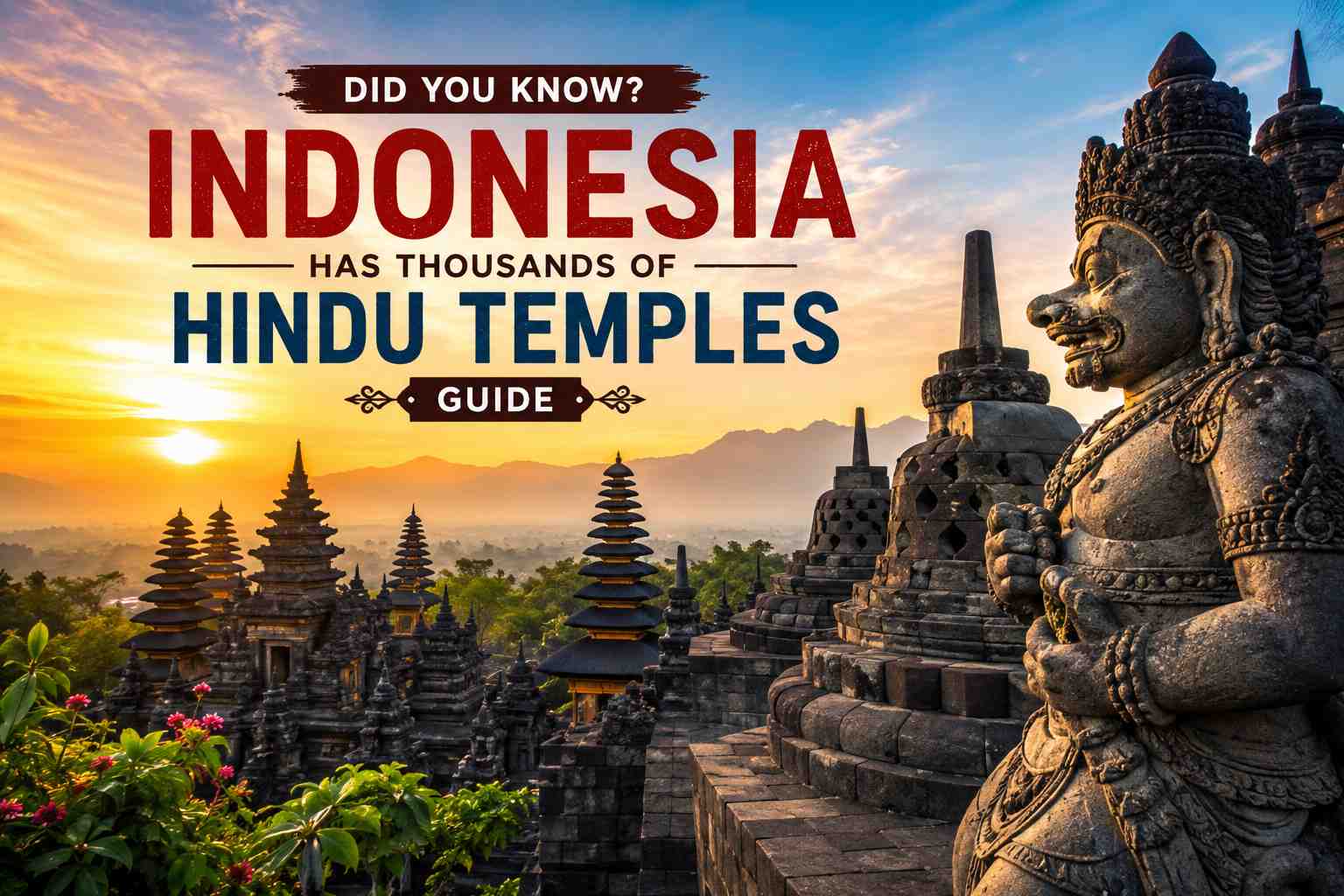
Om Swastyastu! When we envision the global footprint of Sanatana Dharma, our thoughts frequently linger around the sacred riverbanks of the Ganges or the towering gopurams of Southern India. Yet, across the Indian Ocean lies an astonishing, vibrant spiritual realm: the Indonesian archipelago. Home to the largest Muslim-majority population in the world today, Indonesia simultaneously cradles a breathtaking, thriving Hindu civilization with tens of thousands of active and ancient Hindu temples, known locally as 'Puras' in Bali and 'Candis' in Java. From the volcanic heights of Mount Agung at Pura Besakih to the colossal stone spires of Prambanan, the chants of the Gayatri Mantra and the fragrance of incense still permeate the tropical air. For any devotee or spiritual traveler, exploring Indonesia's Hindu heritage is a transformative revelation—a testament to how the timeless wisdom of the Vedas, the Ramayana, and the Mahabharata took root, flourished, and remains vibrantly alive thousands of miles from the Indian subcontinent.
The Island of Ten Thousand Temples: Bali's Sacred Pura Culture
Bali is universally known around the globe as 'Pulau Dewata'—The Island of the Gods. But to truly comprehend this title, one must look at the staggering numbers: across this single tropical island, there are estimated to be between 20,000 and 50,000 Hindu temples and shrines. In Bali, a temple is not merely a designated building in a town; it is the absolute center of cosmic life, social organization, and daily existence. The sacred architecture is divided into three distinct realms: Pura Kahyangan Jagat (universal temples open to all devotees), Pura Desa (village temples dedicated to Lord Brahma), and family shrines (Sanggah or Merajan) built in the courtyard of virtually every Balinese Hindu home.
At the spiritual summit of this temple network stands Pura Besakih, reverently referred to as the 'Mother Temple of Bali'. Perched nearly 1,000 meters high on the volcanic slopes of the sacred Mount Agung—which the Balinese revere as the spiritual equivalent of Mount Meru—Pura Besakih is an awe-inspiring complex of 23 separate but interconnected temples. The central sanctuary, Pura Penataran Agung, is dedicated to the Trimurti: Lord Shiva (the Transformer), Lord Brahma (the Creator), and Lord Vishnu (the Preserver). Rising through iconic multi-tiered black thatched roofs called 'Meru' towers, the temples represent the cosmic mountain layers connecting the earthly realm (Bhurloka) to the divine heavens (Swarloka).
What makes Pura Besakih so deeply revered is its miraculous history of divine protection. In 1963, Mount Agung suffered a catastrophic volcanic eruption that devastated surrounding villages and claimed thousands of lives. Yet, in what devotees worldwide consider a profound act of divine grace, the rivers of molten lava parted just meters away from Pura Besakih's outer gates, coursing down the mountain slopes and leaving the sacred sanctum entirely untouched. To stand before the candi bentar (split gateway) of Besakih, enveloped in mountain mist while hearing the rhythmic clanging of sacred Gamelan bells and Sanskrit-derived mantras, is an experience of pure, unadulterated transcendence.
Candi Prambanan: The Colossal Trimurti Masterpiece of Java
While Bali is the living heartbeat of contemporary Indonesian Hinduism, the island of Java preserves some of the most colossal stone temple architectures ever constructed in human history. Rising dramatically against the skyline of Yogyakarta in Central Java is Candi Prambanan, a 9th-century Hindu temple compound built during the reign of the Sanjaya dynasty of the Mataram Kingdom. Recognized as a UNESCO World Heritage site, Prambanan is the largest Hindu temple site in Indonesia and one of the grandest in all of Southeast Asia, originally consisting of 240 soaring stone temples.
The epicenter of Prambanan is a towering architectural marvel dedicated entirely to the Trimurti. The central and tallest spire, reaching an astonishing 47 meters (154 feet) into the sky, is the Shiva Mahadeva temple. Flanking Lord Shiva’s colossal sanctuary are two slightly smaller, yet equally magnificent spires dedicated to Lord Vishnu and Lord Brahma. Facing these three principal shrines are three smaller temples dedicated to their sacred divine Vahanas (vehicles): Nandi the Bull for Shiva, Garuda the divine eagle for Vishnu, and Hamsa the swan for Brahma. The sheer scale and precision of stone interlocking without modern mortar highlight an era of immense Vedic scientific and architectural genius.
What captivates devotees and art historians alike is the extraordinary narrative relief carvings adorning the temple walls. Walking along the inner balustrades of the Shiva and Brahma temples, pilgrims can read the entire epic story of the Ramayana carved in breathtaking detail—from the divine birth of Lord Rama and the abduction of Sita Devi to the heroic leap of Lord Hanuman across the ocean and the battle of Lanka. Surrounding the base of the Shiva temple are bas-reliefs illustrating the Bhagavata Purana, detailing the divine pastimes (Leelas) of Lord Krishna. Though earthquakes and centuries of volcanic ash from Mount Merapi buried Prambanan for hundreds of years, painstaking archaeological restorations have revived this majestic sanctuary, allowing modern pilgrims to witness the boundless glory of Javanese Hindu civilization.
Guardians of the Seas: Pura Tanah Lot and Pura Luhur Uluwatu
In Balinese spiritual cosmology, the ocean represents both infinite cosmic power and the realm of powerful spirits. To maintain cosmic equilibrium, ancient Shaivite sages established a chain of sacred sea temples (Pura Segara) along the southwestern coast of Bali, strategically positioned so that each temple is visually connected to the next. The two most iconic and spiritually potent guardians of these waters are Pura Tanah Lot and Pura Luhur Uluwatu.
Pura Tanah Lot (literally translating to 'Land in the Sea') is an ethereal offshore temple perched atop a massive, wave-sculpted rock formation in the Tabanan regency. Established in the 16th century by the revered Shaivite saint Dang Hyang Nirartha, the temple is dedicated to the sea gods, specifically Lord Varuna and the cosmic guardian Bhatara Segara. During high tide, the ocean entirely engulfs the causeway, transforming the temple into a floating island fortress amidst crashing waves. According to sacred lore, Nirartha spent nights meditating on this rock; before departing, he created a giant, venomous sea snake from his sacred sash to guard the temple against dark energies. To this day, wild sea snakes dwelling in the underwater sea caves around the base are venerated by priests as living divine protectors.
Further south, perched precariously on the edge of a sheer 70-meter-high (230 feet) limestone cliff dropping directly into the roaring Indian Ocean, stands Pura Luhur Uluwatu. Dedicated to Sang Hyang Widhi Wasa in his manifestation as Lord Rudra (the fierce aspect of Shiva), Uluwatu is one of Bali’s six key directional spiritual pillars (Sad Kahyangan). Devotees believe that the divine trident of Shiva guards the entire southwestern tip of Bali from malevolent cosmic forces. Every evening at sunset, as the sky turns fiery crimson over the ocean horizon, the cliffside amphitheater comes alive with the world-famous Kecak Fire Dance, a mesmerizing, trance-like musical reenactment of the Ramayana where hundreds of men rhythmically chant 'Cak-cak-cak', recounting Hanuman's fearless mission to rescue Mother Sita.
The Mystical Mountain Shrines of Java: Candi Cetho and Candi Sukuh
High in the misty highlands of Mount Lawu on the border between Central and East Java, far removed from modern tourist hubs, lie two of the most enigmatic and esoteric Hindu temples ever discovered: Candi Cetho and Candi Sukuh. Built during the fading decades of the glorious Majapahit Empire in the 15th century, these mountain shrines represent a fascinating evolution of late-medieval Javanese Hinduism, heavily infused with Tantric traditions, ancestor worship, and spiritual liberation (Ruwatan) rituals.
Unlike the traditional Indian-style towering spires of Prambanan, Candi Sukuh features a striking, stepped-pyramid architecture that bears an uncanny and mysterious resemblance to the ancient Mayan stone pyramids of Mesoamerica. Dedicated to the esoteric aspects of Shaivism, Sukuh’s stone reliefs are deeply symbolic and unapologetically direct, portraying the themes of cosmic creation, fertility, and the transmigration of the soul through detailed carvings of Bima (Bhima from the Mahabharata) depicted as a semi-divine liberator of cursed souls. The rituals conducted here were designed to cleanse devotees of spiritual impurities before ascending to higher planes of consciousness.
Further up the mountain slope, shrouded in eternal mist at an altitude of over 1,400 meters, rests Candi Cetho. Laid out across thirteen ascending stone terraces, Cetho mirrors the concept of a sacred staircase leading directly to heaven. The temple complex features stone statues of Hindu deities, stone turtle platforms symbolizing Kurma Avatar (Vishnu's cosmic turtle incarnation stabilizing the universe), and a towering split gate that opens to an endless sea of clouds. These highland sanctuaries demonstrate that even when political fortunes waned and Islamic sultanates rose across the Javanese lowlands, the resilient yogis and devotees retreated into the sacred mountains to keep the eternal flame of Shiva worship burning unbroken.
Agama Hindu Dharma: The Living Philosophy of Indonesian Sanatana Dharma
What makes the Indonesian Hindu temple legacy truly extraordinary is that it is not merely an archaeological relic of the past; it is a breathing, thriving, and deeply sophisticated way of life known officially as 'Agama Hindu Dharma'. In Indonesia, Sanatana Dharma adapted harmoniously with local culture, giving rise to unique theological and philosophical concepts that offer profound lessons to the modern world.
At the core of Balinese Hindu life is the profound philosophy of 'Tri Hita Karana'—the three causes of true well-being and prosperity. This ancient principle mandates that a fulfilled spiritual life requires maintaining perfect harmony across three dimensions: Parahyangan (harmony between humanity and the Divine), Pawongan (harmony among human beings), and Palemahan (harmony between humans and the natural environment). Every temple design, village irrigation system (Subak, recognized by UNESCO), and daily offering (Canang Sari—delicate palm-leaf baskets filled with vibrant flowers, betel nut, and incense) is an active physical practice of Tri Hita Karana.
This unbroken devotion is showcased during grand festivals such as 'Nyepi'—the Balinese Day of Silence. On this day, the entire island of Bali shuts down completely for 24 hours: no flights land, no vehicles drive, no electricity is lit, and no noise is made, as millions of devotees spend the day in absolute introspection, meditation, and fasting to reset the spiritual atmosphere of the planet. Festivals like 'Galungan' and 'Kuningan' celebrate the eternal victory of Dharma over Adharma, during which streets are lined with thousands of towering, arched bamboo poles (Penjor) decorated with offerings. The thousands of Hindu temples across Indonesia stand today as glorious beacons of cultural resilience, spiritual purity, and the universal, timeless truth of Sanatana Dharma: 'Ekam Sat Vipra Bahudha Vadanti'—Truth is One, the wise speak of it in many ways.
Frequently asked questions
How many Hindu temples are there in Indonesia?
While the exact count is difficult to measure, the island of Bali alone is home to over 20,000 to 50,000 Hindu shrines and temples (including public Puras, village temples, and family shrines). In addition, Java and other islands house hundreds of ancient stone temples (Candis).
What is the largest Hindu temple in Indonesia?
Candi Prambanan in Central Java is the largest ancient Hindu temple compound in Indonesia, while Pura Besakih (the Mother Temple of Bali) is the largest and holiest active temple complex in the country.